Skip to content
1) Intro: Why Irish durability is different
I’ve installed, repaired, and pulled up floors in every kind of Irish house you can imagine, from Victorian terraces in Dublin 8 to 1990s estates in Kildare, coastal cottages in Clare, and rural bungalows across the Midlands. The same products behave very differently here than they do in dry continental climates.
Ireland is mild, but persistently wet. We track grit and water into the halls for nine months of the year. Coastal air carries salt and sand. Indoor humidity swings are frequent because heating is often intermittent and ventilation varies widely. Condensation seasons matter here, especially in autumn and spring when outdoor air is damp, and homes are half-heated.
Subfloors add another layer of risk. Older concrete slabs often lack a reliable damp-proof membrane (DPM). Suspended timber floors rely on ventilation that’s sometimes blocked or inadequate. Moisture migration from below is common. All of this means durability in Ireland isn’t about lab abrasion tests alone, it’s about how a floor survives real homes, real habits, and real moisture.
This guide explains exactly that.
2) What “durability” actually means (Irish definition)
When homeowners ask me for the “most durable floor,” I don’t give a single answer. In Irish homes, durability is a scorecard made up of several factors working together:
- Wear layer/abrasion resistance
How well the surface resists grit, foot traffic, and daily scuffing. - Dent resistance
How it handles furniture legs, heels, dropped items, and kids’ toys. - Water resistance vs waterproof
Water-resistant slows water damage. Waterproof means water won’t penetrate the core, but joints, edges, and subfloors still matter. - Dimensional stability
How much the floor expands, contracts, cups, or gaps with humidity changes. - UV fade resistance
Important in bright living rooms, sunrooms, and south-facing spaces. - Chemical and stain resistance
Especially relevant in kitchens and utility rooms. - Repairability
Can one plank or tile be fixed, or does damage mean replacing the lot? - Installation sensitivity
How forgiving the product is of minor subfloor issues or installer errors.
A floor that scores well across most of these will usually survive Irish conditions. A floor that excels in one area but fails in others often causes callbacks within a few years.

3) The Irish Stress Tests
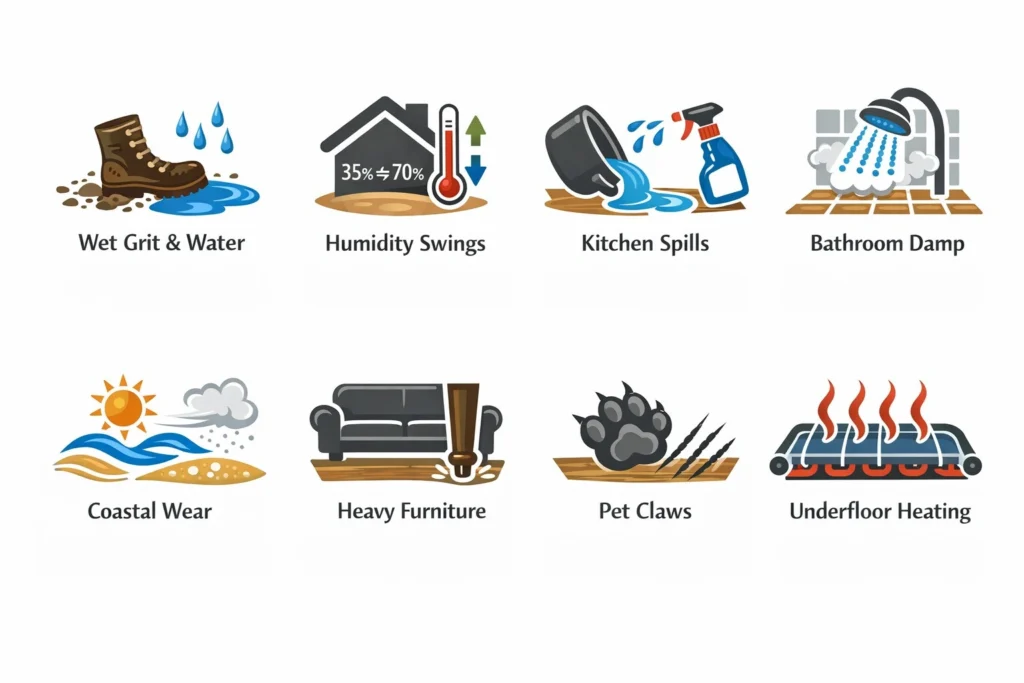
Below are the real-world stress tests I use, mentally and practically, when judging flooring durability in Ireland.
Wet-entrance grit + water test
What it measures:
Resistance to abrasive grit combined with repeated wetting.
Why it matters in Ireland:
Most Irish damage starts at the hall. Wet shoes carry sand, stone dust, and water inside.
What fails first:
Soft finishes scratch. Open joints swell. Laminate edges chip and darken.
How to reduce risk:
Choose hard, sealed surfaces. Use large entrance mats (outside + inside). Avoid floors with exposed fibreboard edges in halls.
Humidity swing test (winter heating vs shoulder seasons)
What it measures:
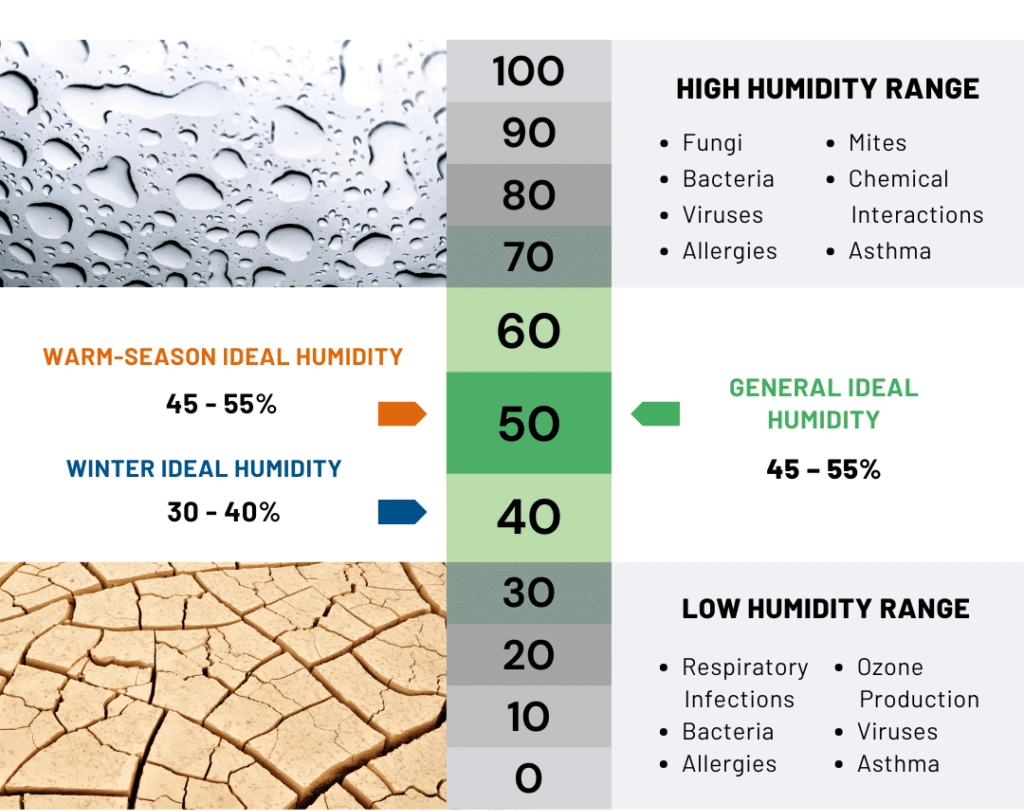
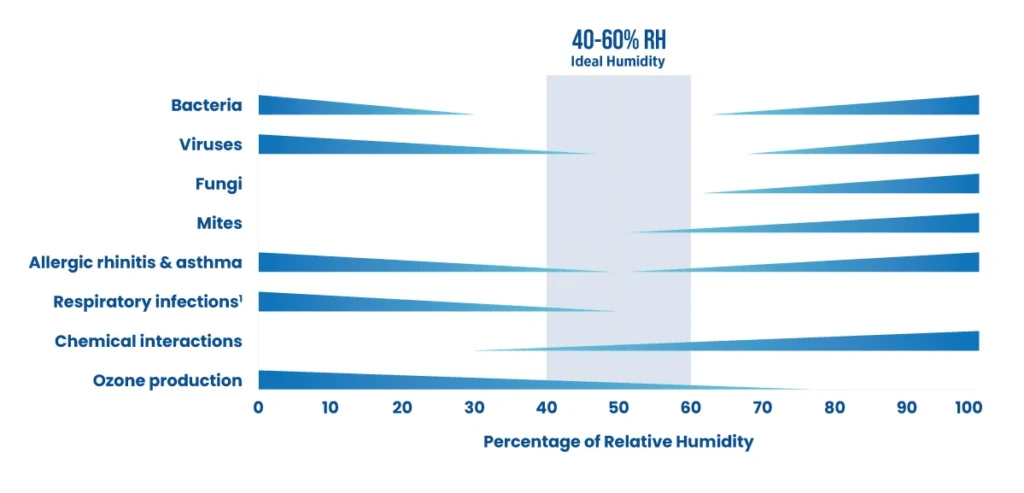
Dimensional stability as indoor RH (relative humidity) rises and falls.
Why it matters in Ireland:
Homes often swing from 35–40% RH in winter to 65–75% in spring.
What fails first:
Solid wood cups or gaps. Poorly acclimated engineered boards move excessively.
How to reduce risk:
Favour stable cores (SPC, porcelain, quality LVT). Maintain indoor RH between 40–60% where possible.
Kitchen spill + steam + cleaning chemical test
What it measures:
Resistance to liquids, heat, and everyday cleaners.
Why it matters in Ireland:
Kitchens combine spills, kettles, steam, and frequent mopping.
What fails first:
Low-grade laminates swell at joints. Unsealed stone stains or etches.
How to reduce risk:
Choose sealed, non-porous surfaces. Avoid harsh cleaners. Seal stone properly and re-seal as required.
Bathroom splash zone + drying cycle test
What it measures:
Performance in realistic bathroom use, not submersion.
Why it matters in Ireland:
Bathrooms dry slowly here. Splash zones stay damp longer.
What fails first:
Wood-based cores swell. Poor adhesives fail at the edges.
How to reduce risk:
Use porcelain, sheet vinyl, or fully bonded LVT. Separate wet and dry zones carefully.
Coastal corrosion/salt air + sand abrasion test
What it measures:
Surface wear and chemical stability in coastal conditions.
Why it matters in Ireland:
Salt air accelerates wear. Sand acts like sandpaper.
What fails first:
Soft finishes dull quickly. Metals corrode. Poor coatings break down.
How to reduce risk:
Hard, sealed surfaces. Frequent grit removal. Avoid delicate finishes.
Furniture dent test
What it measures:
Resistance to point loads from legs and wheels.
Why it matters in Ireland:
Heavy sofas, dining tables, and home offices are common.
What fails first:
Soft woods, cork, and low-density vinyl dent permanently.
How to reduce risk:
Use felt pads. Choose higher-density cores and thicker wear layers.
Pet claw + slip risk test
What it measures:
Scratch resistance and traction.
Why it matters in Ireland:
Wet paws plus smooth floors increase slip risk.
What fails first:
High-gloss finishes scratch and become slippery.
How to reduce risk:
Textured finishes. Matte surfaces. Regular nail trimming.
Underfloor heating (UFH) cycle test
What it measures:
Stability under slow heat cycles.
Why it matters in Ireland:
UFH is increasingly common in renovations and new builds.
What fails first:
Solid wood. Poorly specified laminates.
How to reduce risk:
Use UFH-compatible materials. Control temperature ramp-up.
Subfloor moisture migration test
What it measures:
Resistance to moisture coming from below.
Why it matters in Ireland:
Older slabs often lack effective DPMs.
What fails first:
Adhesives, wood-based cores, and mould under impermeable floors.
How to reduce risk:
Test moisture. Use primers or barriers where needed.
Maintenance tolerance test
What it measures:
How the floor copes with “normal” homeowners.
Why it matters in Ireland:
Not everyone follows perfect care routines.
What fails first:
Floors needing frequent resealing or specialist cleaners.
How to reduce risk:
Choose low-maintenance options with wide tolerance.
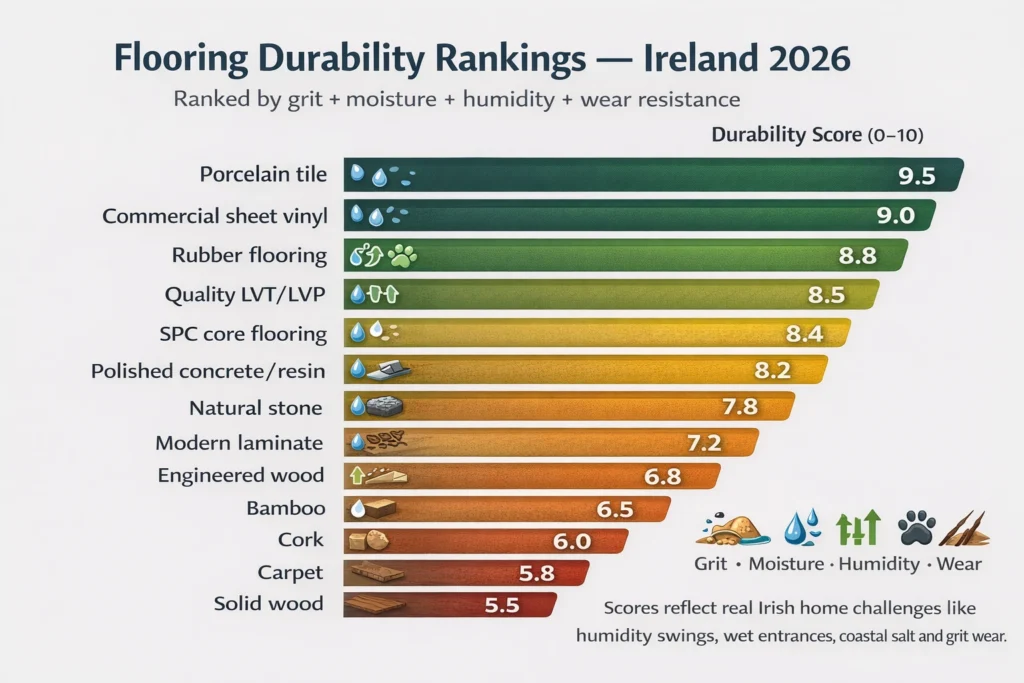
4) Durability Rankings 2026 (Ireland)
Durability Rankings 2026 (Quick Table)
| Flooring Type | Durability Score (0–10) | Key Notes |
|---|---|---|
| Porcelain tile | 9.5 | Extremely stable, waterproof, hard-wearing |
| Commercial sheet vinyl | 9.0 | Seamless, waterproof, forgiving |
| Rubber flooring | 8.8 | Tough, slip-resistant, niche use |
| LVT/LVP (quality) | 8.5 | Stable, repairable, moisture tolerant |
| SPC core flooring | 8.4 | Very stable, hard underfoot |
| Polished concrete/resin | 8.2 | Durable but needs expert prep |
| Natural stone | 7.8 | Long-lasting but maintenance-heavy |
| Laminate (modern) | 7.2 | Improved, but edge risk remains |
| Engineered wood | 6.8 | Good if specified correctly |
| Bamboo | 6.5 | Variable quality |
| Cork | 6.0 | Comfortable, dent-prone |
| Carpet | 5.8 | Wear and damp risk |
| Solid wood | 5.5 | Beautiful, humidity-sensitive |
On-site note: Most failures I see aren’t total catastrophes; they’re edge swelling, joint gaps, surface wear, or adhesive breakdown that ruins appearance long before structural failure.
Category explanations (Ireland-focused)
Porcelain tile
Where it wins: Halls, kitchens, bathrooms, coastal homes.
Where it fails: Cold feel; grout maintenance.
Who it suits: Busy families, rentals, UFH homes.
Install gotchas: Subfloor flatness and movement joints matter.
Natural stone
Wins: Longevity, aesthetics.
Fails: Etching, staining if unsealed.
Suits: Low-traffic areas, owners willing to maintain.
Gotchas: Needs sealing; reacts to acids.
Sheet vinyl (commercial-grade)
Wins: Waterproof, forgiving, quiet.
Fails: Design limitations.
Suits: Kitchens, utilities, rentals.
Gotchas: Subfloor prep shows through.
LVT/LVP
Wins: Balance of durability and comfort.
Fails: Cheap versions dent or scratch.
Suits: Most Irish homes.
Gotchas: Flatness tolerances are strict.
SPC vs WPC cores
SPC: More rigid, stable in humidity.
WPC: Warmer feel, slightly less stable.
Laminate
Wins: Cost-effective, improved coatings.
Fails: Edge swelling if water penetrates.
Suits: Bedrooms, living rooms, away from moisture.
Gotchas: Expansion gaps are critical.
Engineered wood
Wins: Real wood look with better stability.
Fails: Poor acclimation leads to movement.
Suits: Living rooms, bedrooms.
Gotchas: RH control is essential.
Solid wood
Wins: Refinishable.
Fails: Movement in Irish humidity.
Suits: Stable, well-controlled homes only.
5) Best by Room (Ireland-specific picks)
Hallway/entrance
- Common failure: Edge swelling from wet grit.
- Best: Porcelain tile.
- Runner-up: Commercial sheet vinyl.
- Avoid if… You don’t have proper mats.
Kitchen
- Failure: Joint swelling, chemical damage.
- Best: LVT (fully bonded) or porcelain.
- Runner-up: Sheet vinyl.
- Avoid if… You mop heavily with laminate.
Living room
- Failure: Denting, UV fade.
- Best: Quality LVT or engineered wood.
- Runner-up: Laminate (modern).
- Avoid if… You have uncontrolled humidity and solid wood.
Bedrooms
- Failure: Movement, wear under furniture.
- Best: Engineered wood or laminate.
- Runner-up: Carpet (dry homes only).
- Avoid if… RH regularly exceeds 65%.
Bathrooms
- Failure: Core swelling.
- Best: Porcelain tile.
- Runner-up: Sheet vinyl.
- Avoid if… Any wood-based core in splash zones.
Utility room
- Failure: Standing water.
- Best: Sheet vinyl.
- Runner-up: Porcelain.
- Avoid if… Laminate of any type.
Coastal sunroom
- Failure: Sand abrasion, UV fade.
- Best: Porcelain.
- Runner-up: SPC LVT.
- Avoid if… Soft finishes.
Rentals / high-traffic
- Failure: Combined wear and neglect.
- Best: Porcelain or sheet vinyl.
- Runner-up: Commercial LVT.
- Avoid if… High-maintenance surfaces.
6) Best by Subfloor (slab vs suspended floor)
Concrete slabs in Ireland
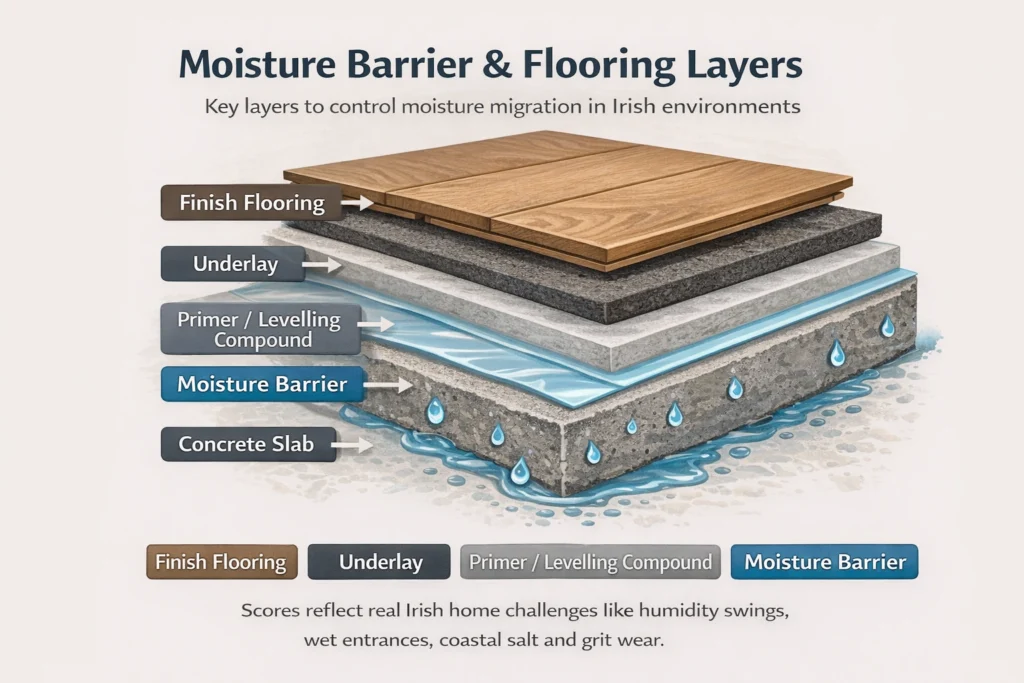
Older slabs often lack reliable DPMs. Moisture can rise invisibly.
- Unknown DPM: Porcelain or sheet vinyl with a moisture barrier.
- Confirmed low moisture: LVT, SPC, engineered wood.
Suspended timber floors
Ventilation is critical.
- Good airflow: Engineered wood, laminate, LVT.
- Poor airflow: Avoid impermeable floors without remediation.
Existing tile overlays
Possible, but risky if moisture is trapped. Always assess.
7) Moisture & Humidity: homeowner checks (10 minutes)
Look for signs:
- Musty smells
- White salts on slabs
- Black mould in corners
- Curling skirting boards
Simple tools:
- Hygrometer (aim for 40–60% RH)
- Basic moisture meter (trend, not absolute truth)
Stop and call a pro if:
- RH stays above 70%
- Visible moisture marks appear
- Floors feel damp underfoot
8) Installation quality: the hidden durability multiplier
Most warranty claims fail because installation didn’t meet requirements.
- Flatness: Many floors tolerate only a few millimetres over two metres.
- Acclimation: Not leaving boxes open forever, bringing the product to room conditions.
- Expansion gaps: Essential in Irish humidity swings.
- Underlay and adhesives: Must match the moisture risk.
Common mistakes I’m called to fix: rushed installs, missing moisture tests, and ignoring expansion gaps.
9) Maintenance schedules that preserve durability
- Weekly: Vacuum grit, damp mop with approved cleaner.
- Monthly: Check mats, felt pads.
- Yearly: Inspect joints, reseal stone if needed.
Avoid steam mops on wood-based floors. Control indoor humidity where possible.
10) Cost, value, and lifespan (Ireland, 2026 reality)
Durability often costs more upfront but less over time.
- Material grade: Thicker wear layers last longer.
- Prep costs: Moisture mitigation isn’t optional.
- Lifecycle: Repairable floors often outlast cheaper replacements.
11) Buyer’s checklist + decision tree
Checklist:
- Identify subfloor
- Measure RH
- Note room use and traffic
- Consider pets and UFH
- Choose the top two options for your risk profile
Decision tree:
- Coastal? → Porcelain or SPC
- High RH? → Avoid solid wood
- Pets? → Textured, scratch-resistant surfaces
- UFH? → Check compatibility first
12) FAQ
What is the most durable flooring in Ireland in 2026?
Porcelain tile ranks highest overall. It resists water, grit, humidity swings, and wear better than any other option. The trade-off is comfort and cost, but for pure durability in Irish conditions, it’s unmatched.
What flooring survives Irish wet entrances best?
Porcelain tile performs best. It handles repeated wetting and grit without swelling or scratching. Commercial sheet vinyl is a strong runner-up where a softer feel is preferred.
Is LVT actually waterproof for Irish kitchens?
Quality LVT is waterproof at the surface and core, but joints and subfloor prep still matter. Fully bonded installations perform best in Irish kitchens with frequent spills.
Laminate vs LVT in humid Irish homes: which lasts longer?
LVT generally lasts longer. Laminate has improved, but its fibreboard core still risks edge swelling if moisture penetrates. LVT’s synthetic core is more stable.
Can engineered wood handle Irish humidity without warping?
Yes, if specified correctly. Engineered boards with stable cores and controlled indoor RH perform well. Poor acclimation or high humidity causes problems.
What RH level causes wood floors to cup or gap?
Sustained RH above 65–70% or below 35% increases risk. Irish homes often exceed this in shoulder seasons, so monitoring matters.
What’s best for coastal homes in Ireland (sand + salt air)?
Porcelain tile or SPC LVT. Both resist abrasion and chemical exposure better than softer or natural materials.
What is the most scratch-resistant flooring for pets?
Textured porcelain and high-quality LVT perform best. Avoid high-gloss finishes, which show scratches easily.
What flooring works best with underfloor heating long-term?
Porcelain tile and LVT are the most reliable. They conduct heat well and remain dimensionally stable.
Do I need a moisture barrier on an Irish concrete slab?
Often yes, especially in older homes. Moisture testing determines the exact requirement, but barriers prevent long-term failures.
Can I install new flooring over existing tiles safely?
Sometimes. The tiles must be sound, flat, and dry. Trapped moisture is the main risk in Irish homes.
What’s the most durable choice for rentals and high traffic?
Porcelain tile or commercial-grade sheet vinyl. Both tolerate wear, moisture, and imperfect maintenance.
Conclusion
Durability in Ireland isn’t about chasing the hardest surface or the latest marketing term. It’s about matching the floor to your moisture risk, subfloor, and daily habits. Measure your RH this week. Identify your subfloor type. Then choose from the top two options that suit your home’s reality, not a brochure.