Skip to content
Intro Answer
For most Irish homes, a quality LVT/LVP (especially glue-down) or properly tanked porcelain tile gives the best mix of water tolerance, slip safety, and long-term reliability in kitchens and bathrooms, especially in Ireland’s damp, slow-drying conditions.
Quick picks (Irish kitchens vs Irish bathrooms)
If you only read one section, read this. These picks assume Irish realities: wet jackets, muddy runners, mop water, condensation, older subfloors, and a non-zero chance of a small plumbing leak.
Quick picks table (2026)
| Category | Irish kitchens (most homes) | Irish bathrooms (most homes) | Why it wins (Ireland-specific) |
|---|---|---|---|
| Best overall | Glue-down LVT/LVP | Porcelain tile + tanking | Waterproof surface + realistic tolerance of damp; bathrooms need a waterproofing “system,” not just a finish. |
| Best budget | Sheet vinyl | Sheet vinyl (coved edges if possible) | Few joints, forgiving, fast to clean; great for wet mats and rentals. |
| Best for UFH | Tile or glue-down LVT | Tile (tanked) or glue-down LVT | Efficient heat transfer; stable under UFH if installed correctly. |
| Best for rentals | Click LVT (thicker wear layer) or sheet vinyl | Sheet vinyl or slip-rated tile | Handles turnover wear, easy swaps, fewer “tenant-proofing” surprises. |
| Best for wet rooms | (rare in kitchens) Sheet vinyl (welded) / resin system | Wet-room tanking + tile or welded sheet vinyl | Wet rooms fail at edges, joints, and penetrations—not in the middle of a tile. |
| Best eco option | Linoleum (kitchen) | Rubber or slip-rated tile | Linoleum is durable and repairable in kitchens; bathrooms need water + slip performance first. |
Irish installer reality check: For wet areas, your “flooring choice” is really flooring + subfloor prep + waterproofing details + cleaning regime. That’s why so many “perfect on paper” floors fail in Irish homes.
FBS Flooring plug (kept practical): If you want Ireland-specific fitting guidance (subfloor moisture, levelling, thresholds, UFH rules, real price drivers), the FBS Flooring guides are unusually detailed. Start here:

- Internal link: Flooring installation cost breakdown (2026 labour)
- Internal link: Subfloor issues in Ireland (2026)
- Internal link: Underfloor heating flooring (Ireland, 2026)
The 2026 Water-Resistance Ratings (IWWR): How to read them
This guide’s hook is the Irish Wet-Area Water-Resistance Rating (IWWR), 2026.
Important: IWWR is not an official standard. It’s an editorial framework designed to stop the usual Irish wet-area nonsense: “It says waterproof on the box, so it’ll be grand.”
IWWR rating legend (text “graphic”)
- 💧 (IWWR 1) = High risk in wet areas. A leak or daily splashes can permanently damage it.
- 💧💧 (IWWR 2) = Manageable only with strict habits (mats, wiping, ventilation) and low exposure.
- 💧💧💧 (IWWR 3) = OK for kitchens; cautious in bathrooms (depends on joints + subfloor + detailing).
- 💧💧💧💧 (IWWR 4) = Strong wet-area performer when installed correctly; leaks still matter.
- 💧💧💧💧💧 (IWWR 5) = Wet-room-ready system (details + drains + waterproofing stack done right).
How we built these 2026 ratings (methodology, not pretend-labwork)
Each material gets scored (1–5) across five real-world Irish factors:
A) Surface waterproofness (does the top layer resist water?)
B) Seam/joint vulnerability (does water sneak through edges, grout, or cracks?)
C) Subfloor risk (what happens if water gets underneath, especially in older Irish subfloors?)
D) Repairability after a leak (can you replace a section, or is it a full rip-out?)
E) Realistic Irish household tolerance (steam, splashes, wet mats, occasional minor leaks, slow drying)
Then we average and round to the nearest droplet.
We also cross-checked practical guidance on Irish humidity/climate mismatch and common subfloor types (suspended timber vs slab vs beam-and-block), because the same product behaves very differently depending on what’s underneath.
IWWR comparison table (by material, with “What can go wrong in Ireland?”)
| Flooring type | IWWR (1–5) | Kitchens | Bathrooms | What can go wrong in Ireland? (the usual suspects) |
|---|---|---|---|---|
| Porcelain/ceramic tile | 💧💧💧💧 | Excellent | Excellent if tanked | Grout lines + cracks + poor tanking detail; smooth tiles can be dangerously slick when wet. |
| Natural stone | 💧💧💧 | Good | Cautious | Porosity + staining; sealing maintenance; slip risk if honed/polished. |
| Sheet vinyl | 💧💧💧💧💧 | Excellent | Excellent | If edges aren’t sealed/coved, water can creep under and get trapped in slow-drying homes. |
| LVT/LVP (SPC/WPC) | 💧💧💧💧 | Excellent | Very good (better glue-down) | Click seams can pass water; subfloor flatness + moisture prep gets skipped in older houses. |
| Water-resistant laminate | 💧💧💧 | OK | Not recommended | “Waterproof” marketing meets swelling core, joint failure, and Irish humidity. |
| Engineered wood | 💧💧 | Good (carefully) | Not recommended | Dishwasher leaks, wet mats, and steam drive edge swelling/cupping unless conditions are controlled. |
| Solid wood | 💧 | Cautious | No | Movement + swelling in damp/humid homes; leaks become structural repair jobs. |
| Polished concrete / microcement | 💧💧💧💧 | Very good | Very good | Cracking + failed sealer = staining; detailing at drains/thresholds is make-or-break. |
| Linoleum | 💧💧💧 | Good | Cautious | Seams + prolonged standing water; needs correct sealing at edges. |
| Cork | 💧💧 | OK (sealed) | No | Swelling if water gets through finish; needs meticulous maintenance. |
| Rubber | 💧💧💧💧 | Very good | Very good | Adhesive/moisture issues on damp slabs; choose a texture suited to wet bare feet. |
Two key takeaways for Ireland:
- Joints are the battlefield. Irish wet-area failures are almost always edge/joint/detail failures, not “the material just melted.”
- Bathrooms are a system. A tile floor without proper wet-area waterproofing is not automatically “waterproof,” even if the tile itself is. (More on this under tanking and EN 14891.)
What makes Irish kitchens and bathrooms uniquely hard on floors
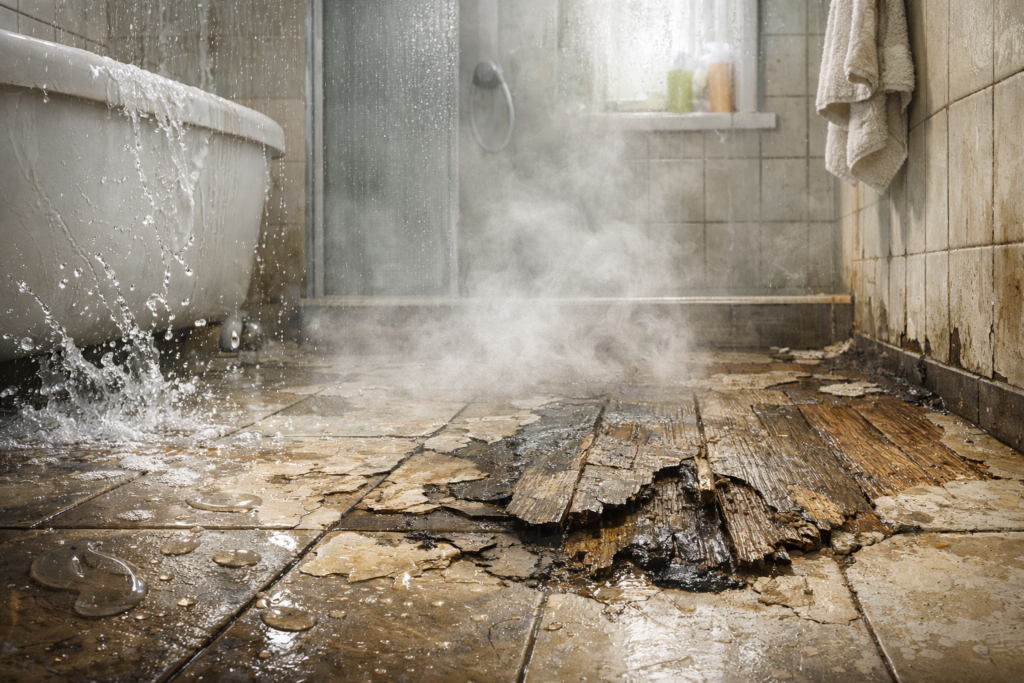
The phrase “Ireland is damp” is true but unhelpful. What matters is what damp does inside homes:
- Slow drying in winter (heating patterns + ventilation habits matter).
- Condensation cycles (hot shower → cold surfaces → moisture film).
- Wet entrances (rain gear, dog paws, wet mats) that drag water into kitchens and through hallways.
- Older subfloors (suspended timber with ventilation issues; slabs with trapped moisture) that react badly when covered with impermeable finishes.
- Coastal air and wind-driven rain near thresholds and extensions, water gets into places you don’t see.
Kitchens vs bathrooms: different water patterns (Ireland)
| Room | Typical water exposure | Common Irish failure mode | What you should prioritise |
|---|---|---|---|
| Kitchen | Frequent small spills, wet mopping, wet shoes near doors | Water ingress at the perimeter, around the toilet pedestal, at the shower/wet-room drain | Seam resistance + repairability + tolerance of wet mats |
| Bathroom | Steam + condensation + splashes + occasional standing water | Water ingress at the perimeter, around the toilet pedestal, and at the shower/wet-room drain | Waterproofing stack + slip resistance + correct falls/drain detailing |
5 real Irish scenarios (and what they demand)
- Busy family kitchen in a semi‑D (Dublin/Cork/Galway): constant traffic + wet mopping. Needs seam-tolerant flooring and easy spot repair.
- Rental bathroom (ROI or NI): inconsistent ventilation habits. Needs a floor that doesn’t degrade when cleaning is… let’s say “symbolic.”
- Coastal cottage (Donegal/Mayo/Kerry): salt air + wind-driven rain near doors. Prioritise moisture-stable systems like LVT or tile.
- Older terrace with suspended timber floors: underfloor ventilation issues + bounce. Needs subfloor prep (plywood/levelling) before click systems.
- Apartment bathroom with acoustic constraints: you may be forced into certain underlays; thick foam can ruin UFH efficiency and can trap moisture if misused.
Best flooring options for Irish kitchens (ranked, with who each is for)
This is the “kitchen flooring Ireland” section where we stop pretending every home is a showroom.
1) Glue-down LVT/LVP (SPC/WPC) — best all-rounder
IWWR: 💧💧💧💧
Best for: busy homes, pets, near-back-door kitchens, most renovations.
Pros
- True waterproof surface (spills don’t instantly become structural drama)
- Softer and warmer underfoot than tile
- Easy to replace individual planks/tiles if badly damaged (glue-down can be harder, but still manageable)
Cons
- Glue-down demands an excellent subfloor (levelling is rarely optional in older Irish houses)
- Some click systems let water travel through seams if spills sit too long
Slip considerations
- Look for texture/matte finishes; avoid glossy “wet-look” in kitchens with kids and wet socks.
UFH notes
- Generally excellent for underfloor heating flooring as long as you use UFH-rated adhesives/underlays and follow heat-up cycles.
Irish installation notes
- If your subfloor is a bit of a rollercoaster (common), budget for levelling. Levelling in Ireland is often priced around €8–€25/m² depending on depth.
Maintenance
- Neutral cleaner, rinse if needed; avoid leaving detergent film (it can increase slipperiness over time).
Cost band (Ireland, 2026, ranges)
- Materials: €15–€60/m² (budget to premium; patterns cost more)
- Labour: €18–€28/m² (click) or €35–€55/m² (glue-down)
- Typical “real” total: €45–€120/m² depending on prep.
FBS note (non-hype): If you’re choosing between laminate and vinyl for Irish kitchens, FBS has a practical comparison that’s very Ireland-specific on moisture risk. Internal link: Laminate vs vinyl (Ireland)
Kitchen spills aren’t rare events in Ireland—they’re a lifestyle. Your floor needs “oops tolerance.”
2) Porcelain tile (matte/textured) — best for “I never want to think about floors again”
IWWR: 💧💧💧💧 (💧💧💧💧💧 if detailed like a wet-area system)
Best for: high-traffic kitchens, open-plan with UFH, coastal entrances.
Pros
- Waterproof surface, highly durable, heat-friendly for UFH
- Doesn’t swell when wet
- Ideal near external doors
Cons
- Hard and cold without UFH
- Grout is maintenance, not décor
- Can be slippery if wrong finish is chosen
Slip considerations
- Choose finishes that perform wet, not just dry. Ireland’s safety guidance emphasises selecting slip resistance based on real contamination (water, cleaning, grease).
UFH notes
- One of the best coverings for efficient heat transfer.
Irish installation notes
- On older floors: check movement/bounce first; tile hates flex. Suspended timber often needs stiffening/overlay.
Maintenance
- Use a cleaner that doesn’t leave residue; rinse occasionally. Grout haze and detergent film can change slip behaviour.
Cost band (Ireland, 2026)
- Materials: €20–€80+/m² (tile choice drives this)
- Labour (tiling): €40–€70/m²
- Extras: levelling, membrane, trims.
3) Sheet vinyl — best budget + best “no joints”
IWWR: 💧💧💧💧💧
Best for: rentals, small kitchens, utility rooms, “get it done” renovations.
Pros
- Fewer seams than planks; easy cleaning
- Comfortable underfoot compared to tile
- Can be detailed upturns/coved skirting in higher-wet zones
Cons
- Subfloor prep still matters (telegraphs lumps)
- If water gets under, it can sit there—especially in slow-drying Irish homes
Slip considerations
- Good textured options exist; avoid glossy prints in wet-entry kitchens.
UFH notes
- Usually compatible with UFH if specified and installed correctly; avoid insulating underlays.
Irish installation notes
- Typical labour for sheet vinyl is €20–€35/m².
Cost band
- Materials: €15–€25/m² for budget sheet vinyl ranges
- Labour: €20–€35/m²
- Total: commonly €35–€70/m² plus prep.
4) Engineered wood — best “warmth + real timber look” (kitchens only, with rules)
IWWR: 💧💧
Best for: kitchens away from external doors, households with good ventilation habits.
Pros
- More dimensionally stable than solid wood
- Warmer underfoot, nicer acoustics than tile/vinyl
- Can work beautifully in open-plan kitchen/living
Cons
- Still vulnerable to standing water and slow leaks
- Needs disciplined spill cleanup and humidity control
Slip considerations
- Usually fine in kitchens, but wet socks + lacquer can be skaty.
UFH notes
- Many engineered products are UFH-compatible if the product is rated and heat-up cycles are followed.
Irish installation notes
- Labour in Ireland: €20–€30/m² floating, €30–€45/m² glue-down.
- Kitchens often need better perimeter sealing and leak discipline (dishwasher line!).
Cost band
- Materials (entry level): €30–€50/m² on promotions
- Labour: €20–€45/m²
- Total: often €60–€120/m² depending on prep.
FBS product spotlight (relevant, not “magic”): The Lignum Strada range includes engineered wood options marketed as UFH-compatible with lacquered finishes and tongue & groove systems (useful in open-plan areas). Browse: Lignum Strada category and an example product page for specs.
5) Water-resistant laminate — acceptable only in the right kitchen
IWWR: 💧💧💧
Best for: tight budgets, low-spill kitchens, upstairs kitchens (rare), careful households.
Reality check
“Water-resistant” laminate can delay swelling, but it’s still fundamentally a fibreboard product. In Ireland, moisture sensitivity is the main failure mode and it’s why laminate is typically framed as not ideal for bathrooms or high-humidity zones.
Cost band
- Materials: €12–€25/m² (budget ranges)
- Labour: €15–€25/m²
- Watch the extras: door trimming (€15–€30/door) and moisture barriers (€6–€12/m²) can matter more than the plank price.
Best flooring options for Irish bathrooms (ranked, with wet-room notes)
Bathrooms are “bathroom flooring Ireland” territory: steam, condensation, splash zones, and the occasional “how long has that been leaking?” surprise.
1) Porcelain tile + proper tanking — best long-term bathroom system
IWWR: 💧💧💧💧💧 (when tanked correctly)
Best for: most bathrooms, especially showers and family baths.
Why tile alone isn’t enough
Tile and grout are not a complete waterproofing system in wet rooms. In modern practice, you typically use a liquid-applied waterproofing product beneath tiling (EN 14891 covers these products and their performance requirements).
Wet-room note
In wet rooms, tanking continuity at corners, pipe penetrations, and the drain detail is everything. “Looks sealed” is not a technical specification.
Slip considerations
Pick tiles with wet performance in mind; smooth finishes + soap film is a slip recipe.
Cost band
- Labour (tiling): €40–€70/m²
- Waterproofing/membrane, trims, levelling: additional (often the difference between success and failure).
2) Sheet vinyl (with coved edges where possible), best “water containment” on a budget
IWWR: 💧💧💧💧💧
Best for: rentals, small bathrooms, quick refurbishments, households where cleaning is frequent.
Pros
- Few seams; can be detailed to reduce edge ingress
- Softer underfoot than tile (good for kids and older adults)
Cons
- Subfloor prep must be clean and stable
- If edges are poorly finished, water can still creep under
Cost band
- Labour: €20–€35/m²
- Total often lower than tile when you include drying time and multi-day tiling workflows.
3) Glue-down LVT — best “tile look” with better comfort
IWWR: 💧💧💧💧
Best for: bathrooms without a true wet-room floor drain, or where you want warmer underfoot.
Wet-room note
Click LVT in a true wet room is risky unless the system is designed for it. Glue-down reduces water travel through seams, but wet rooms still need correct falls, drain detail, and waterproofing decisions.
4) Rubber flooring — best for slip resistance and bare feet
IWWR: 💧💧💧💧
Best for: kids’ bathrooms, accessibility-focused design, utility wet areas.
Slip
Rubber can be one of the most naturally slip resistant flooring options when textured appropriately.
Downside
Style preferences (some people love it, some don’t), and adhesive/substrate moisture compatibility needs attention.
5) Microcement / polished concrete (sealed) — best minimalist look (but detail-sensitive)
IWWR: 💧💧💧💧
Best for: design-led bathrooms with good installers and good detailing discipline.
Irish caution
Cracks and failed sealers show quickly. In damp homes, vapour management matters.
Material deep dives (the “truth serum” section)
This is where we stop being polite to marketing labels.
Porcelain/ceramic tile
- IWWR: 💧💧💧💧 (💧💧💧💧💧 when detailed as a waterproofed wet-area system)
- Best: kitchens, bathrooms, UFH
- Avoid if…
- Your suspended timber floor bounces and you won’t stiffen it first.
- You want “zero maintenance” but hate grout cleaning.
- Truth serum: Tile is waterproof as a surface. Your bathroom floor may not be waterproof if the system beneath isn’t designed that way.
Natural stone
- IWWR: 💧💧💧
- Best: kitchens, lower-wet bathrooms (not wet rooms unless specified carefully)
- Avoid if…
- You won’t maintain sealers.
- You’re choosing polished stone in a splash-prone bathroom.
- Truth serum: Stone is beautiful and durable, but porosity + Irish cleaning habits can lead to staining and slip risk.
LVT/LVP (SPC vs WPC)
- IWWR: 💧💧💧💧
- SPC (stone-plastic composite): stiffer, more dent resistance; can feel harder underfoot.
- WPC (wood-plastic composite): slightly softer/warmer feel; still waterproof as a surface.
- Avoid if…
- You won’t pay for subfloor flatness (especially glue-down).
- Truth serum: “100% waterproof” often refers to the plank, not the whole floor system. Seams and edges are where Irish kitchens punish you.
Sheet vinyl
- IWWR: 💧💧💧💧💧
- Avoid if…
- You expect it to hide poor subfloors (it won’t).
- Truth serum: It’s boring in the best way: reliable, easy, and joint-minimised.
Laminate (including “water-resistant”)
- IWWR: 💧💧💧
- Avoid if…
- Bathroom.
- Kitchen with kids, pets, and a busy back door.
- Truth serum: If a product’s core is fibreboard, Ireland’s humidity can still win—especially when spills aren’t wiped immediately.
Engineered wood
- IWWR: 💧💧
- Avoid if…
- Bathroom or wet-room zones.
- You’ve had previous leak issues under appliances.
- Truth serum: Engineered wood is a controlled-risk option for Irish kitchens, not a “wet-area” option. UFH compatibility exists in many ranges but doesn’t equal waterproofness.
Solid wood
- IWWR: 💧
- Avoid if…
- Any wet area where you can’t guarantee stable indoor conditions.
- Truth serum: In Ireland, solid wood in kitchens/bathrooms is a lifestyle commitment. You’re signing up for vigilance.
Polished concrete / microcement
- IWWR: 💧💧💧💧
- Avoid if…
- You can’t guarantee an experienced installer.
- Truth serum: Sealers are the “wear layer.” When they fail, you notice.
Linoleum
- IWWR: 💧💧💧
- Avoid if…
- Bathroom with daily shower splashes and standing water.
- Truth serum: In kitchens, it can be a genuinely smart eco option if detailed well at edges.
Cork
- IWWR: 💧💧 (sealed, kitchens only)
Cork can be comfortable and lower-impact, but wet-area detailing is unforgiving.
- Avoid if…
- Bathroom.
- You dislike ongoing finish maintenance.
- Truth serum: Cork is not magically waterproof because it’s “natural.” It needs a finish that stays intact.
Rubber
- IWWR: 💧💧💧💧
- Avoid if…
- You hate the aesthetic.
- Truth serum: It’s one of the most sensible options for slip + water management, especially in family bathrooms.
Slip resistance & safety in wet areas (Ireland)
Water resistance keeps floors intact. Slip resistance keeps people intact.
Ireland’s Health and Safety Authority (HSA) stresses choosing pedestrian surfaces based on real contamination risks (water, cleaning, grease) and specifying slip resistance as installed, not just ex-factory numbers.
The tests, explained like a human
- Pendulum test (PTV): Measures slip resistance in a way that mimics a slipping foot/heel action. The HSA highlights the pendulum as a robust method for specification/legal contexts and references wet PTV values.
- R-ratings (ramp test): Often used for certain environments; HSA notes r-ratings start at 9 (higher risk) and go to 13 (lower risk).
Practical Irish takeaways (not lab theory)
- Cleaning residue matters. A “safe” tile can become slippery if detergent film builds up—especially in bathrooms with soap/shampoo.
- Texture beats shine in wet zones.
- Specify for “wet, in use” conditions. HSA explicitly recommends considering slip resistance for the surface as installed/in final use conditions, and suggests considering a wet PTV of 36+.
“Waterproof ≠ slip-proof” (tattoo this on your renovation budge
Texture and micro-roughness often matter more than material type for wet-foot safety. Img.
Minimum recommended approach (simple and effective)
Bathrooms (especially shower rooms / wet rooms):
- Prioritise wet slip performance, not showroom shine.
- Ask for slip resistance evidence for the installed surface, and plan cleaning to avoid residue.
Kitchens:
- Focus on the “entrance-to-sink-to-hob” line: where wet shoes, splashes, and mopping overlap.
- Don’t choose glossy finishes in a family kitchen unless you enjoy living dangerously.
Installation in Ireland: subfloors, moisture, membranes, and the stuff that ruins good flooring
A floor fails in Ireland when moisture pathways and movement are ignored.
Irish subfloors you’ll actually meet (and why it matters)
A useful Ireland-specific breakdown is:
- Suspended timber (ventilated void) — common in older terraces/semi‑Ds.
- Ground-bearing slab — common mid/late‑20th century onward.
- Beam-and-block / suspended concrete — newer builds or tricky sites.
If you don’t know which you have, don’t guess; look for vents/air bricks, feel for bounce, check thresholds.
Subfloor prep checklist (callout box)
Subfloor prep checklist (Ireland, kitchens + bathrooms)
- Identify subfloor type (timber / slab / beam-and-block).
- Check for damp indicators (musty odour, swelling skirtings, efflorescence).
- Fix leaks before flooring (obvious, yet Ireland remains Ireland).
- Budget levelling if needed (often €8–€25/m²).
- Decide moisture system (DPM / primer / membrane) early (€6–€12/m² for moisture barriers is a common allowance).
- Plan thresholds and door clearances (door trimming €15–€30/door is common).
Underfloor heating: do’s and don’ts (Ireland)
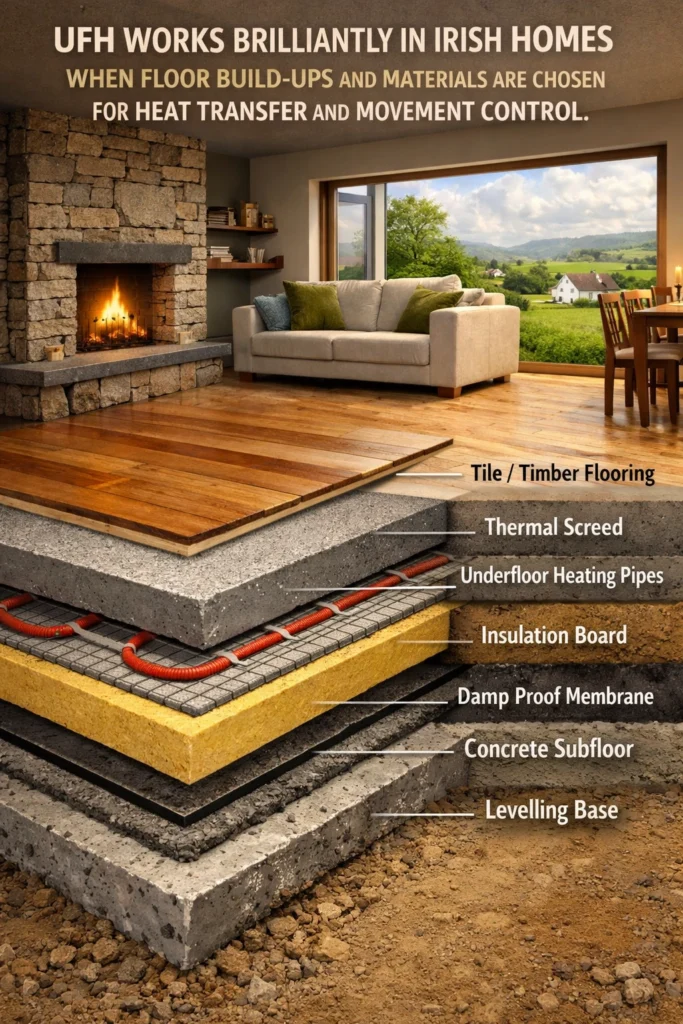
UFH works brilliantly in Irish homes when floor build-ups and materials are chosen for heat transfer and movement control.
Do
- Choose products labelled UFH-compatible and follow heat-up/cool-down cycles.
- Use a low-TOG (low thermal resistance) underlay where needed; avoid thick soft foams that insulate heat.
- Keep indoor conditions stable—Irish humidity swings matter for wood-based floors.
Don’t
- Switch UFH on full blast the day after install (classic crack-and-curl manoeuvre).
- Assume “UFH compatible” = “bathroom safe.” Different problem.
Wet-room waterproofing (“tanking”): where membranes matter most
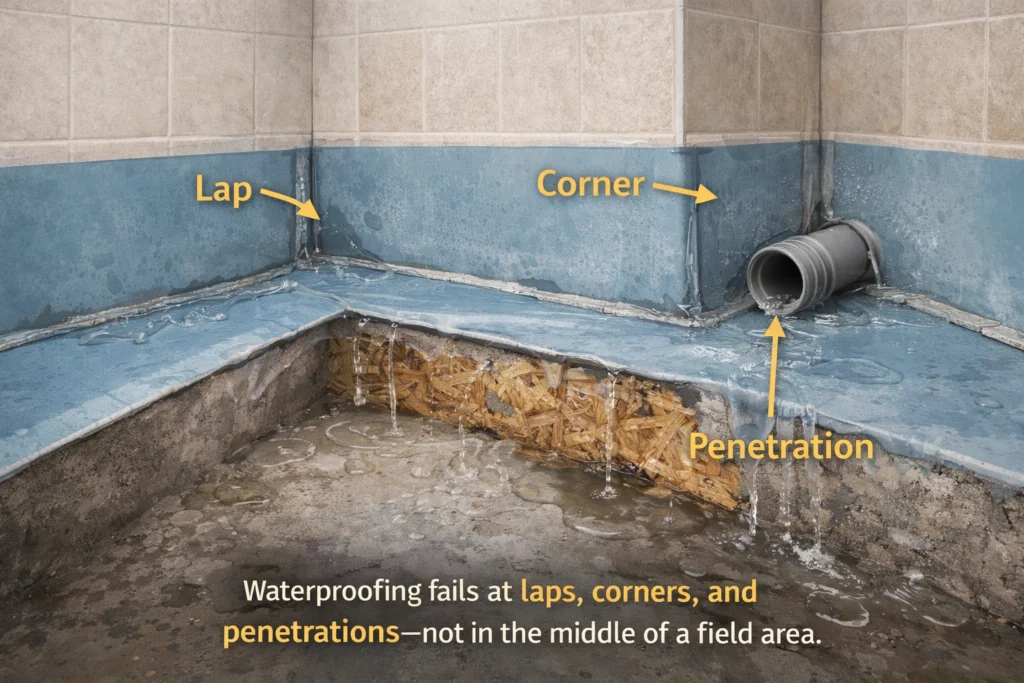
Waterproofing fails at laps, corners, and penetrations, not in the middle of a field area.
Standards context (why EN 14891 keeps coming up): EN 14891 describes performance requirements and test methods for liquid-applied water impermeable products used beneath ceramic tiling.
Manufacturers also reference EN 14891 within product approvals/standards for certain waterproofing membranes used under tiles in wet rooms.
“Tile waterproofinginking stack” (bullet visual)
- Tile (slip-appropriate finish)
- Tile adhesive
- Waterproofing layer (EN 14891-classified product, where specified)
- Correctly detailed corners/tape, pipe collars, and drain detail
- Screed/backer board
- DPM/radon barrier (as relevant)
- Structural slab/floor deck
“Vinyl waterproofing stack” (bullet visual)
- Sheet vinyl (minimise seams)
- Edge detailing (seal/cove as appropriate)
- Compatible adhesive system
- Smooth, dry, stable substrate (often levelling compound)
- Moisture mitigation (primer/DPM) where needed
- Subfloor structure
Costs in Ireland (2026): what you’ll actually pay
Costs vary by county, access, VAT status, prep, and pattern complexity. But the big Irish truth is this:
Prep and extras decide the final number, not the headline “€X per m².”
A useful Ireland-specific breakdown from FBS includes typical labour ranges by flooring type and the extras that move quotes most.
2026 cost table (materials + labour + realistic total ranges)
| Flooring type | Materials (€/m²) | Labour (€/m²) | Typical total (€/m²) | Notes |
|---|---|---|---|---|
| Laminate (click) | 12–25 | 15–25 | 30–60+ | Add moisture barriers, doors, trims. |
| Click LVT/LVP | 15–35+ | 18–28 | 40–90+ | Subfloor still matters. |
| Glue-down LVT | 20–60+ | 35–55 | 70–140+ | Levelling almost always appears. |
| Sheet vinyl | 15–25 | 20–35 | 35–80+ | Great bathrooms/rentals. |
| Tile (porcelain/ceramic) | 20–80+ | 40–70 | 70–160+ | Membranes, trims, drying time. |
| Engineered wood | 30–50+ | 20–45 | 60–140+ | Glue-down adds prep cost. |
Hidden costs Irish homeowners underestimate
- Removal/disposal: €3–€6/m² for carpet/laminate; €8–€15/m² for tiles.
- Moisture barriers/DPM systems: €6–€12/m².
- Door trimming: €15–€30 per door.
- Minimum charges: small rooms can trigger €150–€250 call-outs.
- Pattern installs: herringbone/diagonal can add +30–50% labour.
Common mistakes Irish homeowners make (and how to avoid them)
Myth 1: “Waterproof laminate” is bathroom-safe
Reality: Water-resistant laminate can be fine in some kitchens, but bathrooms add steam + standing water risk. Even FBS’s laminate guidance frames standard laminate as not recommended for bathrooms due to moisture sensitivity.
Myth 2: “Tile is waterproof.”
Reality: Tile is waterproof. A bathroom floor system isn’t automatically waterproof without proper wet-area waterproofing. EN 14891 exists for a reason.
Myth 3: “Vinyl is indestructible.”
Reality: Vinyl survives spills. It does not survive a persistently damp substrate and sloppy edge detailing forever.
Myth 4: “Grout is sealed forever.”
Reality: Sealers wear; cleaners and limescale build-up change surface behaviour. Plan maintenance.
Myth 5: “Irish homes are damp, so nothing works.”
Reality: Plenty works—when the subfloor and moisture pathway are treated as part of the job. Ireland’s housing stock just punishes shortcuts harder than drier climates.
Decision tree: choose your floor in 2 minutes
Use this when decision fatigue kicks in.
Start | |-- Is this a TRUE wet room (walk-in shower with floor drain / constant wet zone)? | |-- Yes --> Choose: Tanked tile system (IWWR 💧💧💧💧💧) OR welded sheet vinyl (IWWR 💧💧💧💧💧) | |-- No --> Continue | |-- Do you have underfloor heating? | |-- Yes --> Prefer: Tile or glue-down LVT (efficient heat transfer) | |-- No --> Continue | |-- Is your household "high spill / high traffic" (kids, pets, back door kitchen, rentals)? | |-- Yes --> Prefer: LVT/LVP or sheet vinyl (repairable, joint-tolerant) | |-- No --> Continue | |-- Do you insist on real timber look/feel? | |-- Yes --> Engineered wood (kitchens only) with strict spill discipline + correct prep | |-- No --> Continue | |-- Is budget the primary limiter? | |-- Yes --> Sheet vinyl or good-value click LVT | |-- No --> Choose based on slip needs + aesthetics: tile vs LVT |End
Glossary (Ireland-focused)
- IWWR: Irish Wet-Area Water-Resistance Rating (editorial framework in this guide).
- Tanking: Waterproofing layer(s) applied beneath tiles in wet areas.
- DPM: Damp-proof membrane (blocks moisture rising from below).
- UFH: Underfloor heating.
- PTV: Pendulum Test Value (a slip resistance measure referenced by HSA guidance).
- R-rating: Ramp test classification (often referenced for certain use cases; HSA notes r-ratings 9–13).
- SPC/WPC: Vinyl core types (SPC stiffer; WPC slightly softer).
- Levelling compound: Smoothing layer to meet flatness requirements (often essential for glue-down LVT).
- Expansion gap: Space left at edges so floors can expand/contract without buckling.
- Acoustic underlay: Underlay specified for sound control (often in apartments; can affect UFH efficiency).
Best flooring for Irish kitchens and bathrooms: final guidance
The Best flooring for Irish kitchens and bathrooms in 2026 is the one that matches your water pattern, your subfloor, and your tolerance for maintenance—not the one with the loudest “waterproof” sticker.
If you want the safest default for most Irish households:
- Kitchens: glue-down LVT/LVP or sheet vinyl (then tile if you want maximum durability and can manage grout).
- Bathrooms: tanked tile system or sheet vinyl (and treat wet rooms as a specialist waterproofing job).
Author box
Author: Flooring consultant-style technical writer (Ireland-focused)
Expertise: Wet-area flooring specification, slip-risk selection, subfloor/moisture risk framing for Irish housing stock
Note: This guide does not claim proprietary testing or lab results; it synthesises standards guidance and Ireland-specific installation realities.
Editorial policy box
How this guide is reviewed: Technical claims are linked to authoritative sources (e.g., HSA slip guidance; EN 14891 context; manufacturer standards references). Prices are presented as ranges and labelled as region-dependent.
Update cadence: Reviewed at least every 6 months, or sooner if Irish guidance/standards or market pricing shifts materially.
Corrections: If a standard reference or price range changes, update the relevant section and date-stamp the edit.
“We reviewed and exceeded” retailer guides (for transparency)
These are common Irish retailer blog baselines we deliberately aimed to outperform with a rating framework, slip safety detail, and Irish subfloor/moisture realism:
- Tile Merchant kitchen flooring guide
- Tile Merchant bathroom flooring guide
- Des Kelly kitchen flooring guide
- Delforno Bathrooms flooring guide
- Bathshack bathroom flooring ideas
FAQ (10–14 questions)
1) What is the most waterproof flooring for an Irish bathroom?
Direct answer: Sheet vinyl or a properly tanked tile system are the most reliably waterproof choices.
In Irish bathrooms, “most waterproof” means fewer joints and a waterproofing layer where needed. Tile works brilliantly when the waterproofing stack is correct; sheet vinyl wins by minimising seams.
2) Is “waterproof laminate” actually safe for bathrooms?
Direct answer: Generally, no—it’s a high-risk compromise.
Even water-resistant laminates can fail with steam, standing water, and joint saturation. In Ireland’s damp conditions, laminate is best kept to lower-moisture rooms.
3) Is LVT/SPC better than tile in Irish kitchens, and why?
Direct answer: Often yes for comfort and repairability; tile wins for maximum wear resistance.
LVT/SPC tolerates daily spills, feels warmer, and can be quieter—great for busy Irish family kitchens. Tile is tougher long-term but needs slip-aware selection and grout maintenance.
4) What slip rating should I look for in a shower room or wet room?
Direct answer: Treat wet slip performance as mandatory; ask for evidence for the installed surface.
The HSA recommends considering slip resistance based on real contamination and notes specifying a wet Pendulum Test Value (PTV) of 36+ for surfaces as installed/in use conditions.
5) Can I put vinyl or laminate over underfloor heating?
Direct answer: Vinyl (and many LVTs), yes; laminate, sometimes—only if UFH-rated and installed properly.
Follow UFH guidance: low-TOG underlays, correct heat-up cycles, and stable indoor conditions.
6) Do I need tanking under bathroom tiles in Ireland?
Direct answer: In shower areas and wet rooms, yes—strongly recommended.
Tile and grout aren’t a complete waterproofing system. EN 14891 covers liquid-applied waterproofing products beneath ceramic tiling, and manufacturers reference it in wet-room membrane standards/approvals.
7) What’s the cheapest flooring that won’t swell in an Irish kitchen?
Direct answer: Sheet vinyl is usually the safest low-cost option.
Budget laminates can swell if water gets into joints; sheet vinyl avoids that vulnerability by minimising seams.
8) What’s best for a rental property in Ireland?
Direct answer: Sheet vinyl or durable LVT.
Rentals need forgiveness: easy cleaning, good joint performance, and simple repairs. Also assume varied ventilation habits—especially in bathrooms.
9) How long should each option last realistically?
Direct answer: Expect 10–25+ years depending on material and installation quality.
Tile and well-installed vinyl/LVT can be long-lived. Floors installed over poor subfloors or without moisture planning often fail early—especially in Ireland’s humidity conditions.
10) Do I need a moisture barrier in Irish kitchens and bathrooms?
Direct answer: Often yes, especially on ground floors and apartments.
Moisture barriers/DPM systems are commonly treated as a separate line item in Irish quotes, and they can be critical on slabs.
11) Why do floors fail so often in older Irish homes?
Direct answer: Subfloors and ventilation are the hidden drivers.
Suspended timber floors rely on ventilation; slabs rely on membranes and detailing. Covering a damp or moving subfloor with an impermeable finish is a classic Irish failure path.
12) How do I compare flooring quotes fairly in Ireland?
Direct answer: Compare what’s included: levelling, moisture system, trims, disposal, VAT.
Irish quotes can look similar until you see what’s excluded. Levelling, moisture protection, doors, and access constraints often decide the final cost.