Skip to content
Table of Contents
A practical Irish guide to choosing flooring for comfort, acoustics, durability, warmth, and everyday work-from-home use.
Why home office flooring matters more than people think
The shift to remote and hybrid work has permanently changed how we live in Ireland. From converted box rooms in Dublin semi-Ds to custom-built garden pods in Galway, the home office is no longer a luxury—it is a necessity. However, when designing these spaces, homeowners frequently obsess over the perfect desk or ergonomic chair, completely overlooking the literal foundation of the room: the floor.
At FBS Flooring, we have spent years transforming Irish homes. In our experience, the wrong home office flooring leads to echoing conference calls, ruined surfaces from castor wheels, and a cold, uninviting atmosphere. The right flooring, however, provides acoustic dampening, stands up to the rigorous durability required for long sitting, and offers ergonomic comfort.
Irish home offices have moved well beyond the emergency desk-in-the-corner phase. For many households, the spare bedroom, attic conversion, box room, garden room, or part-time dining space has become a serious working environment. That changes what the floor needs to do. It is no longer just a background finish. It affects comfort, warmth, sound, cleaning, chair movement, appearance on video calls, and how well the room holds up over the years of daily use.
A floor that looks great in a showroom can become irritating in real life. It might feel cold in winter, amplify chair noise upstairs, scratch under castors, or make a small room sound hollow. In Irish homes, those issues show up fast. Damp-prone ground floors, timber upper floors, compact terraced layouts, and colder north-facing rooms all shape what works and what fails. That is why choosing home office flooring properly is not a cosmetic decision. It is a usability decision.
For homeowners, landlords, and hybrid workers across Dublin, Cork, Galway, Limerick, Waterford, and commuter-town developments, the smartest choice usually balances comfort, acoustic performance, durability, and practicality rather than chasing one feature alone. FBS Flooring sees this in real projects all the time: people start by asking what looks best, then realise the better question is what will still feel right after eight hours at a desk in February, with a chair rolling back and forth, calls happening overhead, and muddy shoes coming in from the garden or school run.

The best flooring for most home offices in Ireland is usually high-quality LVT or rigid core flooring for all-around durability and easy maintenance, carpet or cork where acoustic comfort matters most, and engineered wood where premium appearance matters and chair protection is used. The right choice depends on whether your office is upstairs or downstairs, how often you use it, how much chair movement it gets, and whether warmth, noise control, or appearance matters most.
This guide will walk you through exactly what you need to know to choose the ultimate home office floor in Ireland.
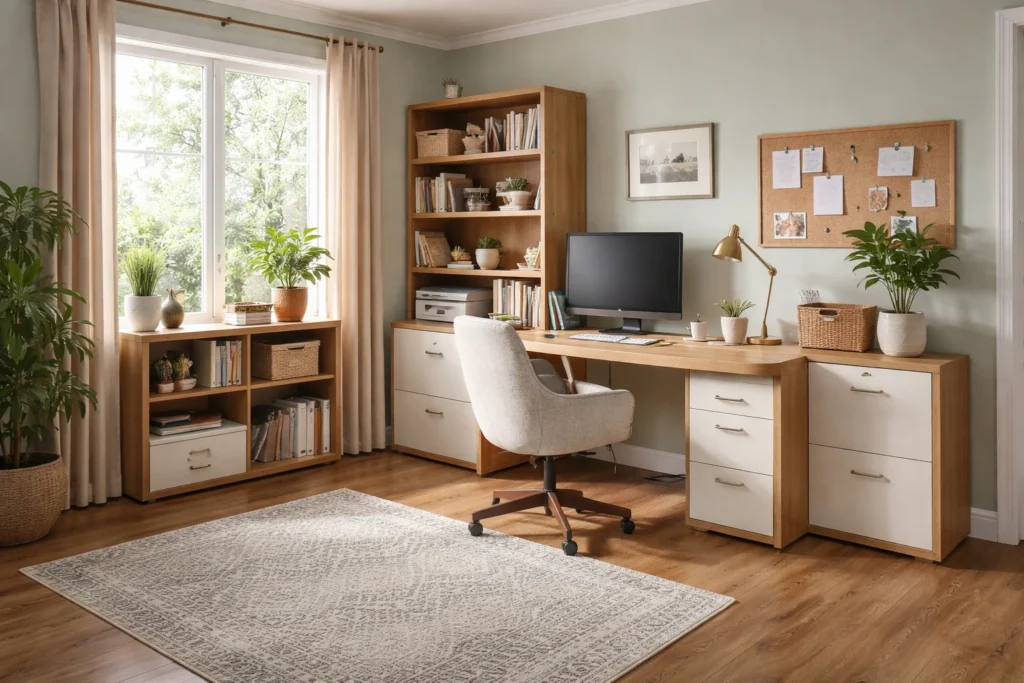
Most people choose office flooring too late in the process. They think about the desk, the chair, the shelving, the broadband point, and maybe the wall colour. The floor gets treated as background. In reality, it is the surface your whole workday sits on. It affects how the room sounds, how warm it feels, how chair wheels behave, how easy it is to clean, and whether the space feels professionally calm or oddly harsh.
There is a big difference between an occasional desk setup and a genuine full-time workspace. A room used twice a week for emails can cope with compromises. A room used five days a week for calls, admin, creative work, or consulting cannot be. Under daily use, weak flooring choices show their flaws fast. Chair tracks appear, the room feels noisier than expected, the floor becomes chilly under bare feet, or the finish starts to look worn around the desk zone while the rest of the room stays untouched.
That matters in Irish houses because many work-from-home rooms are not purpose-built offices. They are adapted spaces. A spare bedroom over a living room, an attic conversion with timber structure, a narrow box room in a semi-detached home, or a garden office with temperature swings all place different stresses on the floor. A good home office floor must work with the room you actually have, not the imaginary showroom cube many websites seem to design for.
What Irish home offices really demand from a floor
A home office in Ireland needs more from a floor than simple domestic foot traffic. It must deal with long sitting hours, bursts of chair movement, winter cold, wet-weather maintenance, and in many homes, noise transfer to the room below or next door.
The key demands are practical:
- Long sitting hours: even seated users notice cold, hard, echo-prone floors over time.
- Office chair rolling wear: one small area can take repeated pressure every day.
- Acoustic control: upstairs rooms, apartments, and terraced homes punish noisy finishes.
- Warmth and comfort: Irish rooms often feel cooler than they look, especially north-facing spaces and converted rooms.
- Easy cleaning: dust, crumbs, pet hair, and damp-day debris need sensible maintenance.
- Appearance: the room may appear on Zoom or Teams calls and may double as guest space or family overflow.
In practical terms, that means the best flooring is rarely the one with the loudest sales pitch. It is the one that fits the rhythm of the room. A busy parent using a dining-room office has different needs from a consultant taking confidential calls upstairs. A landlord upgrading a rental workspace will value durability and maintenance. A designer or therapist may care more about acoustic softness and calm visual character.
The key performance criteria for home office flooring
The smartest way to compare home office flooring is by performance, not by marketing category. A floor should be assessed across the following criteria.
Comfort underfoot
This means how the floor feels when seated, standing, stretching, or working barefoot or in socks. It includes softness, thermal feel, and the sense of fatigue from being on the surface all day. Even if you spend most of the day sitting, you still move your feet, shift posture, stand during calls, and walk in and out repeatedly.
Acoustic comfort
Acoustic comfort is how the flooring helps reduce harsh room sound and transmitted noise. It includes both impact sound, which is the noise created by footsteps or chair movement travelling through the structure, and echo, which is the reflective sound inside the room itself. Hard floors tend to reflect more sound. Softer finishes absorb more.
Chair resistance
Chair resistance is the floor’s ability to cope with rolling office chairs without visible damage, premature wear, or denting. Some surfaces look durable until castors chew through the finish. Others resist wear well but need correct chair wheels or a mat.
Scratch resistance and appearance retention
A home office needs to look respectable for years, not just the first six months. That means resisting desk-chair wear, dropped chargers, furniture movement, and sunlight. Long-term appearance retention matters because the desk zone often ages differently from the rest of the room.
Warmth and thermal feel
Thermal feel is not just actual temperature. It is the perceived warmth of the surface. Some floors feel colder even at the same room temperature. In Irish homes, that matters more than many buyers expect.
Cleaning practicality
Dust, cable fluff, pet hair, and tea splashes are office realities. Some floors hide debris well but trap it. Others wipe clean quickly but show every crumb. Practical cleaning is part of everyday usability, not a side issue.
Suitability for Irish subfloors and moisture conditions
Many Irish homes combine solid ground floors with timber upper floors. Older properties may have uneven boards, minor damp history, or squeaks. Flooring that ignores subfloor reality is asking for trouble. A beautiful finish on a poor base is just an expensive future complaint.
| Performance criterion | Why it matters in a home office | Especially important for |
|---|---|---|
| Comfort underfoot | Supports daily use, standing moments, and general room comfort | Full-time remote workers, cold rooms, barefoot users |
| Acoustic control | North-facing rooms, attics, and garden offices | Upstairs offices, apartments, consultants |
| Chair resistance | Prevents wear in the desk zone | Heavy chair users, admin roles, long daily use |
| Warmth | Makes the room feel more usable in winter | North-facing rooms, attics, garden offices |
| Cleaning practicality | Keeps the room manageable without fuss | Family homes, shared spaces, rentals |
| Subfloor suitability | Protects comfort, stability, and lifespan | Older homes, conversions, uneven floors |
Best flooring types for home offices in Ireland
This is where the trade-offs matter. There is no magical unicorn floor that does everything perfectly. The best option depends on your room, your chair use, your acoustic needs, your budget, and how premium you want the space to feel.
| Flooring type | Comfort | Acoustics | Chair suitability | Maintenance | Overall Irish home-office fit |
|---|---|---|---|---|---|
| Carpet | High | High | Fair with chair mat | Medium | Excellent for warmth and quiet rooms |
| Carpet tiles | Medium to high | High | Good with quality spec | Good | Very practical for flexible workspaces |
| LVT | Medium | Medium | High | High | Excellent all-rounder |
| Sheet vinyl | Medium | Medium | Good | High | Strong budget practical option |
| Laminate flooring | Medium-low | Low to medium | Good with protection | Good | Decent if budget-led and well chosen |
| Engineered wood flooring | Medium | Medium-low | Good with mat and soft castors | Medium | Best for premium appearance |
| Solid wood flooring | Medium | Medium-low | Fair | Medium-low | Usually less practical than engineered wood |
| Cork flooring | High | High | Medium | Medium | Excellent for comfort-focused offices |
| Rubber/specialist ergonomic flooring | Medium | Medium | High | High | Very strong modern option |
| Best for a premium appearance | High | High | High | High | Niche but useful in specialist cases |
Carpet
Carpet is one of the strongest choices for acoustic comfort, warmth, and general softness. It suits upstairs home offices particularly well, especially in semi-detached homes, apartments, and terraced houses where sound transfer matters. It also works well in spare bedrooms and guest-office combinations.
Its weakness is chair movement. Repeated rolling from office chairs can flatten pile, create tracks, and wear the desk zone faster than the rest of the room. A good chair mat helps, and low-pile commercial-style carpet performs better than very soft domestic plush types. Carpet also needs more regular vacuuming, which is fine for many households but less ideal in pet-heavy or crumb-heavy spaces.
Carpet tiles
When it comes to the primary discussion, carpet tiles deserve more attention than they usually get in domestic advice. In a home office, they are practical, acoustically strong, and easier to replace in worn desk areas. They suit serious workspaces, shared home offices, and rooms where functionality matters more than a plush bedroom look. For a box room office or business-use room, they can be a surprisingly clever fit.
Luxury vinyl tile (LVT)
LVT is one of the best all-round choices for Irish home offices. It handles chair movement well, cleans easily, looks sharp, and works across many room types. It is particularly strong in multi-purpose rooms, ground-floor offices, and family homes where resilience matters. Compared with laminate, it usually feels quieter and more forgiving underfoot if installed correctly.
Its limitation is that it is not naturally as warm or acoustically soft as carpet or cork. The quality of the product and the underlay or installation system make a huge difference. Cheap LVT can feel hard and look flat. Good LVT, fitted well, is a workhorse. For many buyers, that is precisely what they need. [link: LVT flooring services]
Sheet vinyl
Sheet vinyl is often overlooked because it lacks the prestige of other categories, but it can be sensible in budget-conscious home offices, especially where easy cleaning and moisture tolerance matter. It suits utility-adjacent workspaces, rentals, and practical family homes. The downside is aesthetic perception. Some products still look budget, and heavy office-chair use can mark weaker grades.
Laminate flooring
Laminate remains popular because it offers a timber look at a more approachable price. In home offices, it can work well where budget matters and chair use is moderate. Better laminates resist wear well and can look smart on camera.
The snag is sound and feel. Laminate can sound sharper under chair movement and footsteps, especially on upper timber floors or poor underlay. It can also feel hard and cold in Irish rooms if not balanced with a rug or heating. This is where many buyers realise that low purchase cost and long-term satisfaction are not identical twins. [link: Laminate flooring guide]
Engineered wood flooring
Engineered wood is the premium choice for many home offices because it brings warmth, visual depth, and a more elevated finish than laminate or vinyl. It is an excellent fit for professional video-call spaces, premium home studies, and rooms that need to blend with the rest of a well-finished house.
Its weakness is protection. Office chairs can mark wood, especially without proper castors or a chair mat. Engineered wood also needs realistic moisture management and correct fitting. In Irish homes, it is a beautiful option when the room is dry, the subfloor is stable, and the user understands maintenance. [Engineered wood flooring Dublin]
Solid wood flooring
Solid wood looks appealing on paper, but for many Irish home offices, it is less practical than engineered wood. It is more sensitive to environmental movement and often less forgiving in real domestic conditions. Unless there is a very specific design reason to choose it, engineered wood usually makes more sense.
Cork flooring
Cork is one of the most underrated home office floors. It is warm, softer underfoot than many hard finishes, and acoustically better than laminate, wood, or standard vinyl. For upstairs offices, quiet workspaces, and users who care about long-sitting comfort, cork can be brilliant.
The caution is durability under intense chair movement. It performs best when properly sealed or specified and when chair protection is used. It is not the right choice for every heavy-use commercial-style setup, but it is one of the best comfort-led options for real home working.
Hybrid or rigid core flooring
Rigid core and hybrid flooring sit close to LVT in many buyers’ minds, and for good reason. They are often durable, water-resistant, stable, and practical for varied subfloor conditions. They work well in garden offices, busier family homes, and modern home-office upgrades where resilience matters.
Rubber or specialist ergonomic flooring
This is niche territory, but it has a place. In therapy rooms, wellness-focused offices, workshops-with-desks, or spaces where standing work happens regularly, specialist ergonomic surfaces can reduce fatigue and improve acoustics. Most domestic buyers will not need them, but they are not nonsense; they are just specialist tools for specialist rooms.
The best flooring for rolling office chairs
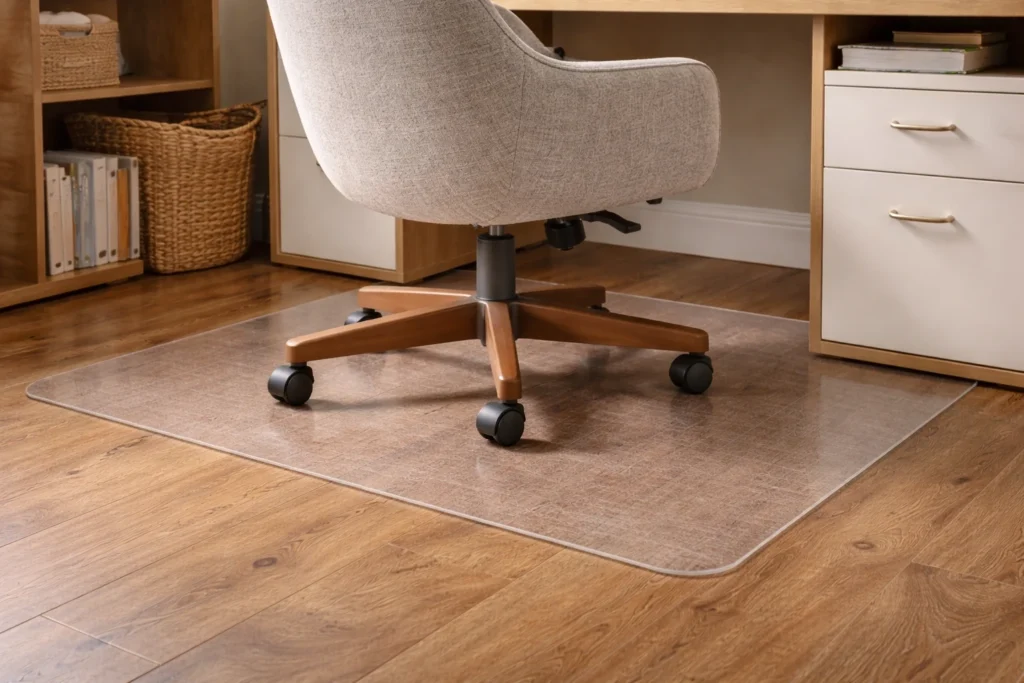
Rolling office chairs are the little goblins of localised floor damage. They concentrate repeated movement in one zone and expose weaknesses quickly. Harder floors generally handle rolling better, but not all hard floors are equal.
The best choices for chair-heavy use are usually LVT, rigid core flooring, quality commercial carpet tiles, and some sheet vinyl products. Engineered wood and laminate can work, but they benefit from chair mats and soft polyurethane castors. Carpet is comfortable, but it needs protection if the chair moves constantly.
The practical rules are simple. Use soft castors rather than hard plastic where possible. Use a good-quality chair mat on wood, laminate, cork, or standard carpet if the desk chair is in daily motion. Check chair-wheel hygiene too. Tiny grit trapped in castors behaves like malicious sandpaper with a business degree.
Acoustic comfort and sound control in Irish homes
Acoustic comfort matters more in home offices than many product pages admit. Sound problems in a workspace do not just annoy the household. They affect concentration, privacy, and how professional the room feels on calls.
In Irish homes, this issue becomes sharper upstairs. Timber floors transfer impact noise. Hard finishes can amplify footsteps and chair movement. In apartments and terraced houses, that can be a real problem. Carpet and cork are the strongest performers for acoustic softness. Carpet tiles also perform well. LVT and rigid core can be decent when paired with the right acoustic system. Laminate on a weak underlay is often where the gremlin starts dancing.
A few practical truths matter here. Underlay helps, but it cannot fully rescue a noisy floor choice. Rugs soften echo, but they do not always solve transmitted structure-borne noise. Acoustic privacy also matters for consultants, therapists, interviewers, and anyone handling confidential work.
| Room type | Best acoustic flooring options | What to avoid if noise is the priority |
|---|---|---|
| Upstairs spare bedroom office | Carpet, carpet tiles, cork | Low-quality laminate on minimal underlay |
| Apartment workspace | Carpet, cork, acoustic LVT systems | Hard reflective finishes without acoustic build-up |
| Terraced house office | Carpet, cork, quality underlay-backed systems | Cheap floating floors with hollow sound |
| Garden office | LVT, rigid core, cork with suitable build-up | Uninsulated hard floors that echo badly |
Long-sitting comfort and fatigue reduction
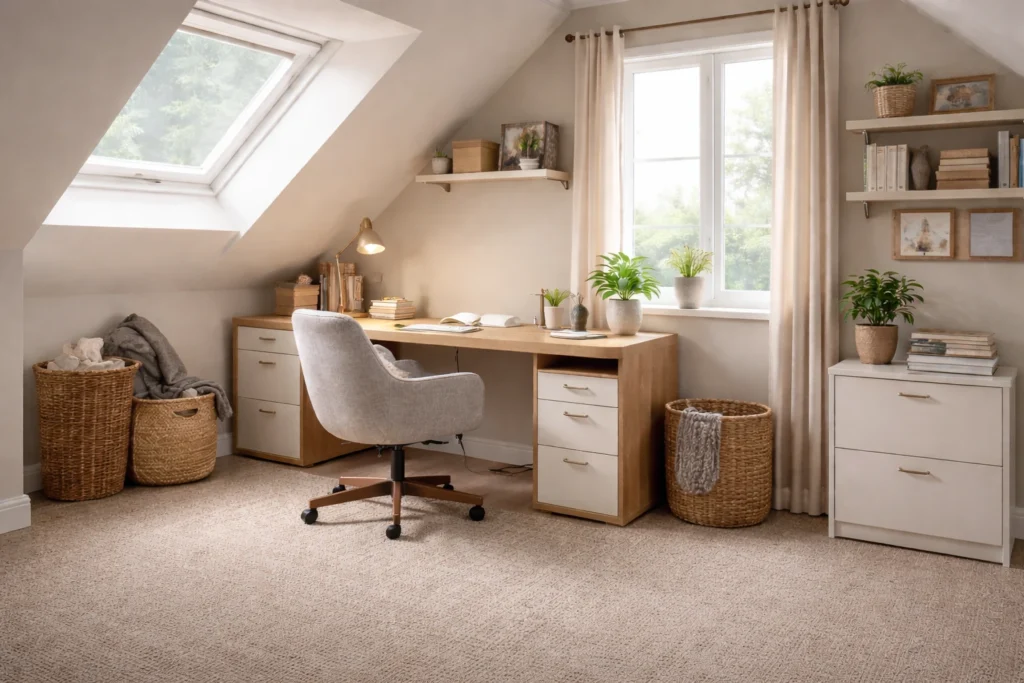
Long-sitting durability is not only about whether the floor survives. It is also about whether the room remains comfortable enough to use day after day. People who sit for long hours still interact constantly with the floor. Their feet shift, they sit forward, push back, stand for calls, and rest barefoot or in socks. A floor that feels cold, harsh, or fatiguing changes the overall experience of the room.
This is where carpet and cork stand out. They make a space feel more forgiving. They soften posture transitions and create a warmer sensory base. LVT and rigid core can still work well, particularly with a rug under the non-chair zone. Engineered wood sits somewhere in the middle: visually warm, physically firmer.
Users most likely to benefit from softer or warmer surfaces include full-time remote workers, barefoot workers, people in colder north-facing rooms, and anyone using a compact office where the floor is always in visual and physical range. The less room you have, the more the feel of the floor matters.
Flooring by home-office setup
Different room types need different priorities. That is where many generic articles go a bit wobbly.
| Home-office setup | Best flooring choices | Main reason |
|---|---|---|
| Spare bedroom office | Carpet, cork, LVT | Balances comfort, noise control, and domestic warmth |
| Box room office | LVT, cork, carpet tiles | Works well in small spaces where comfort and scale matter |
| Attic conversion office | Carpet, cork, acoustic LVT | Helps with sound and temperature feel |
| Garden office | Rigid core, LVT, cork with correct build-up | Handles variable conditions and practical wear |
| Apartment workspace | Carpet, cork, acoustic-backed LVT | Noise control is critical |
| Shared office | Carpet tiles, LVT | Durability and maintenance matter more |
| Office-guest room | Carpet, engineered wood with rug, cork | Needs domestic comfort and visual flexibility |
| High-traffic family office | LVT, rigid core, sheet vinyl | Easy cleaning and resilience |
For a spare bedroom office, comfort and acoustic control often matter most. Carpet or cork make sense, with LVT a good alternative for easier maintenance.
For a box room office, avoid making the room feel colder and smaller than it already is. Lighter-toned LVT, cork, or soft low-profile carpet usually works better than glossy dark flooring.
Saying so ,for an attic conversion, sound and thermal feel matter more because the space can feel exposed. Carpet, cork, or acoustic-focused systems are usually stronger than hard, hollow finishes.
For a garden office, resilience, stability, and ease of cleaning matter. Rigid core flooring and good LVT are often excellent here, provided the building is properly insulated and dry.
Flooring by user type
The right floor depends heavily on who is using the room and how.
| User type | Best flooring options | Why they suit |
|---|---|---|
| Full-time remote worker | LVT, cork, carpet | Daily comfort and durability both matter |
| Hybrid worker | Laminate, LVT, carpet | Balanced performance for moderate use |
| Creative professional | Cork, engineered wood | Atmosphere, texture, and visual quality matter |
| Therapist or consultant | Carpet, cork, engineered wood with acoustic support | Quiet, calm, trustworthy room feel |
| Home-based admin or business owner | LVT, carpet tiles | Handles heavy use and repeated chair movement |
| User needing maximum acoustic privacy | Carpet, cork | Best sound absorption and softness |
| User wanting premium visual appearance | Engineered wood | Strongest high-end finish |
| Budget-conscious upgrader | Sheet vinyl, laminate, entry-level LVT | Lower upfront spend with sensible performance |
For the full-time remote worker, LVT, cork, or carpet are usually strongest because daily comfort and durability matter equally.
For the hybrid worker, laminate, LVT, or carpet can all work depending on budget and room location.
Meanwhile, for the creative professional, cork and engineered wood are often appealing because they bring character and a better atmosphere, not just function.
For a therapist or consultant on video calls, carpet, cork, or engineered wood with acoustic softening tends to work best. The room should feel calm, quiet, and visually trustworthy.
For a home-based admin or business owner, LVT and carpet tiles are superb because they cope with heavy use and stay practical.
Also, for the user needing maximum acoustic privacy, carpet and cork are the front-runners.
For the user wanting a premium visual appearance, engineered wood is usually the standout option, provided chair protection is planned.
For the budget-conscious upgrader, sheet vinyl, laminate, or entry-level LVT can all work, but the quality of fitting still matters. A cheap floor badly fitted on a poor subfloor is not valuable. It is a delayed annoyance wearing a fake moustache.
Warmth, insulation, and Irish comfort expectations
Irish buyers often underestimate how much flooring changes the perceived warmth of a room. The room temperature may be technically the same, but the floor can make the space feel inviting or slightly miserable. In home offices, that matters because discomfort undermines concentration.
Carpet is the warmest-feeling finish for most users. Cork also performs very well because it does not feel as cold or hard as many resilient floors. LVT and rigid core can feel comfortable enough when paired with rugs in the seating zone. Laminate and wood vary depending on room temperature, build-up, and user sensitivity.
In colder Irish rooms, such as north-facing bedrooms, attic conversions, and some garden rooms, warmth should be treated as a functional criterion. Rugs can help. So can good underlay. Underfloor heating compatibility matters too, especially on renovated ground floors and more energy-conscious upgrades. Many LVT, engineered wood, and some rigid core systems can work with underfloor heating when correctly specified. Always check the product and build-up rather than assuming the label alone solves everything. [Underlay and acoustic flooring advice]
Moisture, subfloor preparation, and installation realities
This is where good flooring decisions either become durable successes or expensive lessons. Irish homes bring mixed subfloor conditions. Ground floors are often concrete. Upper floors are commonly timber. Older houses may have uneven boards, draughty voids, or historic damp issues. Converted spaces may look neat on top while hiding movement or levelling problems below.
Concrete subfloors need moisture assessment and appropriate preparation. Timber subfloors need stability, level correction where needed, and squeak management. If the floor beneath moves, dips, or sounds hollow, the finished office floor will never feel quite right.
Levelling matters for comfort as much as appearance. Chair movement over an uneven floor becomes irritating. Hard floors reveal imperfections brutally. Even small differences in surface flatness can change how premium or cheap the final room feels.
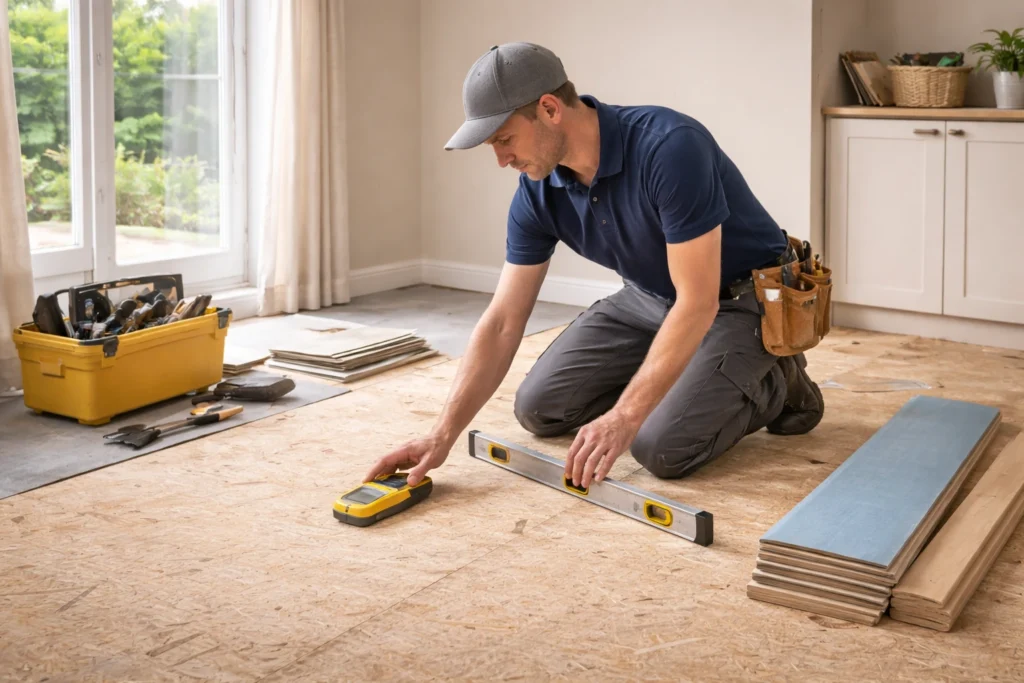
FBS Flooring should lean into this point because it builds trust honestly. Homeowners do not need fairy tales. They need to know that the best-looking floor on a bad base is a trap. That is exactly why professional advice matters. [Flooring installation in Dublin]
Design and style considerations
A home office should not look like a corporate cubicle dropped into a semi-detached house. It should feel professional, calm, and integrated with the home. Flooring plays a big role in that.
Lighter tones usually help smaller Irish rooms feel brighter and less boxed in. They work particularly well in box rooms and attic spaces. Mid-tone timber looks, whether in LVT or engineered wood, often create the safest all-round balance for video calls because they look warm without dominating the frame.
Dark floors can look dramatic, but in compact offices, they may show dust more readily and make the room feel visually heavier. Busy patterns can be distracting on camera and in person. Calm texture usually performs better than high-drama grain when the room is meant for concentration.
For Zoom and Teams-friendly rooms, the floor should support a clean visual impression without stealing attention. That is another reason LVT, cork, and engineered wood often work well: they offer visual credibility without looking flashy.
Cost considerations in Ireland
Cost matters, but the smarter question is value over time. A home office floor takes concentrated use in one part of the room. A slightly higher spend on the right product can pay back in comfort, appearance retention, and fewer regrets.
| Flooring type | Typical supply cost position | Value verdict for Irish home offices |
|---|---|---|
| Sheet vinyl | Budget | Good for practical low-cost upgrades |
| Laminate | Budget to mid-range | Works if acoustics and chair wear are managed |
| Carpet | Budget to premium | High comfort value, especially upstairs |
| Carpet tiles | Mid-range | Excellent practical value for serious workspaces |
| LVT | Mid-range to premium | One of the strongest value performers overall |
| Cork | Mid-range to premium | Worth it where comfort and quiet matter most |
| Engineered wood | Premium | Worth spending on when appearance is a key goal |
Supply-only can look cheaper, but the total value depends on preparation, fitting quality, and whether the floor actually suits the room. False economy shows up when buyers choose a hard, noisy, cheaper floor for an upstairs office and then spend the next three winters wondering why the room feels like a stylish biscuit tin.
Most common mistakes Irish homeowners make
The first mistake is choosing purely by looks. A beautiful floor that is noisy, cold, or poor with castors is not a good office floor.
The second is ignoring acoustics, especially upstairs. This is common in semi-detached homes and apartments where impact sound becomes a daily irritant.
The third is forgetting chair wear. Office chairs are not occasional furniture. They are mechanical repeat-wear devices.
The fourth is poor subfloor preparation. Uneven, squeaky, or damp-prone bases ruin otherwise good products.
The fifth is using the wrong underlay or assuming that underlay can fix everything. It helps, but it is not wizardry.
The sixth is buying for occasional use when the room is actually going to be full-time. Once the spare room becomes a genuine office, the floor has to perform like one.
Final expert recommendations
For most Irish buyers, the best all-rounder is high-quality LVT or rigid core flooring. It balances durability, cleaning ease, visual versatility, and practical chair performance.
The best premium option is engineered wood flooring, particularly in a well-finished study or client-facing video-call room where appearance matters. Use chair protection and fit it properly.
The best budget option is good sheet vinyl or carefully chosen laminate, depending on the room and acoustic expectations.
The best acoustic option is carpet, with cork a very strong alternative for buyers wanting more natural texture and less obvious softness.
Meanwhile, the best option for chair-heavy use is LVT, rigid core, or commercial-grade carpet tiles.
The best option for comfort is carpet or cork.
The best option for multi-purpose rooms is LVT, because it transitions well between office use, family use, and guest-room practicality.
For Irish homes specifically, the shortlist is usually this:
- Choose LVT or rigid core if you want resilience, easy cleaning, and strong overall balance.
- Choose carpet or cork if warmth, quietness, and daily comfort matter most.
- Choose engineered wood if you want a premium professional finish and are willing to protect it properly.
FBS Flooring is well placed to guide this decision because home office flooring is not just a style category. It sits at the intersection of comfort, acoustic performance, installation quality, and the realities of Irish housing. Readers comparing options should also explore related guides and service pages, such as Engineered wood flooring Dublin, LVT flooring services, Underlay and acoustic flooring advice, and Flooring installation in Dublin, that you can find in our blog section.
| Need | Best recommendation | Why |
|---|---|---|
| Best all-rounder | LVT / rigid core | Durable, practical, easy to clean, good with chair use |
| Best premium option | Engineered wood | Strong visual impact and warm professional finish |
| Best budget option | Carpet/cork | Accessible cost with decent performance if chosen well |
| Best acoustic option | LVT / rigid core/carpet tiles | Softer, quieter, better for upstairs rooms |
| Best chair-heavy option | Carpet/cork | Better wear resistance in desk zones |
| Best comfort option | Carpet / cork | Warmer and softer underfoot |
| Best multi-purpose room option | LVT | Strong balance of appearance and resilience |
Frequently asked questions about home office flooring in Ireland
What is the best flooring for a home office in Ireland?
For most homes, high-quality LVT is the best all-around option because it balances durability, cleaning ease, and good chair performance. Carpet and cork are better where warmth and acoustics matter more.
Is carpet better than LVT for a home office?
Carpet is better for softness, warmth, and sound control. LVT is better for chair movement, easy cleaning, and multi-purpose practicality. The better choice depends on how the room is used.
What flooring works best with office chairs?
LVT, rigid core flooring, and quality carpet tiles are usually the best performers. Laminate, wood, and cork can work well too, but they often benefit from chair mats and soft castors.
How can I reduce noise in an upstairs home office?
Use carpet, cork, or an acoustic-focused flooring system with the right underlay or build-up. Rugs help with echo, but flooring choice and subfloor detail matter more.
Is cork flooring good for a home office?
Yes. Cork is excellent for comfort, warmth, and acoustic softness. It is especially appealing in quieter offices and upstairs rooms, though heavy chair use should be managed properly.
What flooring feels warmest in winter?
Carpet usually feels warmest, followed by cork. Harder finishes, like laminate and some vinyls, can feel cooler unless balanced with rugs, heating, or good room insulation.
Which home-office flooring is easiest to clean?
LVT, rigid core flooring, and sheet vinyl are among the easiest to clean. Carpet needs more regular vacuuming and occasional deeper care.
Can I use engineered wood in a home office?
Yes, and it can look superb. It is one of the best options for a premium, professional home office, but it should be protected from repeated chair wear.
Do I need a chair mat on laminate or wood flooring?
In most cases, yes. A chair mat helps protect the finish and reduces concentrated wear from daily rolling movement.
What is the most durable flooring for full-time remote work?
LVT and rigid core flooring are usually the most durable all-around options for full-time remote work, especially in homes where easy maintenance also matters.
What flooring suits a small box room office best?
Light-toned LVT, cork, or low-profile carpet usually works well because they help the room feel brighter, calmer, and more comfortable.
Should I choose supply-only or supply-and-fit for a home office floor?
That depends on the condition of the room, but many home offices benefit from supply-and-fit because subfloor preparation, levelling, and installation quality affect durability and comfort more than people expect.
Conclusion
The best home office flooring in Ireland is not the one with the fanciest brochure. It is the one that fits your room, your work pattern, your comfort needs, and the reality of Irish housing conditions. A floor for a spare bedroom office upstairs has different priorities from one in a garden room or a busy family home. Noise, warmth, chair wear, cleaning, and subfloor condition all matter. Ignore them, and the room may still look fine while feeling wrong.
For most readers, the strongest shortlist is clear. Choose LVT or rigid core for the best all-round practicality. Choose carpet or cork where comfort and acoustic softness matter most. You should choose engineered wood where premium visual impact is worth the extra care. Get the subfloor right, protect chair zones properly, and think about the room as a working environment rather than just a decorative corner.
That is exactly where FBS Flooring can add real value. The right advice is not just about the product category. It is about matching comfort, acoustics, durability, design, and installation quality to real Irish homes and real working habits. Readers planning a serious upgrade should explore FBS Flooring’s related guides, services, and flooring ranges, including Home office flooring consultation, LVT flooring services, Engineered wood flooring Dublin, and Flooring installation in Dublin. A good home office floor does not just finish a room. It supports better work, better comfort, and a room that still feels right long after the novelty has worn off.