 Skip to content

Reviewed for technical accuracy by the FBS Flooring installation team
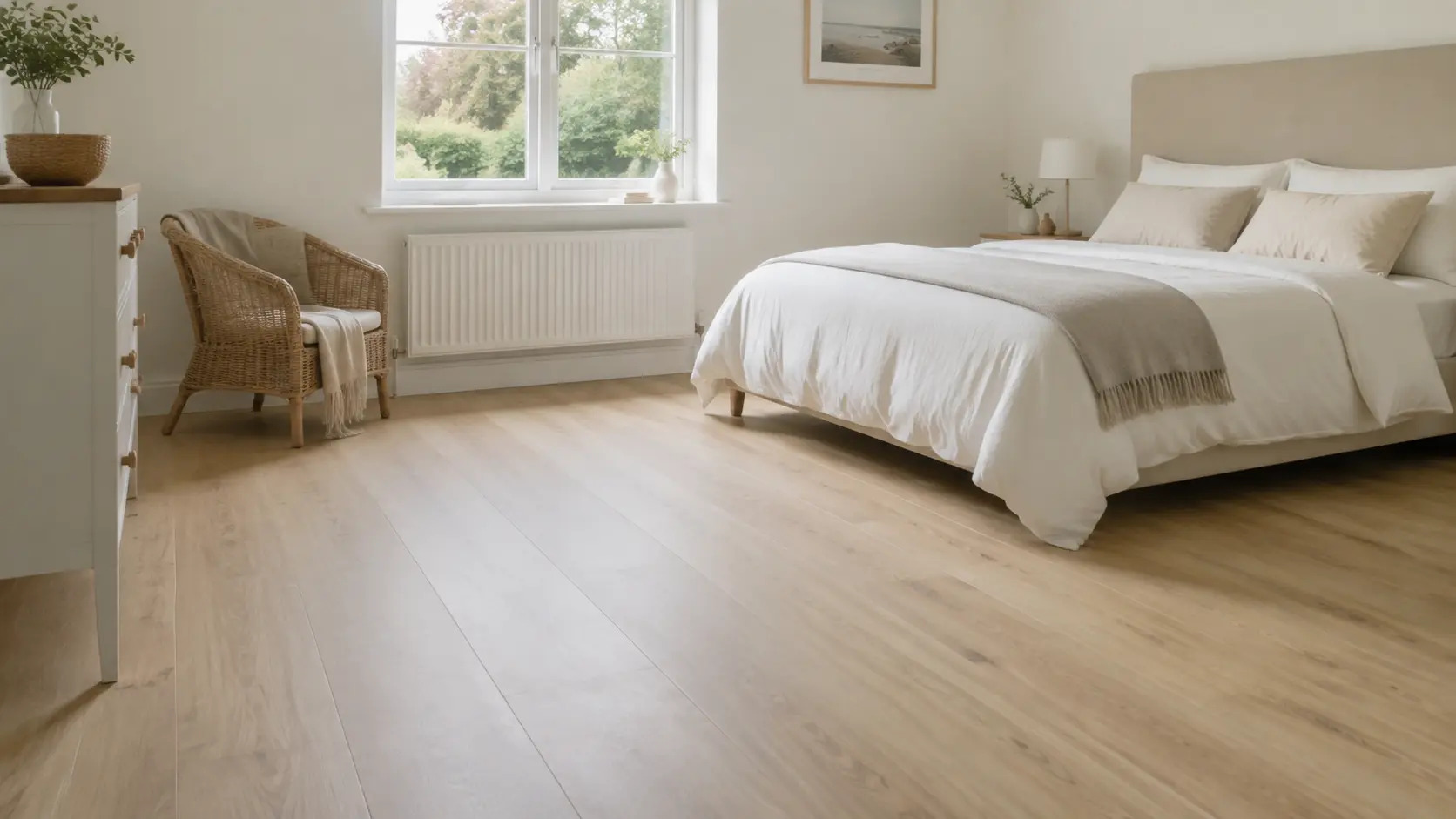
Engineered oak flooring is a genuine hardwood floor made by bonding a real oak wear layer onto a stable, cross-layered core, rather than milling a single piece of timber top to bottom, the way solid wood is. That layered build is what makes it suit Irish homes so well: it resists the expansion, contraction, and gapping that Ireland’s damp, changeable climate and central heating put solid wood through, and it’s compatible with the underfloor heating now standard in most new Irish builds. At FBS Flooring, it’s the only way we build wood flooring — our entire Lignum Strata range, from 90mm herringbone blocks to 180mm statement boards, is engineered oak, chosen deliberately for Irish conditions rather than as a budget alternative.
This guide walks through the widths, thicknesses, and Lignum Strata sub-collections on offer, and why each one earns its place on an Irish floor.
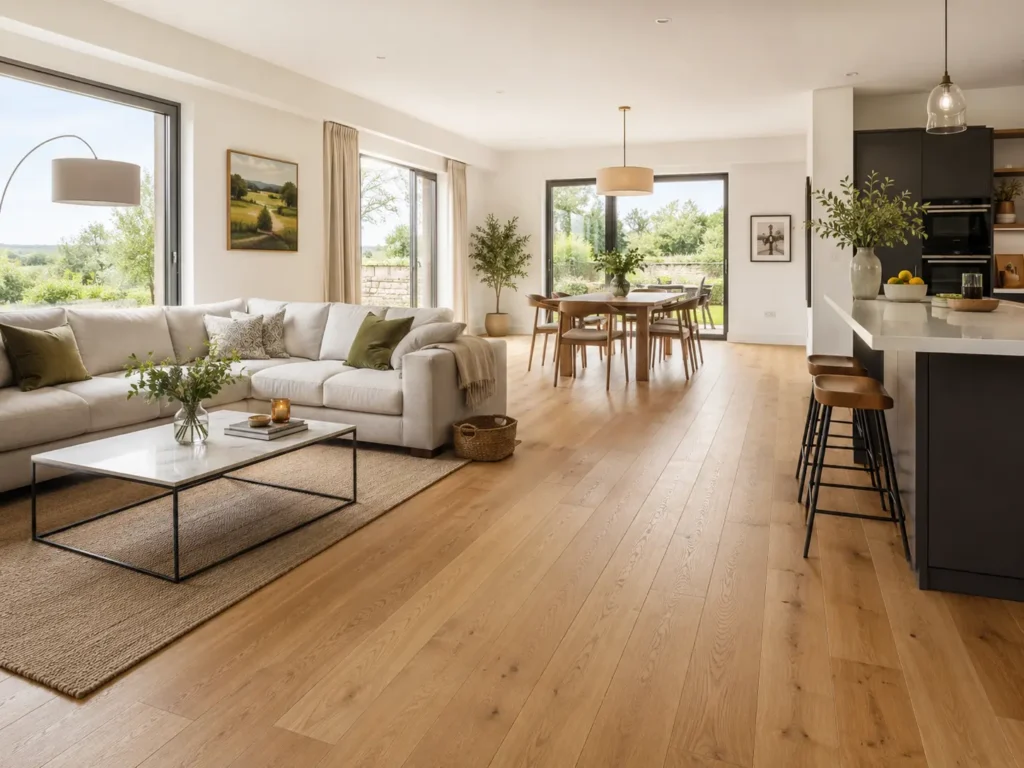
What Is Engineered Oak Flooring, Exactly?
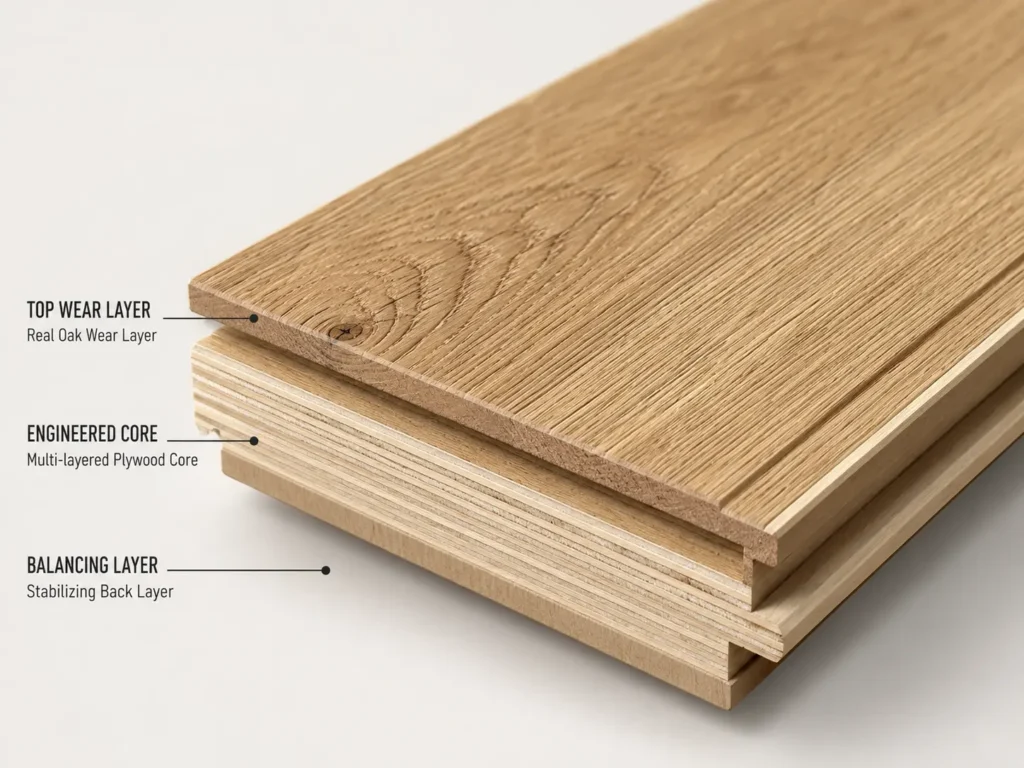
Engineered oak flooring is a genuine hardwood floor made of two or three bonded layers rather than one solid piece of timber: a multi-ply or HDF core for stability, topped with a real oak wear layer, sealed with a lacquer finish, and cut with a tongue-and-groove edge so boards lock cleanly together.
That layered build is the whole point. Solid wood is cut from a single length of timber, so it expands and contracts across its full thickness as humidity and temperature shift — a lot to ask of a floor in an Irish home. Engineered oak’s core is built from layers running in different directions, which cancels most of that movement out before it ever reaches the surface. What you walk on and see is still real oak — the wear layer is solid timber, not a photograph or a laminate print — it’s simply built on a foundation designed to stay flat and stable.
Why FBS Flooring’s Entire Wood Range Is Engineered — Not Solid
Every piece of wood flooring we sell at FBS Flooring is engineered oak. We don’t stock solid hardwood, and that’s a deliberate decision, not a limitation. Solid oak is a single piece of timber from the surface right down to the underside, and it moves with Ireland’s seasons more than most homes can comfortably handle — gapping as radiators dry the air each winter, the classic complaint in a centrally-heated semi-d every January, and cupping or lifting if it ever meets damp concrete or underfloor heating.

Engineered oak solves that by design: a cross-layered core keeps the board dimensionally stable while a genuine oak wear layer on top gives you the same look, grain, and feel underfoot as solid wood. It isn’t a cheaper stand-in for “real” wood — it is real oak, engineered specifically for a damp, centrally-heated, increasingly underfloor-heated Irish housing stock. That’s why every board in our Lignum Strata range, from a 90mm herringbone block to a 180mm Castro plank, is built this way.
Board Widths Explained: 90mm to 180mm
Lignum Strata runs across four widths, and each suits a different kind of room:
| Width | Format | Where it works best |
|---|---|---|
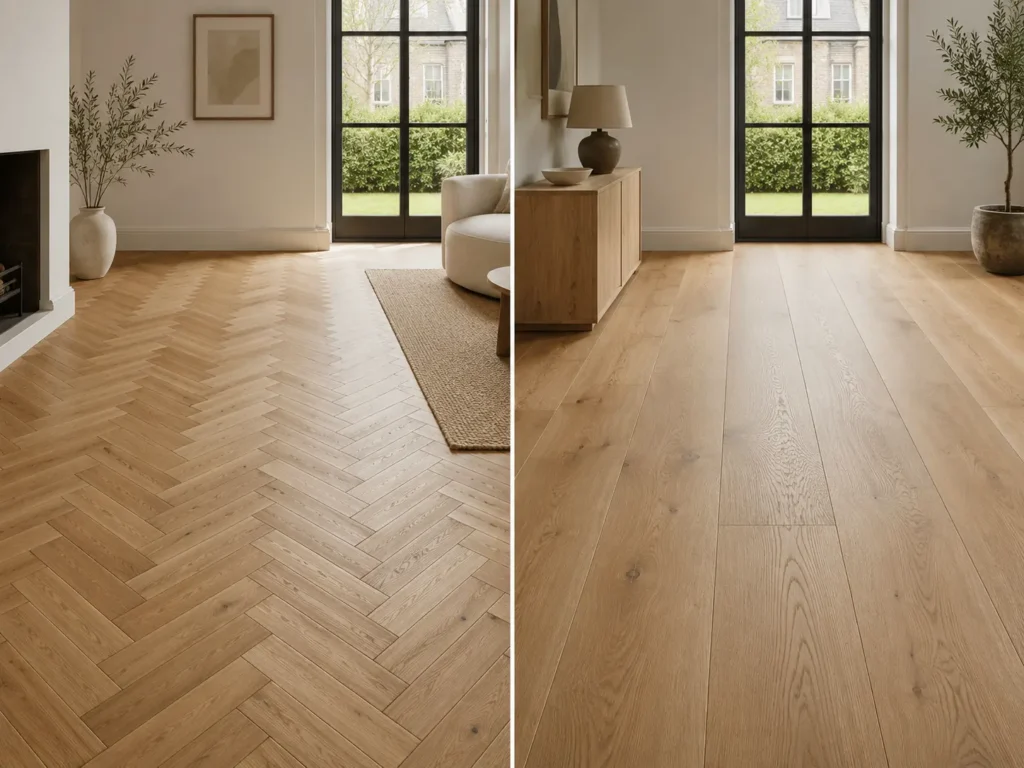
| 90mm | Herringbone block | Hallways, period rooms, smaller or broken-plan spaces |
| 120mm | Herringbone block | A slightly bolder herringbone pattern, same period-friendly appeal |
| 150mm | Straight plank (“Fourteen”) | A versatile mid-width that suits most room sizes and styles |
| 180mm | Wide-format straight plank, including the Castro Collection | Open-plan living, larger rooms, fewer visible joints |
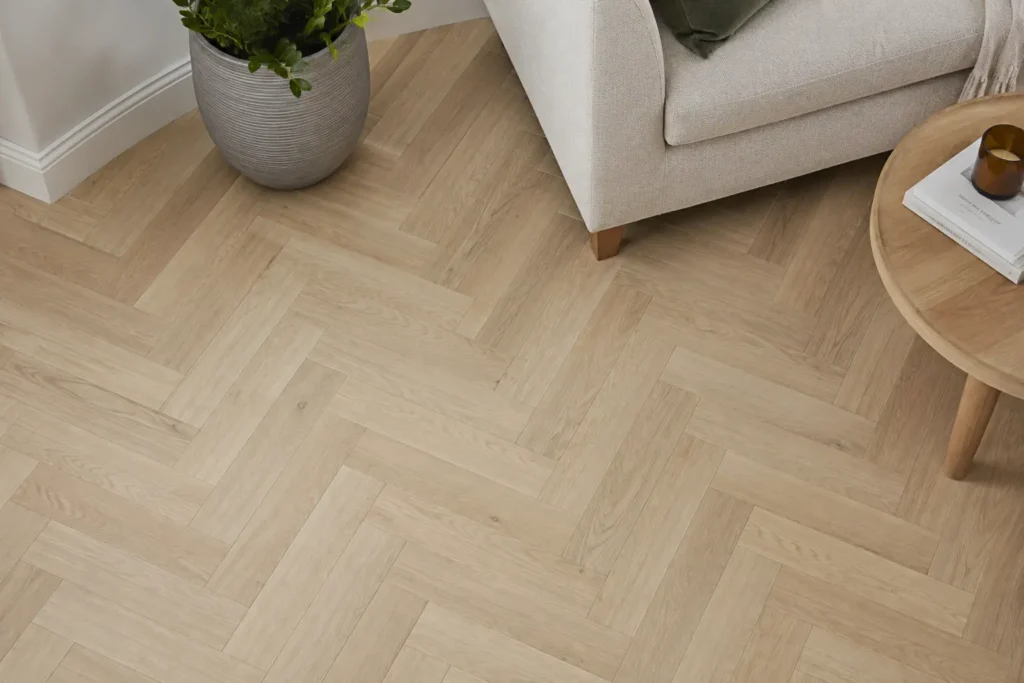
Narrower herringbone blocks bring texture and movement to a floor and sit naturally in the Georgian and Victorian terraces we fit across Dublin, where a hallway or front room often calls for a bit more period character than a straight plank gives you. At 150mm, Whisper Oak is a good example of the straight-plank “Fourteen” line — wide enough to feel current, narrow enough to suit almost any room. At the top end, 180mm is what most open-plan extensions and new-build living spaces are asking for now, Castro included: fewer joints across a big floor, more of each board’s natural grain on show, and a calmer, more contemporary look underfoot.
14mm or 15mm? Choosing Your Board Thickness
Both of our engineered oak thickness lines — Fourteen (14mm) and Fifteen (15mm) — are fully suitable for Irish homes, including over underfloor heating. The difference is smaller than it sounds: 15mm gives a marginally firmer feel underfoot and a touch more headroom for future resanding, while 14mm remains the more common choice for straightforward retrofits and suits the vast majority of rooms we fit.
Which one makes sense for you often comes down to what’s happening beneath the floor rather than personal taste. A thicker board eats slightly more clearance at door thresholds and next to existing tiled floors, which is worth checking before you commit if you’re matching into an existing level. Both lines carry the same tongue-and-groove jointing and lacquered oak wear layer and are laid the same way, so the decision rarely rules a colourway in or out — it mostly comes down to subfloor build-up and how firm you like a floor to feel underfoot.
Meet the Lignum Strata Range
Every engineered oak board we sell sits within one range — Lignum Strata, 25 SKUs deep, covering all four widths above. Two names within it are proper sub-collections in their own right — Castro and Sienna — while the rest of the range is a deep line-up of individual colourways built on exactly the same engineered construction. It’s worth browsing the full range yourself once you’ve a sense of what you’re after.
The Castro Collection: Wide-Format Statement Boards
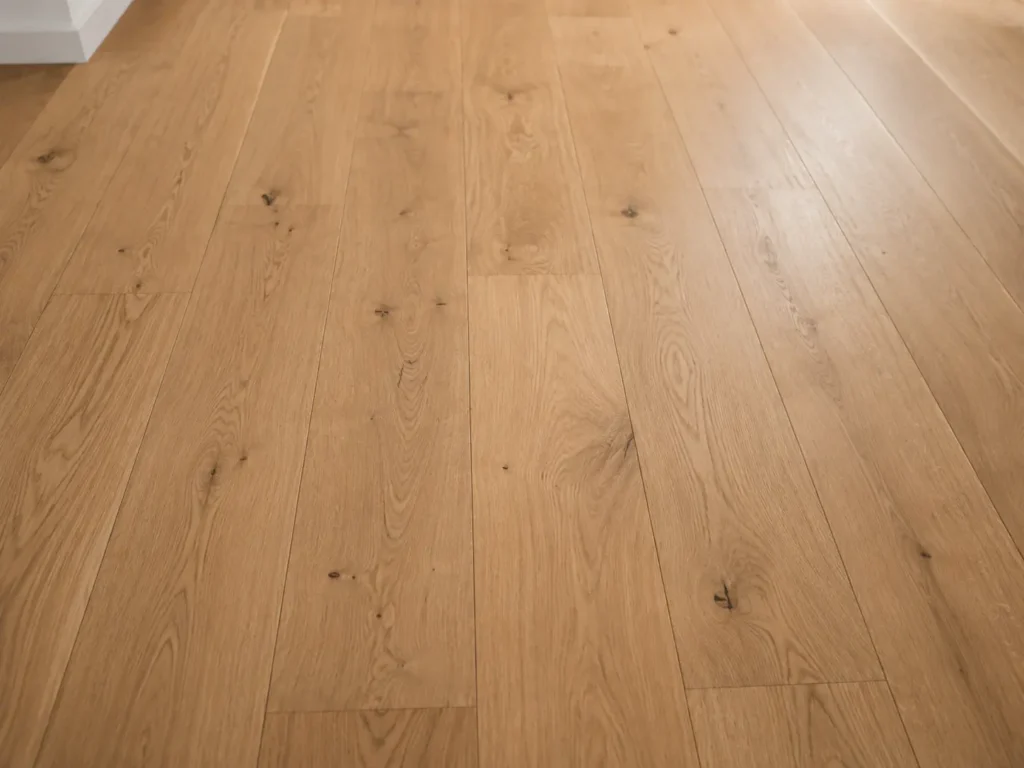
Castro is Lignum Strata’s flagship 180mm straight-plank format — boards built specifically to be the main event in an open-plan room. Alexandria Oak and Imperial Oak are the two named finishes, both carrying the full-width long, uninterrupted grain that the collection is designed around, so wherever the light falls in the room, there’s less pattern-repeat to catch the eye than with a narrower board.
Sienna: Herringbone at 90mm
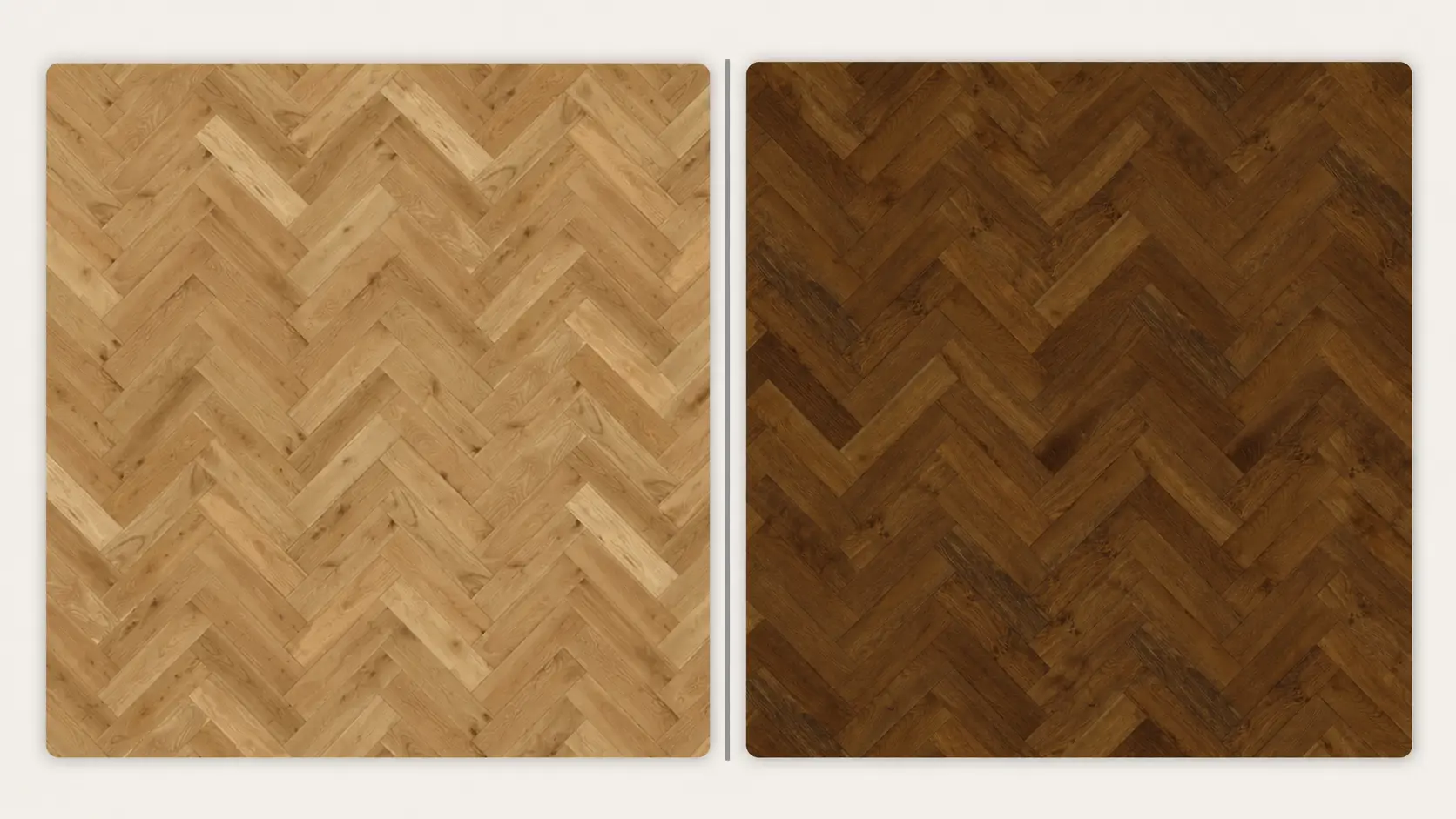
Sienna brings the same engineered construction to a 90mm herringbone block, across three finishes: Florence Oak, Rustic Brushed Oak, and Sparta Oak. It’s the collection we point period property owners toward most often — the herringbone lay adds texture and visual movement that a straight plank can’t, and it’s particularly at home in a Dublin hallway, a small front room, or anywhere a broken-plan layout means a big single sightline was never really on the cards. Rustic Brushed Oak’s brushed surface, in particular, opens up the grain for a bit of extra texture underfoot.
Smoked White Oak: One Tone, Two Formats
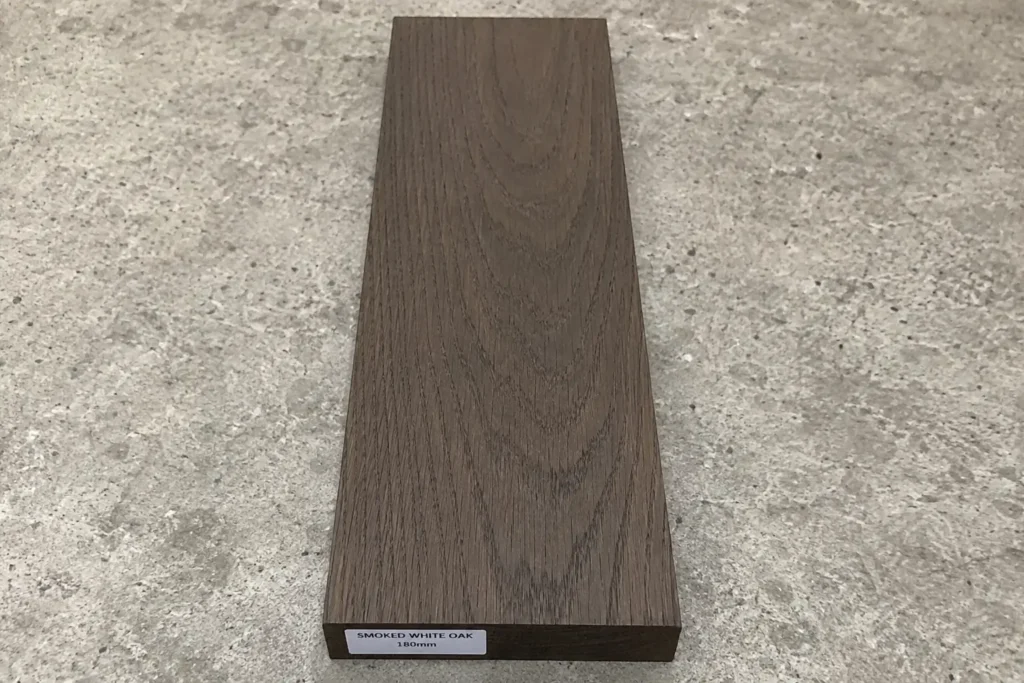
Smoked White Oak is worth calling out on its own, because it’s one of the few Lignum Strata colourways available in more than one format: a 180mm straight plank and a 120mm herringbone block. That means you can run the same tone through an entire home — herringbone in the hall, wide plank through the open-plan kitchen-diner — without the join between rooms ever looking like two different floors.
Beyond these three, the wider range runs deep: Santorini White Oak and Taj Mahal Oak at the lighter end, Prestige Oak for something moodier, and Whisper Oak at 150mm, alongside further herringbone and straight-plank options including Fumado Oak, Harvest Oak, Pearl Grey Oak Herringbone, Romantic Oak Herringbone and Walnut Herringbone — all built on the same core, wear layer and finish as the boards above.
Why Engineered Oak Suits the Irish Climate
Ireland is hard on wood floors in ways a lot of countries simply aren’t. Humidity swings with the seasons, older housing stock often sits on subfloors that were never built with today’s flooring in mind, and central heating dries indoor air out hard every winter — all things that make a solid timber board expand, contract, gap and occasionally cup. Engineered oak’s cross-layered core is built to resist exactly that movement, which is the whole reason we only stock engineered.
It matters more in some parts of the country than others. Coastal counties — Galway, Clare, Cork, Donegal — carry higher ambient humidity for more of the year, and a lot of the period and older housing stock along the west coast has subfloors or damp-proofing that wouldn’t pass muster if built today. Before any of our fitters lay a floor, checking subfloor moisture and confirming there’s an adequate damp-proof membrane over concrete is standard practice, not an optional extra, whether that’s a Georgian terrace in Dublin 8 or a commuter-belt estate further out — it’s the difference between a floor that lasts fifteen-plus years and one that cups within its first winter.
The other big driver is underfloor heating, which is close to standard now in new Irish builds and increasingly common in retrofit extensions. Engineered oak responds to gentle radiant heat far more predictably than solid wood does, which is precisely why it’s the only wood flooring we recommend over UFH. Bring the heat up gradually when a floor is newly fitted, keep to the manufacturer’s guidance on maximum floor temperature, and there’s no reason an engineered oak floor and underfloor heating shouldn’t get on for decades.
Choosing the Right Board for Your Room
A few practical things decide which board actually works, beyond which one you like best in the showroom. Light is the big one: a north-facing room or anywhere with limited natural light generally reads better with a lighter tone — Santorini White Oak or Whisper Oak, for example — while a bright, sun-filled room can carry a deeper tone like Taj Mahal Oak or Prestige Oak without feeling heavy.
Room size and shape matter almost as much. In a large open-plan space, a wide 180mm board reduces the number of joints running across the floor and tends to make the room read as calmer and bigger. In a hallway, snug front room, or anywhere the layout is broken up by doors and turns, herringbone earns its keep — the pattern gives the eye something to follow without needing a long, uninterrupted run of floor to work.
Footfall is the last piece. Every Lignum Strata board is lacquered and built for everyday family life, but a hallway or kitchen sees far more grit and moisture than a bedroom — a decent mat at each external door does more for a floor’s long-term finish than almost anything else you can do.
Installation & Acclimatisation in an Irish Home
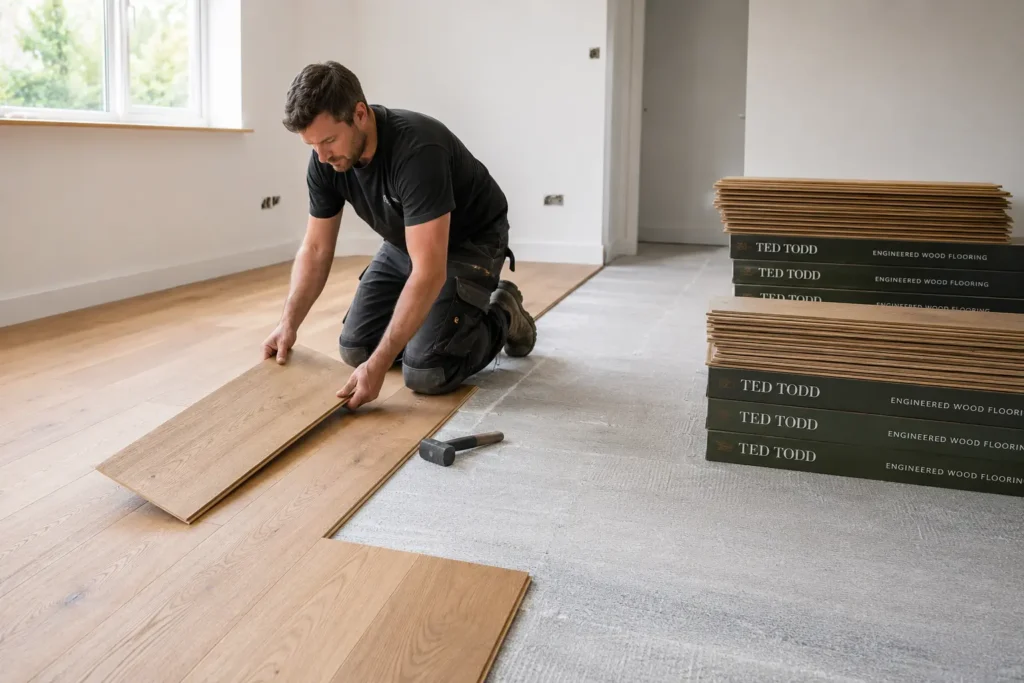
Engineered oak still needs to acclimatise before fitting: boards left in the room they’ll be laid in for at least 48 hours, so they settle to that room’s temperature and humidity before anyone reaches for a saw. Beyond that, whether a floor is floated or glued down, and what the subfloor needs before boards go anywhere near it, depends on the property — concrete slab versus suspended timber, existing tiles, and whether underfloor heating is involved, all of which change the answer. A small expansion gap at the skirting is standard on every job, hidden once the skirting or a scotia goes back on. Our full guide to flooring installation in Dublin covers subfloor prep, room-by-room type.
Caring for Your Engineered Oak Floor
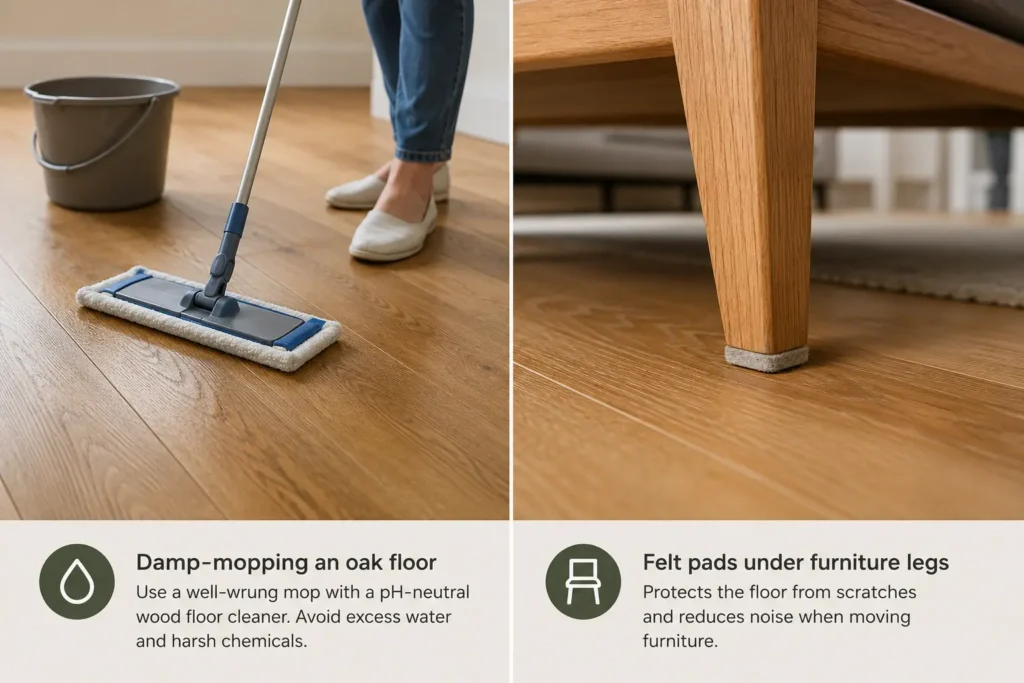
Day to day, an engineered oak floor asks very little: a regular Hoover or soft-bristle sweep to keep grit from grinding into the lacquer, and a barely-damp mop rather than a wet one — standing water is the one thing to genuinely avoid. Felt pads under furniture legs and a mat at every external door will do more for the finish over ten years than any cleaning product. Our hardwood floor maintenance guide goes into more detail on spills, sunlight and long-term care.
Let FBS Flooring Handle It
FBS Flooring has been specifying, supplying, and fitting engineered oak into Irish homes for years, from Georgian terraces in Dublin to new-build extensions with underfloor heating throughout. Owner Ilir Sulaj and the team work out of our Malahide Road Industrial Estate showroom in Coolock, and every board that leaves it has been through the same checks we’d want on our own floor.
Lignum Strata sits in the mid-to-premium tier — a genuine step up from laminate or LVT — and exact pricing depends on width, format, and finish, so we’d always rather talk you through a personalised quote in €/m² than a single headline figure that might not hold for your room.
If you’re weighing up widths, tones, or which colourway suits your room, come and see the full range in person, order samples, or book a free survey, and we’ll talk you through what actually works for your subfloor and your light. Get a free quote, and we’ll take it from there.
FAQ
What widths does FBS Flooring’s engineered oak range come in? Lignum Strata spans four widths: 90mm and 120mm herringbone blocks, 150mm straight plank, and 180mm wide-format boards, including the whole Castro Collection. All are available across the 14mm (“Fourteen”) and 15mm (“Fifteen”) thickness lines, depending on the specific product.
Is engineered oak better than solid wood for an Irish home? For most Irish homes, yes. Engineered oak’s layered core resists the expansion and contraction that Ireland’s damp, changeable climate and central heating put solid wood through, and it’s compatible with underfloor heating, which solid wood generally isn’t. It’s still real oak on the surface — just built to cope with real Irish conditions.
What’s the difference between the Castro Collection, Sienna, and the wider Lignum Strata range? Castro is the wide-format 180mm straight-plank statement collection (Alexandria Oak, Imperial Oak). Sienna is a 90mm herringbone block collection (Florence Oak, Rustic Brushed Oak, Sparta Oak). Beyond these two named collections, the rest of Lignum Strata is a deep line-up of individual colourways on the same construction — some, like Smoked White Oak, available in both a 180mm straight plank and a herringbone block.
Should I choose a 14mm or 15mm engineered oak board? Both are fully engineered and UFH-compatible. The 15mm (“Fifteen”) line has a firmer underfoot feel and slightly more resanding headroom over its lifetime; 14mm (“Fourteen”) is the more common choice for straightforward retrofits. Either is a sound choice — it comes down to subfloor build-up and personal preference underfoot.
Is engineered oak suitable for underfloor heating? Yes — engineered oak’s layered construction is specifically what makes it suitable for underfloor heating, unlike solid wood. As with any wood floor over UFH, follow the manufacturer’s guidance on maximum floor temperature and bring the heat up gradually when the floor is newly fitted.
Can engineered oak flooring be sanded and refinished? Yes, within limits. Because only the top layer is solid oak, engineered boards can be sanded and refinished a limited number of times over their life — fewer than solid wood, but enough to renew the surface after years of wear. How many times depends on the wear layer, so it’s worth asking before you fit.
Is wide-plank (180mm) oak flooring still on-trend for Irish homes in 2026? Yes — 180mm boards remain one of the strongest trends in Irish flooring for 2026, particularly in open-plan extensions and new builds, because the wider format shows off the oak’s grain and cuts down on visible joints across a room. Herringbone in narrower widths remains equally popular for period and hallway settings.
2 Responses