
Table of contents
1) Introduction: why Irish quotes vary (materials, prep, VAT, moisture, labour availability)
If you’ve spent any time looking at Irish interior design accounts lately, you already know the truth: herringbone is everywhere. From lovingly restored redbrick terraces in Dublin to sleek new-builds in Cork and sprawling modern bungalows in rural Galway, the classic parquet zig-zag is experiencing a massive revival.
But here is the harsh reality that catches many Irish homeowners off guard: falling in love with herringbone on Instagram is easy; budgeting for it is a different beast entirely.
As a flooring contractor who has spent over two decades kneeling on screed and plywood across this island, I can tell you exactly why. Standard straight-plank flooring is a relatively straightforward, linear process. Herringbone is a geometric puzzle. It demands meticulous subfloor preparation, specific moisture management tailored to Ireland’s notoriously damp climate, and a craftsman’s eye for symmetry.
In this comprehensive guide, I am going to pull back the curtain on the Irish flooring industry. We are going to look at exact, up-to-date cost breakdowns in Euros (€), dissect the dreaded “waste factor,” explain why your fitter is quoting you double the labour rate of standard laminate, and navigate the tricky waters of Irish VAT regulations.
Herringbone quotes vary in Ireland because the “floor” is only half the job. Waste is higher than straight planks, labour is slower and more technical, and prep can explode if the slab is damp or wavy. VAT can also differ depending on whether it’s supply-only or supply-and-fit. Expect Dublin to price differently to Cork, Galway, Limerick, Waterford, or rural counties.
In real homes, I see the same pattern again and again:
- The tidy quote assumes a flat, dry subfloor and a simple room.
- The expensive quote is pricing the risk: moisture checks, levelling, primers, DPM, trims, door work, and the time to set out a pattern that can’t “wander”.
Ireland-specific realities that move the number:
- Humidity and coastal exposure: winter RH swings and sea air matter for timber movement (especially in older, less airtight homes).
- Housing stock: suspended timber floors (common in older houses) behave differently from concrete slabs (common in newer builds and extensions).
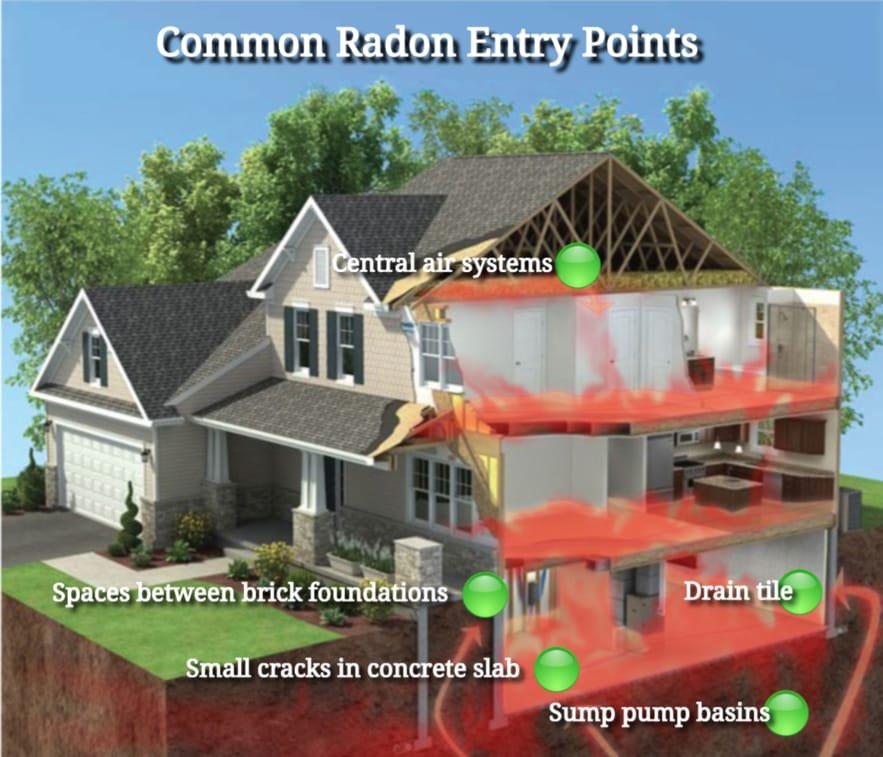
- Radon measures: in some areas, membranes and detailing are part of the floor build-up guidance for new work. [Source: Gov.ie, EPA] (gov.ie)
- Labour availability: Herringbone is a niche. Not every crew will touch it. Short supply = higher labour rates.
2) The “real” cost formula
Your total isn’t “€X per m²”. It’s a stack of multipliers and fixed costs. The trick is separating variable costs (scale with area) from fixed costs (setup, set-out, thresholds, moving furniture, site logistics).
Quick estimator formula (boxed)
Total Cost (ex VAT) = (Area × (1 + Waste%)) × Material €/m²
+ Area × Labour €/m² (or day rates converted)
+ Prep items (levelling, primer, adhesive/DPM/radon details, trims, removal, disposal, door work)
+ VAT treatment (see Section 9)Order quantity (m²) = Area × (1 + Waste%)
Rule-of-thumb: Add more waste when rooms are small, awkward, or border-heavy.
What I mean by “prep items”: anything that must happen before (or after) the pretty pattern goes down: flatness, moisture management, and finishing details. These are the costs that “price per m²” articles conveniently forget.
3) Quick numbers (with ranges and what moves them)
A realistic Ireland-facing budget range depends on (1) material type and (2) how much prep and complexity you’re buying. Below are rule-of-thumb ranges, not promises. They assume normal access, no structural repairs, and a competent herringbone installer.
Rule-of-thumb installed ranges (Ireland)
- Laminate herringbone (click): often the lowest supply cost, but still time-heavy to cut and set out.
- Engineered wood herringbone: premium look, higher material cost, and glue-down versions demand excellent flatness and moisture control.
- LVT herringbone (glue-down): stable product, but adhesive and subfloor perfection are non-negotiable.
What moves you up the range fast
- Levelling to SR1-type flatness (especially for glue-down).
- Moisture mitigation (surface DPM) if RH is too high.
- Small rooms, lots of doorways, hallways, borders, and fireplaces.
- Apartments: acoustics + transitions + neighbour-friendly working hours.
Cost table 1: Rule-of-thumb “all-in” ranges (supply + install, ex VAT)
(Ranges reflect common market spread; verify with local quotes.)
| System (typical) | Flooring supply €/m² | Labour €/m² | Common prep/consumables €/m² | Rule-of-thumb total €/m² (ex VAT) |
|---|---|---|---|---|
| Laminate herringbone (click) | 20–45 | 30–60 | 5–15 | 55–120 |
| LVT herringbone (click) | 25–55 | 35–65 | 5–15 | 65–135 |
| LVT herringbone (glue-down) | 25–60 | 40–75 | 12–30 | 77–165 |
| Engineered wood herringbone (click) | 45–95 | 45–80 | 8–18 | 98–193 |
| Engineered wood herringbone (glue-down) | 50–120 | 55–95 | 15–40 | 120–255 |
How to use this table: pick the row that matches your product and fixing method, then adjust upward for (a) small rooms, (b) doorways/borders, (c) levelling/moisture needs, and (d) Dublin-city logistics versus regional work.
4) Waste factor: how much extra to order and why
Waste is higher in herringbone because the pattern creates more offcuts, starter rows get sacrificed to keep lines true, and awkward rooms force extra trimming. Straight planks can “run” with fewer cuts; herringbone cannot. Expect your supplier to ask about the room shape for a reason.
How much extra herringbone flooring should I buy in Ireland?
For most Irish homes, 15–20% waste is a sensible starting point for herringbone. Use 20–25% when rooms are small, full of doorways, have lots of nibs/returns, or you’re adding borders. Straight plank installs often sit lower (commonly ~5–10%), while chevron tends to be similar or higher than herringbone because angles lock you into more cutting. (All are rules-of-thumb: confirm with your product format and installer’s set-out plan.)
Why waste climbs in herringbone
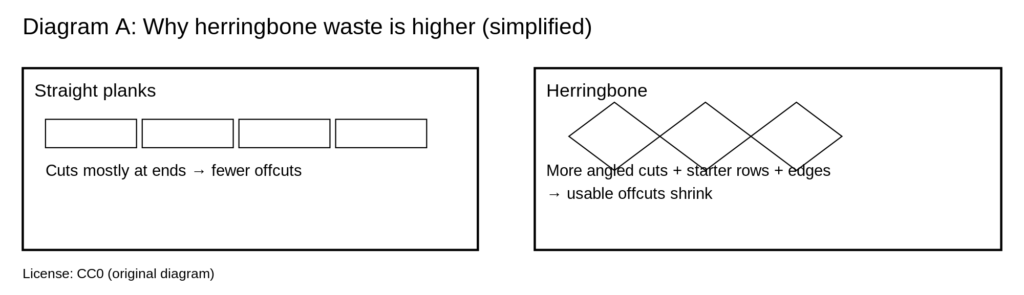
- Pattern geometry: every “V” is made from two pieces, and the ends rarely land perfectly on walls.
- Starter rows: you often cut sacrificial pieces to lock the pattern to a centreline and keep it square.
- Borders: look fantastic; eat time and material.
- Repairs/spares: keeping a small box for future damage is smart, especially if the product may be discontinued.
Waste% sensitivity (required)
If your flooring costs €65/m² and your room is 25 m², adding +5% waste means ordering 1.25 m² extra. That’s €81.25 more on the boards alone (ex VAT), before adhesive and trims. The bigger the €/m², the more waste hurts.
Table: Recommended waste% by room size/shape (straight vs herringbone vs chevron)
| Room situation | Straight plank waste% | Herringbone waste% | Chevron waste% |
|---|---|---|---|
| Big, simple open-plan (40–80 m²), few doors | 5–7% | 12–15% | 15–18% |
| Medium room (20–40 m²), 2–3 doorways | 7–10% | 15–18% | 18–22% |
| Small room (10–20 m²) | 8–12% | 18–22% | 20–25% |
| Hallway / lots of nibs / multi-door room | 10–15% | 20–25% | 22–30% |
| Any of the above + border feature | +2–4% | +2–5% | +3–6% |
How to use this table: find your closest room type and start there. If you’re mixing spaces (e.g., bedroom + hallway), use the higher waste figure for the awkward area, not the average.
Herringbone pattern texture (why offcuts rise)
- Source: Wikimedia Commons (Poly Haven asset)
- License: CC0 1.0 (public domain dedication) (Wikimedia Commons)
- Alt text: Herringbone parquet pattern close-up texture
- Caption: Pattern geometry increases cutting and offcuts; this is why waste% climbs.

5) Labour complexity: what installers actually do (and what you’re paying for)
Herringbone labour costs more because the job has more “non-laying” time: set-out, control lines, constant checking, and slower fitting. On glue-down work, you’re also paying for adhesives, trowel discipline, open time management, rolling, and clean edges. If the subfloor isn’t flat, labour slows further because every small dip telegraphs into the pattern.
Why is herringbone labour more expensive per m²?
Because herringbone is precision carpentry with a stopwatch running. Installers spend a chunk of the day not laying boards at all, snapping lines, setting starter rows, checking squareness, trimming around door linings, and keeping the pattern tight. Small errors compound fast, so competent crews build in “quality time” that straight planks don’t need.
What a decent installer actually does
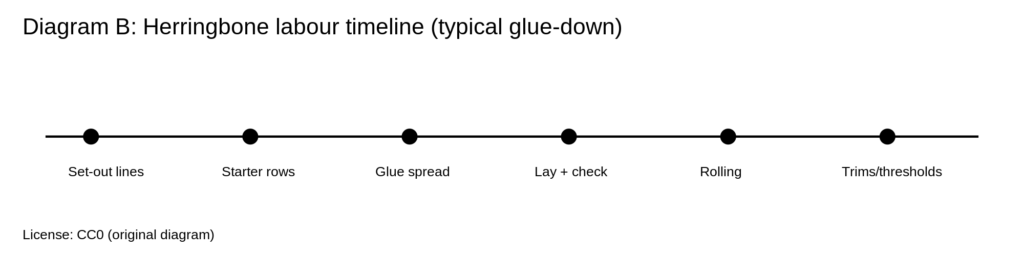
(If it’s not on the quote, ask if it’s included.)
- Acclimatisation plan: timber needs site conditions stable before laying (especially engineered wood).
- Subfloor inspection: flatness check, moisture plan, weak spots, squeaks on timber.
- Setting-out: centre lines, datum lines, squareness checks, dry layout.
- Starter rows: often glued and pinned/weighted to lock the pattern.
- Adhesive management: correct trowel notch, correct spread rate, correct open time.
- Rolling: glue-down floors often require rolling to bed the adhesive properly.
- Expansion gaps: yes, even herringbone needs correct perimeter gaps and transitions.
- Trims and thresholds: neat transitions matter as much as the pattern.
Labour cost in two representations (required)
A) Labour in €/m² (simple way)
Installers often quote labour as €/m², but the number only makes sense if you understand what’s included (glue, primer, levelling, trims, disposal, VAT).
B) Day-rate logic converted to €/m² (estimator way)
A more honest way is:
Labour €/m² ≈ (Crew day rate × Days) ÷ Area
where Days ≈ Setup (fixed) + Area ÷ Productivity
Rule-of-thumb assumptions (verify locally):
- Crew day rate (2-person crew): varies a lot by region and workload.
- Productivity (herringbone): can be ~12–20 m²/day in good conditions, slower in small/awkward rooms.
- Setup time: often 0.5 day equivalent for set-out + protection + trims planning on small jobs.
Example (illustrative): crew €850/day, setup 0.5 day, productivity 18 m²/day
- For 60 m²: days ≈ 0.5 + 60/18 = 3.83 days → labour ≈ €3,258 → ~€54/m²
- For 12 m²: days ≈ 0.5 + 12/18 = 1.17 days → labour ≈ €992 → ~€83/m²
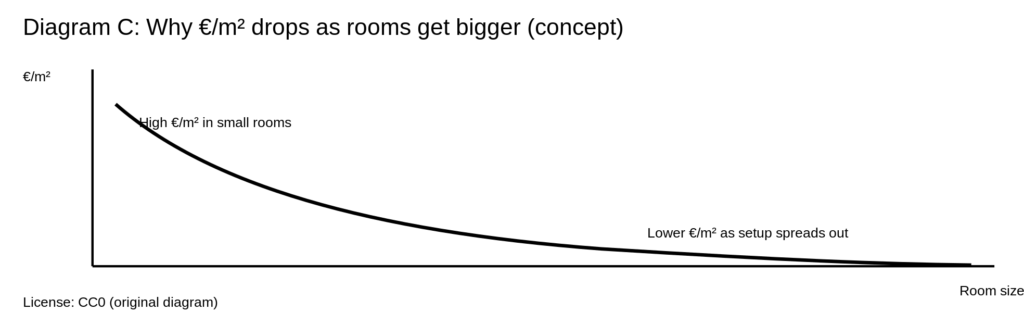
Small rooms “feel expensive” per m² because setup time doesn’t shrink with area.
Complexity multiplier table (labour uplift guide)
| Room feature | Typical impact on labour | Complexity multiplier |
|---|---|---|
| Simple square/rectangle, 1 doorway | baseline | ×1.0 |
| Medium room, 2–3 doorways | more trimming and checking | ×1.1–1.2 |
| L-shape / multiple returns | layout time + more cuts | ×1.2–1.4 |
| Hallway | high cut ratio, slow progress | ×1.3–1.6 |
| Fireplace / bay window | fiddly scribing | ×1.2–1.5 |
| Borders/inlays | premium detailing | ×1.3–1.7 |
| Island kitchen + sliding doors | transitions + expansion detailing | ×1.2–1.6 |
How to use this table: take a baseline labour €/m² from a simple-room quote, then apply the multiplier that matches your room features. If a quote ignores complexity, it often reappears later as “extras”.
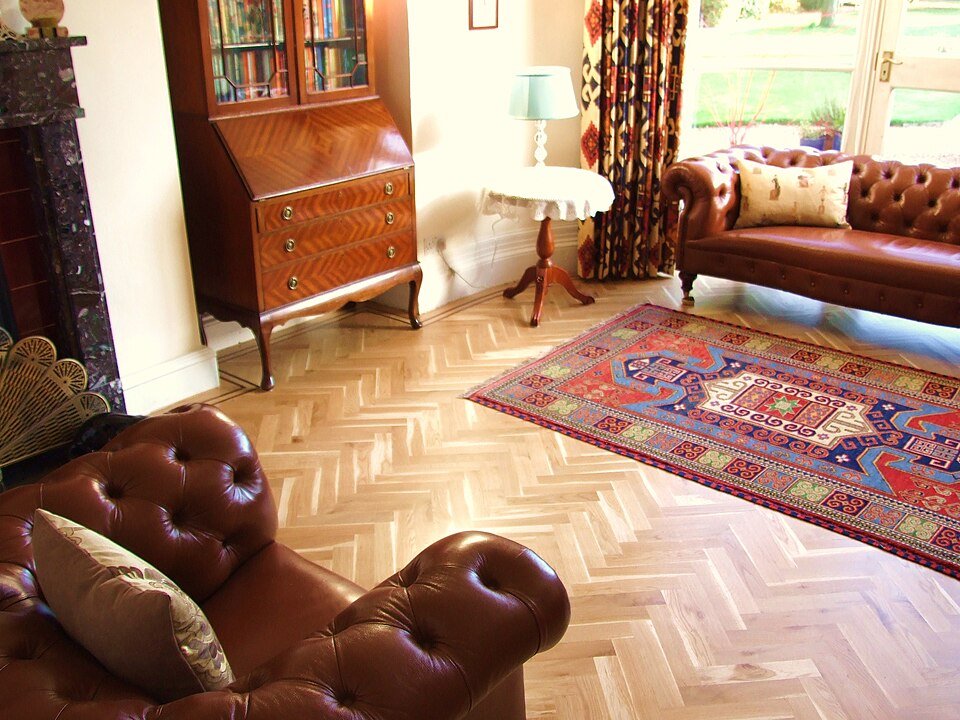
Real herringbone floor with border
- Source: Wikimedia Commons
- License: CC BY-SA 4.0 (Wikimedia Commons)
- Alt text: Oak herringbone wood floor with dark border
- Caption: Borders look premium, but they add layout time and extra cutting.
6) Room size impact: why €/m² drops in bigger rooms (and spikes in tiny ones)
Bigger rooms usually reduce €/m² because the fixed setup time is spread over more area. Tiny rooms can look “overpriced” because you still need set-out lines, cuts, protection, cleanup, and often the same number of transitions. Herringbone exaggerates this because alignment checks are constant.
Does a bigger room reduce herringbone installation cost?
Usually, yes. A 60 m² open-plan often installs at a lower €/m² than a 12 m² bedroom because the crew spends more time in productive laying mode and less time on doorways, thresholds, and fiddly cuts. But big rooms can spike again if you add islands, borders, or complex glazing transitions.
Three scenario examples (with disciplined assumptions)
Below are illustrative worked examples using the same logic I’d use for a quick estimate. Prices are ex VAT. Your quotes will vary by county, access, product, and subfloor condition.
Scenario A) 12 m² bedroom (simple shape, one doorway)
Mini-answer: Small rooms often cost more per m² because the setup and finishing time is nearly the same as a larger room, but spread over fewer metres. Waste also rises because more pieces get cut short. Expect herringbone to feel “minimum-charge-ish” here.
Assumptions (rule-of-thumb):
- Engineered wood herringbone boards: €70/m²
- Waste: 20%
- Labour: ~€88.50/m² equivalent (day-rate logic)
- Prep/consumables: adhesive, primer, light levelling, removal, one threshold
Scenario A total (ex VAT): €2,574
If VAT at 13.5% applies (illustrative): €2,921.49
Scenario B) 25 m² living room with 3 doorways
Mini-answer: Medium rooms are the “most normal” herringbone jobs. Waste is still meaningful, and multiple doorways slow the work. This is where levelling often appears, because existing slabs and timber floors rarely meet the flatness needed for a clean pattern.
Assumptions (rule-of-thumb):
- Boards: €65/m²
- Waste: 18%
- Labour: €72/m²
- Prep: adhesive, primer, levelling skim, removal, 3 thresholds
Scenario B total (ex VAT): €4,812.50
If VAT at 13.5% applies (illustrative): €5,462.19
Scenario C) 60 m² open-plan with kitchen island + sliding doors
Mini-answer: Big open plans can be cheaper per m² because the crew stays productive for longer stretches. But islands and large door systems add detailing and transition work. Waste is lower than small rooms, yet prep costs can still dominate if the slab is out of tolerance or damp.
Assumptions (rule-of-thumb):
- Boards: €60/m²
- Waste: 15%
- Labour: €55/m²
- Prep: adhesive, primer, local levelling, removal, multiple transitions
Scenario C total (ex VAT): €9,290
If VAT at 13.5% applies (illustrative): €10,544.15
Cost table 2: Scenario breakdown (ex VAT)
| Line item | A) 12 m² bedroom | B) 25 m² living (3 doors) | C) 60 m² open-plan (island + sliders) |
|---|---|---|---|
| Ordered area (waste applied) | 14.4 m² | 29.5 m² | 69.0 m² |
| Flooring boards | €1,008.00 | €1,917.50 | €4,140.00 |
| Labour | €1,062.00 | €1,800.00 | €3,300.00 |
| Prep/consumables + disposal + trims | €504.00 | €1,095.00 | €1,850.00 |
| Total (ex VAT) | €2,574.00 | €4,812.50 | €9,290.00 |
How to use this table: copy the structure, swap in your area, your board price, your waste%, and your known prep items. This format makes quote comparisons fair.
7) Subfloor prep in Ireland (the cost driver people ignore)
Subfloor prep is where “cheap” herringbone jobs go to die. Herringbone punishes unevenness. It also punishes moisture mistakes. In Ireland, concrete slabs can hold moisture longer than people expect, and suspended timber floors can move or bounce if not stiff enough. If you budget nothing for prep, you’re gambling.
Do I need levelling compound for herringbone?
Often, yes especially for glue-down engineered wood or glue-down LVT herringbone. Herringbone needs a flatter surface than many straight plank jobs because the pattern highlights lipping and gaps. Installers commonly check surface regularity with a straightedge (SR classes), where SR1 is 3 mm under a 2 m straightedge and SR2 is 5 mm (as guidance used in practice). [Source: Concrete Society / BS 8204 discussion] (Concrete Society)
Important: your product and adhesive manufacturer still set the real tolerance.
Concrete slab vs suspended timber (Ireland reality)
Concrete slab
- Flatness: extensions and older slabs can be wavy.
- Moisture: slabs can be “dry to the touch” and still too wet for adhesive or timber.
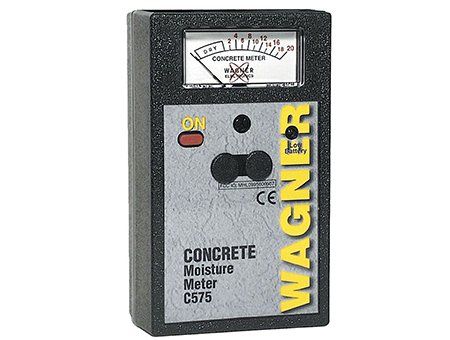
- Testing: moisture meters can mislead. The insulated hygrometer / RH method is widely used for assessing floor readiness. [Source: Concrete Society] (Concrete Society)
Suspended timber floors
- Movement: Bounce and flex can break adhesive bonds and open joints.
- Ventilation: blocked vents and damp subfloors show up as cupping or mould.
- Fix: Sometimes you need stiffening (noggins, ply overlay) before a premium pattern goes down.
Moisture testing in plain English (RH context)
Moisture is usually discussed as relative humidity (RH) in the slab/screed using an in-situ or hygrometer approach. Guidance commonly references ~75% RH as an upper limit for many floor coverings, while timber installs may require lower (often quoted around ~65% RH), but your manufacturer’s limit wins. [Source: CFA guidance note / BS guidance context] (cfa.org.uk)
Also, avoid over-trusting quick surface meters. Industry guidance notes that resistance-type meters are not recommended for properly assessing slab moisture for floor coverings. [Source: Concrete Society] (Concrete Society)
When you might need a surface DPM
If RH is too high for the adhesive or flooring system, a surface damp-proof membrane (DPM) may be specified as part of a manufacturer-approved build-up. This can add meaningful cost, but it’s cheaper than a failure.
Prep-cost sensitivity (required):
On a 60 m² job, adding levelling at €15/m² plus moisture mitigation at €18/m² adds €1,980 (ex VAT). That single decision can be the difference between a quote that looks “cheap” and one that actually survives.
Radon (high-level, Ireland-specific)
For new buildings and some extensions, radon protection measures are addressed in Irish building guidance. Government guidance notes radon resisting membranes in high radon areas, and EPA guidance explains standby sumps and membranes for buildings in high radon areas since 1 July 1998 (new-build context). [Source: Gov.ie / EPA] (gov.ie)
If you’re unsure, check the EPA radon map for your address and ask your designer/BCMS professional what applies to your project.
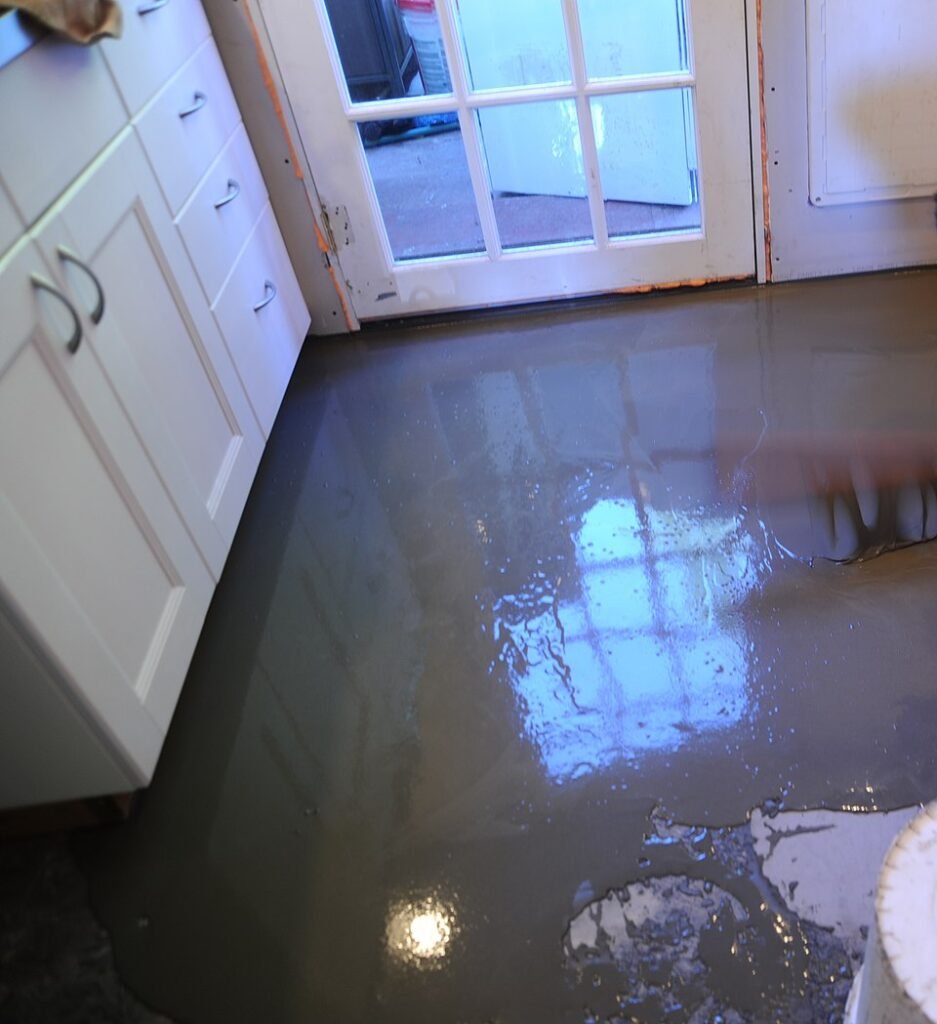
Visual (internet): Self-leveling compound in action
- Source: Wikimedia Commons
- License: CC BY 2.0 (Wikimedia Commons)
- Alt text: Self-leveling compound being applied to a floor
- Caption: Flatness is non-negotiable for herringbone; levelling is often the hidden cost.
Visual (internet): Concrete moisture meter (good tool, not the whole story)
- Source: Wikimedia Commons
- License: CC BY-SA 4.0 (Wikimedia Commons)
- Alt text: Concrete moisture meter used for floor assessment
- Caption: Moisture checks reduce failures, but RH-based testing and manufacturer limits still govern the decision.
Visual (internet): Radon entry points diagram
- Source: Wikimedia Commons
- License: CC0 1.0 (Wikimedia Commons)
- Alt text: Diagram showing common radon entry points into a home
- Caption: Membranes and sealing details matter because gases and moisture travel through gaps, joints, and service penetrations.
8) Materials: engineered wood vs laminate vs LVT herringbone (cost + performance)
Material choice changes everything: moisture tolerance, flatness demands, acoustic behaviour, and whether glue-down is mandatory. In Ireland, I usually frame it as “how much risk do you want to manage” versus “how premium do you want it to look”.
Quick selector (mini-answer)
- Engineered wood: premium look, warm feel, but needs humidity and moisture discipline.
- Laminate: budget-friendly and tough, but herringbone still needs careful set-out and good underlay choices.
- LVT: stable and practical, great for kitchens, but glue-down demands perfect subfloor prep.
Glue-down vs click (where each fits)
- Click systems: faster, more forgiving, sometimes louder underfoot if acoustics aren’t handled.
- Glue-down systems: often quieter and more solid-feeling, but subfloor flatness and moisture become critical.
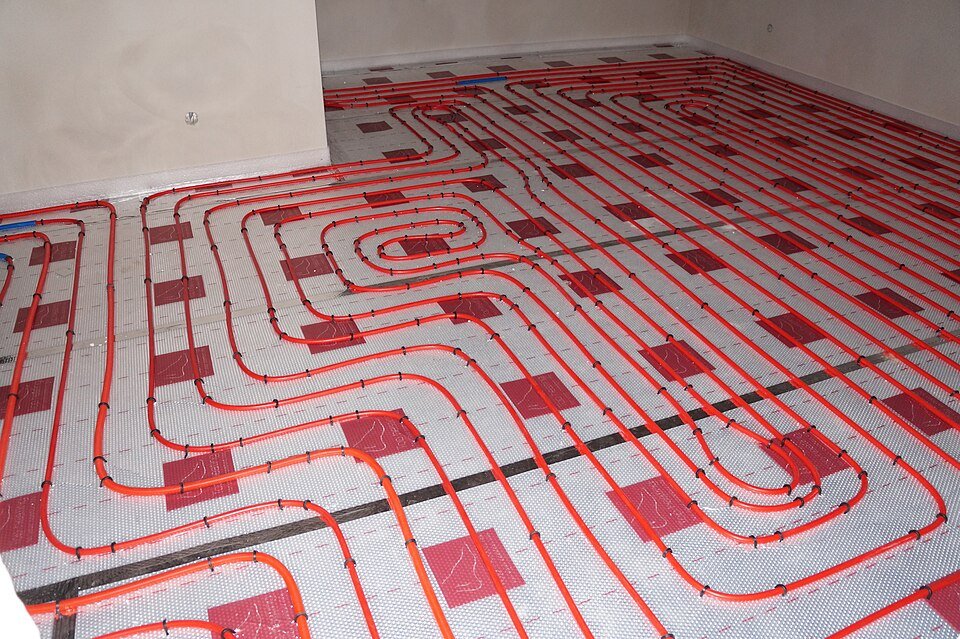
Underfloor heating compatibility (keep it disciplined)
UFH can work with herringbone, but you must follow the flooring and adhesive specs. Surface temperature limits and commissioning cycles vary by manufacturer and system. Treat any “one-size-fits-all” UFH advice as dangerous. (Also: Irish retrofits often have mixed build-ups and patchy insulation, which creates hot spots.)
Underfloor heating installation (context for adhesives + build-up)
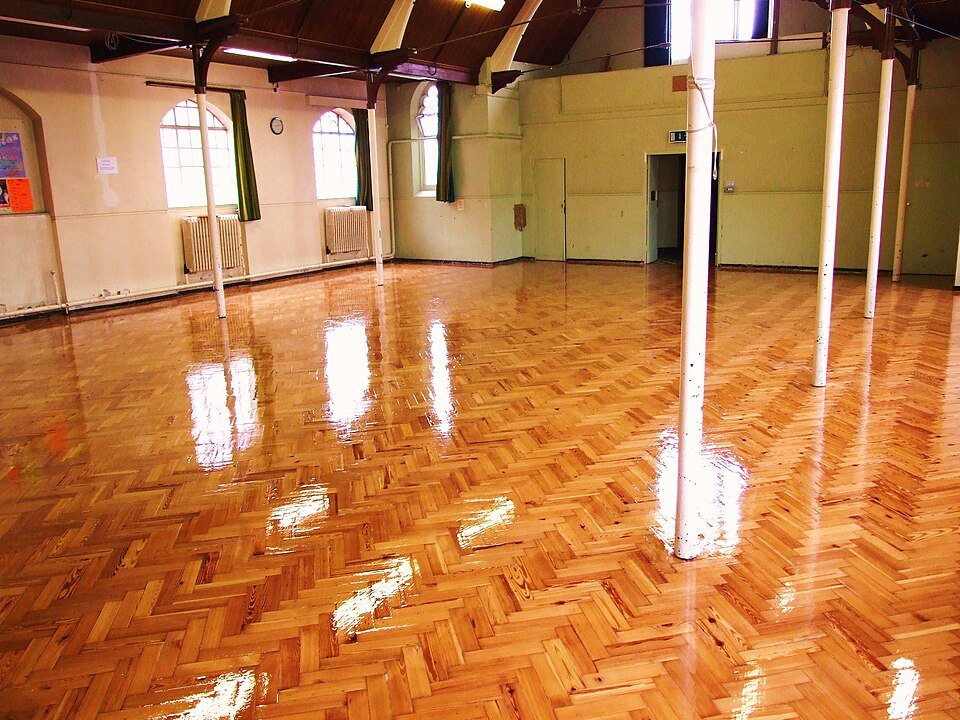
Another herringbone floor photo (finish and scale)
9) VAT and quotations: avoiding quote confusion
VAT is where homeowners get burned by “apples vs oranges” quotes. You need to know whether you’re buying goods only (flooring supply) or a construction service (supply + install). Ireland has a standard VAT rate (23%) and a reduced rate (13.5%) among others, and those are current rates. [Source: Revenue.ie] (Revenue)
(VAT)
If it’s supply-only, expect the standard VAT rate to apply. If it’s supply-and-install as a construction service, the reduced rate may apply in many cases, but you must also consider Revenue’s “two-thirds rule” and the specifics of what’s being supplied and installed. When in doubt, confirm with the contractor and reference Revenue guidance (or your accountant).
The two-thirds rule (high-level, as Revenue describes it)
Revenue explains that when a service involves supplying goods, the VAT treatment can depend on whether the cost of the goods exceeds two-thirds of the total price (VAT exclusive). If it exceeds two-thirds, the VAT rate that applies to the goods can apply to the whole job; if not, the service rate can apply. [Source: Revenue.ie] (Revenue)
Construction services and flooring
Revenue’s construction services guidance explicitly includes flooring within construction-related services. [Source: Revenue.ie] (Revenue)
Supply + install of fixtures/fittings (why flooring can sit in “works to immovable goods”)
Revenue guidance notes that installation work on immovable goods is generally treated as a service (often at the reduced rate), and supply-and-install can be subject to the two-thirds rule. [Source: Revenue.ie] (Revenue)
How does VAT work on supply and fit in Ireland?
Ask these questions on every quote:
- Is this supply-only or supply + install?
- What VAT rate is being applied and why?
- Are prep items (levelling, DPM, primer, disposal) priced ex VAT or inc VAT?
- If a reduced rate is applied, has the contractor considered the two-thirds rule?
Reality check: I’m not your tax advisor. But you can keep quotes honest by forcing VAT clarity in writing and referencing Revenue’s own guidance. (Revenue)
10) Hidden extras checklist (Ireland-specific)
Hidden extras are usually not “scams”. They’re what happens when a quote is built on assumptions you didn’t realise you were agreeing to.
If you want predictable costs, treat herringbone like a small construction project. List every scope item: removal, disposal, levelling, moisture plan, trims, doors, skirting, appliances, and protection. If it’s not written down, it’s not included.
Common extras I see in Irish homes (Dublin apartments to Galway semis to Cork extensions):
- Removal & disposal: skips, dumping fees, and old adhesive scraping.
- Skirting: remove and refit vs replace; caulk and paint are separate trades.
- Door trimming: doors often need undercutting after floor height changes.
- Thresholds and transitions: especially with tiles, carpet, or sliding doors.
- Acoustics (apartments): underlay spec, impact sound targets, neighbour issues.
- Moisture/radon measures: surface DPM, compatible adhesives, membrane detailing where relevant.
- Furniture moving: sometimes excluded; sometimes limited.
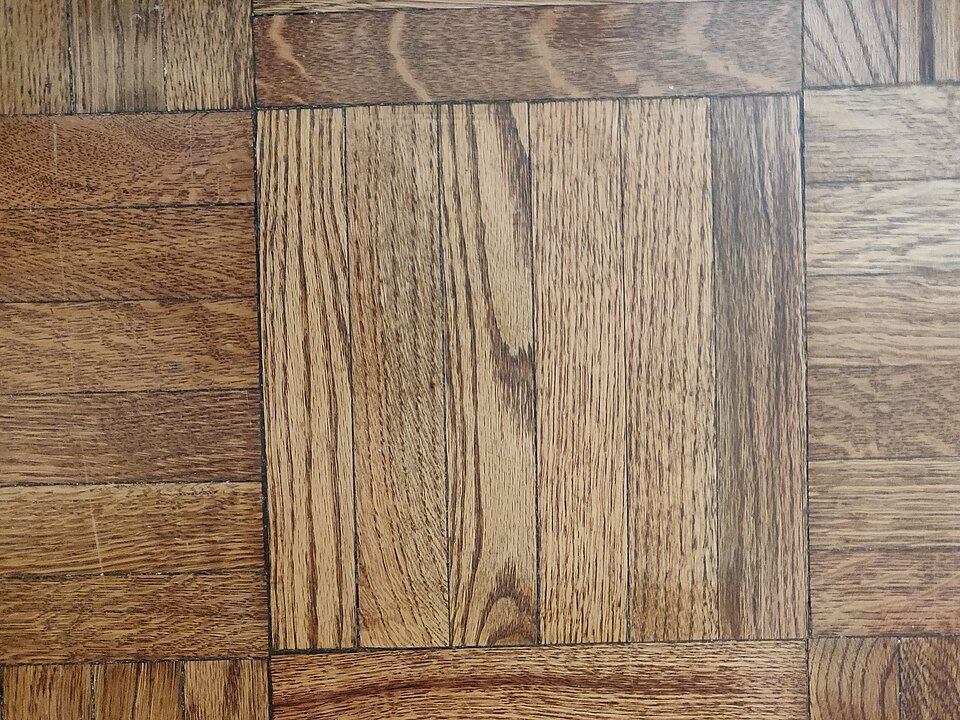
Parquet texture (stock + repairs reminder)
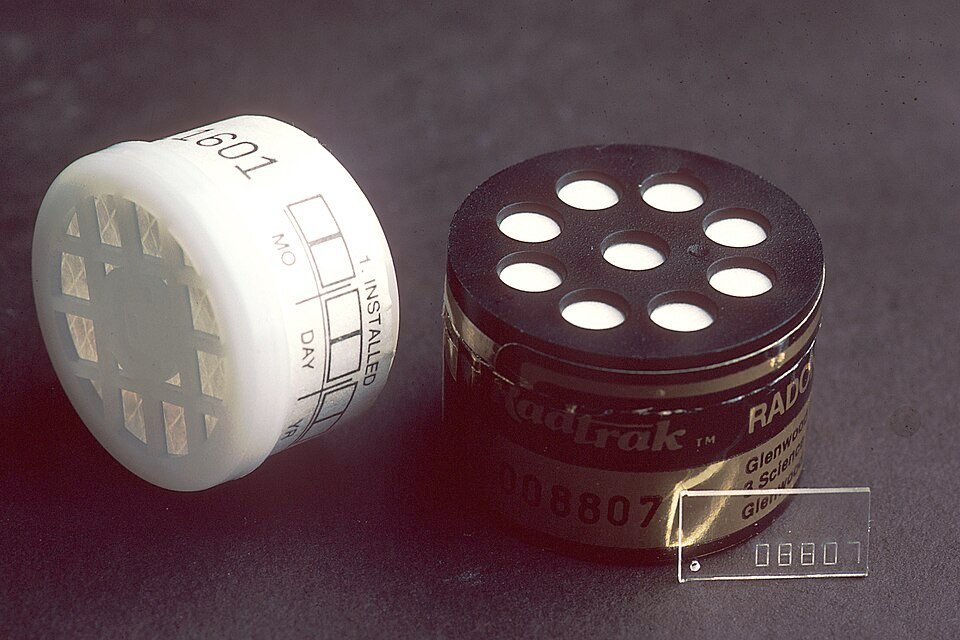
Radon test kit (context for verification culture)
11) How to get accurate quotes (scope checklist + what photos to send)
Accurate quotes come from good inputs. Installers’ price uncertainty. Reduce uncertainty, reduce surprises.
Send a tight scope and clear photos: room plan, doorway count, subfloor type, existing floor type, and any known moisture/levelling history. Ask the installer to confirm waste%, prep assumptions, and VAT basis. The goal is to compare quotes on the same build-up, not just a €/m² line.
Scope checklist (copy/paste to email)
- Address + county (Dublin city centre vs commuter belt vs regional matters for access and travel).
- Total area per room (m²) + rough sketch with dimensions.
- Doorways per room + whether doors need trimming.
- Subfloor type: concrete slab/screed / suspended timber.
- Existing floor type: carpet, tiles, laminate, glued timber, etc.
- Any known issues: damp patches, previous lifting, unevenness, squeaks.
- Product choice + fixing method (click vs glue-down).
- Finish details: borders, thresholds, skirting plan.
- Who moves furniture and appliances?
- Waste% to be used, and who owns leftover packs.
Photos to send
- Wide shot of each room.
- Close-up of subfloor at a removed vent/threshold, if possible.
- Door thresholds and fireplaces/bays.
- Any cracks, dips, or staining.
- Access: stairs, parking, lifts (apartment blocks matter).
12) Common mistakes & failure modes (gapping, tenting, adhesive failure, poor levelling)
Herringbone failures are usually boring. They’re not “mystery defects”. They’re moisture, flatness, movement, or bad detailing.
Most failures come from skipping prep: laying over a damp slab, ignoring flatness, or rushing acclimatisation. Herringbone then amplifies the error, gaps show as repeating patterns, adhesive failures spread, and movement concentrates at weak points like doorways and islands. Preventing failure is cheaper than repairing it.
What I watch for:
- Gapping: seasonal movement, wrong acclimatisation, site RH swings.
- Tenting/lipping: insufficient expansion gaps or uneven substrate.
- Adhesive failure: moisture too high, wrong primer/DPM system, poor troweling, missed rolling.
- Creaks on timber: subfloor movement not fixed before installation.
- Border failure: weak cuts, rushed layout, no proper locking detail.
Moisture discipline is central. The Concrete Society notes RH testing as preferred for assessing slab readiness and warns against relying on resistance meters alone. (Concrete Society)
13) FAQ (8–12 Qs)
1) What is the typical waste percentage for herringbone in Ireland?
The rule of thumb is 15–20% for many rooms. Use 20–25% for small rooms, hallways, lots of doorways, and border work. Confirm with your installer’s set-out plan and your product format.
2) How much extra herringbone flooring should I buy in Ireland?
Use the waste table in Section 4. If you’re unsure, buy the higher waste figure and keep a spare box. Matching later can be difficult.
3) Why is herringbone labour more expensive per m²?
Because of the set-out, constant checking, slower fitting, more cuts, and more finishing work around edges and doorways. Glue-down systems also add technical adhesive steps.
4) Does a bigger room reduce herringbone installation cost?
Usually yes. Fixed setup time gets spread over more m², so €/m² tends to fall, unless complexity (islands, borders, glazing transitions) pushes it back up.
5) Do I need levelling compound for herringbone?
Often yes, especially for glue-down engineered wood or glue-down LVT. Flatness standards are commonly discussed using SR classes (e.g., SR1 3 mm under 2 m straightedge as guidance), but your manufacturer’s tolerance is the real rule. (Concrete Society)
6) What moisture level is “safe” before installing herringbone?
Manufacturers set the limit. Industry guidance commonly references RH testing methods and typical thresholds (often ~75% RH for many coverings, lower for timber), but you must follow your specific flooring and adhesive system requirements. (cfa.org.uk)
7) Is glue-down herringbone better than click?
Glue-down can feel more solid and quieter, but it demands better flatness and moisture control. Click can be faster and more forgiving, but underlay and acoustics matter, especially in apartments.
8) How does VAT work on supply and fit in Ireland?
Ireland’s standard rate is 23% and the reduced rate 13.5% (current rates). Construction services can qualify for a reduced rate, but Revenue’s two-thirds rule can affect the rate depending on the goods-to-service cost split. Always ask what VAT rate is applied and why. (Revenue)
9) What should be included in a proper herringbone quote?
Waste%, set-out, adhesive/primer/DPM system, levelling scope, removal/disposal, trims/thresholds, door trimming, protection, and VAT basis.
10) How do I compare quotes from Dublin vs elsewhere?
Ask each installer to list assumptions and exclusions. Dublin quotes often include higher labour and access costs; regional quotes may add travel. Compare on identical scope, not headline €/m².
14) Conclusion: How to budget safely (and when to walk away from a cheap quote)
Herringbone is a luxury finish with engineering constraints. Budget safely by pricing waste + complexity + prep + VAT clarity, not just boards and labour. In Dublin, you’ll often pay more for access and labour; in Cork, Galway, Limerick, Waterford, and beyond, travel and scheduling can move the quote. The best quote is the one that states assumptions clearly and has a moisture/flatness plan.
Walk away from a cheap quote when:
- There’s no mention of flatness, moisture testing, or prep allowances.
- Waste% is suspiciously low for a small or awkward room.
- VAT is unclear or “we’ll sort it later”.
- The installer can’t explain their set-out method in plain language.
How this was researched
I built this guide from an estimator/installer viewpoint: breaking herringbone jobs into order quantities (waste), labour time (setup vs laying), and subfloor risk (flatness and moisture). For VAT and building guidance, I referenced Irish primary sources (Revenue.ie, Gov.ie, EPA). For flatness and moisture testing context, I used reputable industry guidance that discusses common standards and test methods, while noting that manufacturers’ requirements still govern your specific installation.
Short author bio (installer/estimator perspective)
I’m writing as a flooring estimator + installation specialist mindset: the person who measures rooms, predicts waste, worries about slabs, and knows that a “perfect” herringbone is mostly invisible prep. My bias is toward jobs that last, because failures cost more than doing it right once.
Sources list
- Revenue.ie: Current VAT rates (standard 23%, reduced 13.5%) (Revenue)
- Revenue.ie: Two-thirds rule guidance (Revenue)
- Revenue.ie: Construction services (includes flooring) (Revenue)
- Revenue.ie: Fixtures and fittings VAT treatment (subject to two-thirds rule) (Revenue)
- Gov.ie: Technical Guidance Document C update (moisture/radon context) (gov.ie)
- EPA Ireland: Builders/radon prevention (membrane + standby sump context) (EPA Ireland)
- Concrete Society: Moisture in new concrete floors (RH testing emphasis; meter limitations) (Concrete Society)
- Concrete Society: Surface regularity classes SR1/SR2/SR3 (flatness context) (Concrete Society)
- CFA: Guidance note on moisture measurement (in-situ probe method context) (cfa.org.uk)