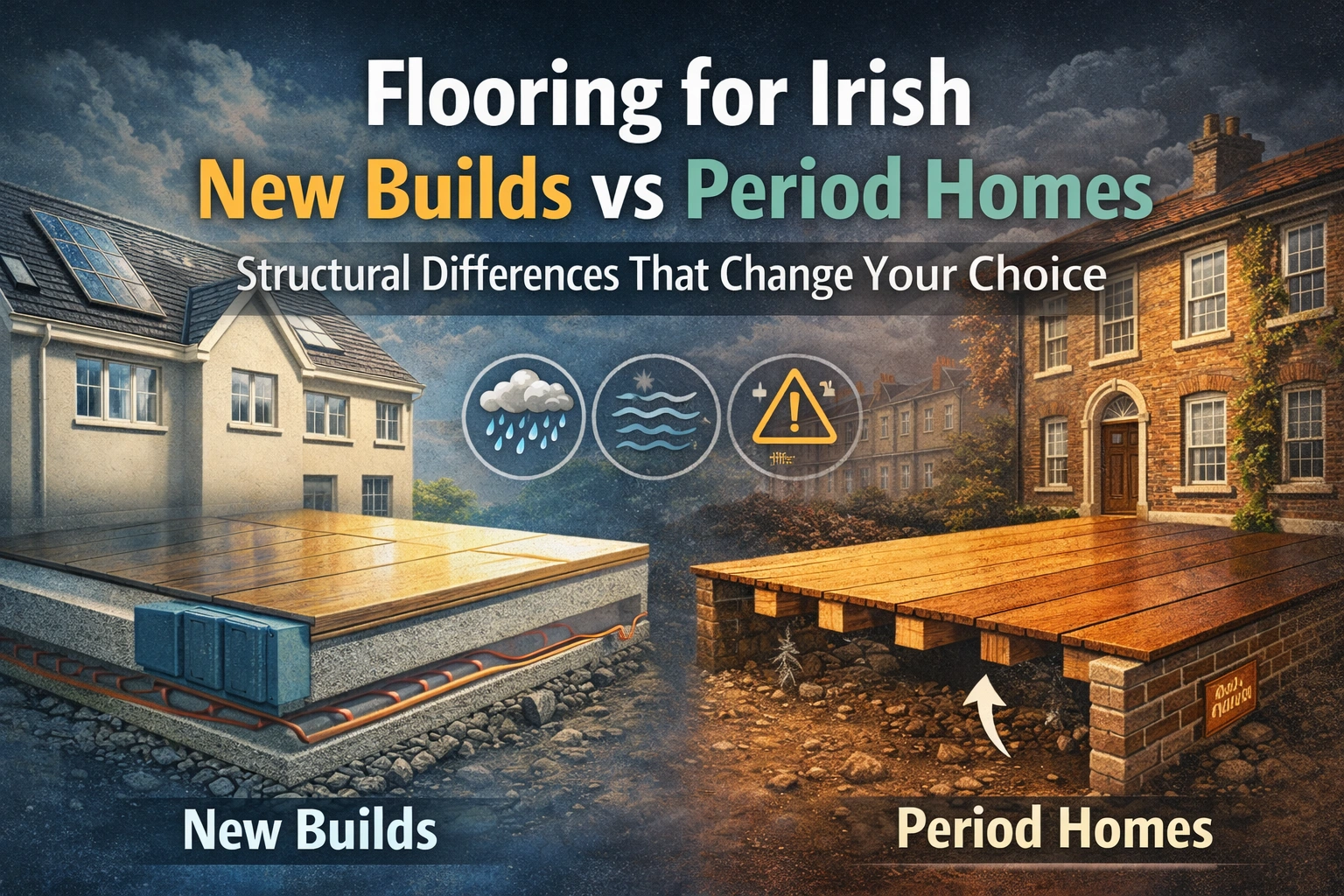
Introduction: why flooring fails in Ireland (and how to avoid it)
Choosing flooring in Ireland is not the same as choosing flooring in mainland Europe or the UK. Ireland’s persistent humidity, frequent rainfall, mild temperatures, salt air along the coast, and diverse housing stock create conditions where the wrong flooring choice can fail within months.
Many homeowners only discover this after seeing swollen laminate, cupped wood, lifting tiles, or a musty smell that never goes away. These problems are rarely about “bad products.” They are usually about climate mismatch.
This guide introduces the Irish Climate Flooring Map (2026), a practical, zone-based way to choose flooring that works with Irish conditions, not against them. It is written for homeowners, landlords, renovators, and small builders who want long-term performance, not short-term savings.
In Ireland, the best flooring depends on local climate exposure, subfloor type, and humidity risk. Coastal and high-humidity areas perform best with moisture-stable options like LVP/LVT or porcelain tile, while rural and older homes require flooring that tolerates uneven subfloors and limited ventilation. Solid wood and standard laminate often fail in damp or coastal zones unless conditions are tightly controlled.
Table of contents
- The Irish Climate Flooring Map (2026): how it works
- Understanding Ireland’s real flooring risks
- Climate Zones A–D explained
- County-by-county quick guide
- Flooring types: what works, what fails, and why
- Subfloors in Irish homes: concrete vs suspended timber
- Underfloor heating in Ireland: flooring compatibility
- Common Irish flooring failure modes (and prevention)
- Room-by-room recommendations
- What Irish installers see most often
- Buyer checklist & questions to ask installers
- Myth vs reality
- Frequently asked questions (FAQ)
- Key takeaways
1. The Irish Climate Flooring Map (2026): how it works
Instead of dividing Ireland by simple geography, the Irish Climate Flooring Map divides the country into four practical flooring risk zones based on what actually damages floors:
- Humidity persistence
- Wind-driven rain
- Salt air exposure
- Subfloor type
- Ventilation quality
- Heating patterns
| Zone | Description | Main risk |
|---|---|---|
| Zone A | High coastal exposure | Salt air + moisture |
| Zone B | High rainfall & humidity | Persistent damp |
| Zone C | Rural & older housing | Ventilation + subfloors |
| Zone D | Urban & newer builds | Trapped moisture |
These zones often overlap. A rural cottage near the Atlantic may sit in Zone A + C, which changes the flooring decision entirely.
2. Understanding Ireland’s real flooring risks
Humidity is the silent killer
Ireland rarely has extreme heat or cold, but it has constantly elevated relative humidity. Floors don’t dry out quickly, especially in winter.
Wind-driven rain
On the west and south coasts, rain doesn’t just fall — it travels horizontally, entering thresholds, walls, and poorly sealed slabs.
Salt air (coastal homes)
Salt accelerates material breakdown, affects adhesives, and increases condensation risk on cooler surfaces.
Housing stock diversity
- Older homes: suspended timber floors, uneven subfloors
- 70s–90s builds: limited insulation, mixed subfloors
- New builds: airtight, sometimes too airtight without proper ventilation
Each responds differently to flooring materials.
Humidity zones (average %)
- Coastal: 93.5%
- Inland: 98%
| City | Region type | Humidity (%) |
|---|---|---|
| Dublin (Coastal) | Coastal | 83% |
| Cork (Coastal) | Coastal | 97% |
| Galway (Coastal) | Coastal | 95% |
| Limerick (Near Coast) | Coastal | 99% |
| Athlone (Inland) | Inland | 98% |
| Tullamore (Inland) | Inland | 96% |
| Kilkenny (Inland) | Inland | 99% |
| Portlaoise (Inland) | Inland | 99% |
3. Climate Zones A–D explained
Zone A: Coastal exposure
Counties: Donegal, Mayo, Galway, Clare, Kerry, Cork (coast), Waterford (coast), Wexford (coast), Louth (coast)
Risks
- Salt air
- High external moisture
- Wind-driven rain
- Condensation near doors and windows
Best flooring
- LVP / LVT (glue-down preferred)
- Porcelain tile
- Polished concrete (with proper sealing)
Avoid
- Solid wood
- Standard laminate
- Untreated cork
Zone B: High humidity & rainfall
Areas: Connemara, West Midlands, upland regions
Risks
- Floors never fully dry
- Mould under impermeable coverings
- Adhesive failure
Best flooring
- LVT
- Tile
- Engineered wood (carefully specified)
Zone C: Rural & older homes
Typical features
- Suspended timber floors
- Limited underfloor ventilation
- Solid fuel heating
- Mud, grit, pets, boots
Best flooring
- LVP
- Engineered wood with tolerance
- Carpet with breathable underlay (in bedrooms)
Zone D: Urban & newer builds
Cities: Dublin, Cork, Limerick, Galway, Waterford
Risks
- Trapped moisture
- Poor ventilation habits
- UFH interactions
Best flooring
- LVT
- Engineered wood (UFH-rated)
- Tile
4. County-by-county quick guide (condensed)
- Donegal: Zone A/B → LVT, tile
- Galway (coast): Zone A → avoid laminate
- Galway (city): Zone D → LVT, engineered wood
- Mayo: Zone A/B → moisture-stable only
- Dublin: Zone D → UFH-compatible flooring
- Cork (city): Zone D
- Cork (west coast): Zone A
- Kilkenny: Zone B/C → engineered wood or LVT
5. Flooring types: what works, what fails, and why
Luxury Vinyl Plank / Tile (LVP/LVT)
Why it works in Ireland
- Dimensionally stable
- Moisture resistant
- Handles temperature swings
Best for
- Coastal homes
- Kitchens
- Rentals
- High traffic
Watch out
- Cheap click systems
- Poor subfloor prep
Laminate (standard & “water-resistant”)
Reality check
- Core is still compressed fibre
- Swells from edges and joints
Best for
- Dry, well-heated urban rooms only
Avoid
- Coastal areas
- Utility rooms
- Older homes
Engineered wood
Why it can work
- Cross-layered stability
- Better than solid wood
Best for
- Living rooms
- Bedrooms
- UFH (if rated)
Avoid
- Poorly ventilated cottages
- Direct coastal exposure without controls
Solid wood
High risk in Ireland
- Expands and contracts
- Sensitive to humidity
Use only if
- Indoor humidity is controlled year-round
- Proper acclimation and installation
Tile & porcelain
Extremely stable
- Immune to humidity
- Long lifespan
Consider
- Cold underfoot
- Requires sound subfloor
Carpet
Often misunderstood
- Can work well in dry bedrooms
- Underlay choice is critical
Avoid
- Damp ground floors
- Utility rooms
Cork & linoleum
Mixed results
- Sustainable
- Sensitive to moisture
Use cautiously
- Only in dry, controlled environments
6. Subfloors in Irish homes: concrete vs suspended timber
Concrete slabs
- Can hold moisture for years
- Requires testing before installation
Suspended timber
- Needs airflow
- Traps moisture if sealed incorrectly
Key rule: Flooring never fixes a damp subfloor; it hides it until failure.
7. Underfloor heating in Ireland
| Flooring | UFH compatibility |
|---|---|
| LVT | Excellent |
| Tile | Excellent |
| Engineered wood | Good (rated only) |
| Laminate | Limited |
| Solid wood | Poor |
UFH dries floors unevenly. Materials must tolerate cycling.
8. Common Irish flooring failure modes
| Problem | Cause |
|---|---|
| Swelling | Moisture ingress |
| Cupping | Humidity imbalance |
| Lifting | Adhesive breakdown |
| Mould smell | Trapped moisture |
9. Room-by-room recommendations
Kitchen
- LVT or tile
- Avoid laminate in coastal/rural homes
Hallway
- LVT with a heavy wear layer
Living room
- Engineered wood or LVT
Bedroom
- Engineered wood or carpet (dry homes)
Bathroom
- Tile only
Utility room
- Tile or LVT only
10. What Irish installers see most often
- Laminate beside leaky patio doors
- Solid wood over damp slabs
- No expansion gaps
- Sealed floors over unventilated timber
11. Buyer checklist & installer questions
Ask before buying
- What zone is my house in?
- What is my subfloor?
- Has moisture been tested?
- Is this UFH compatible?
- What happens if humidity rises?
12. Myth vs reality
- Myth: “Water-resistant laminate is waterproof.”
Reality: It still swells. - Myth: “Concrete is always dry.”
Reality: Often the opposite.
13. Frequently asked questions (FAQ)
Is laminate a bad idea near the Irish coast?
Yes. Salt air and humidity make swelling likely.
What flooring is best for a damp cottage?
LVT or tile with proper subfloor preparation.
Can engineered wood work in Ireland?
Yes, in controlled environments.
Is vinyl bad for sustainability?
Modern LVT lasts longer, reducing waste.
Do I need a vapour barrier?
Often yes, especially on concrete slabs.
14. Key takeaways
- Ireland’s climate requires moisture-aware flooring
- Zone-based decisions outperform generic advice
- LVT is the safest all-round option
- Solid wood and laminate need strict conditions
- Subfloor and ventilation matter more than brand