Skip to content
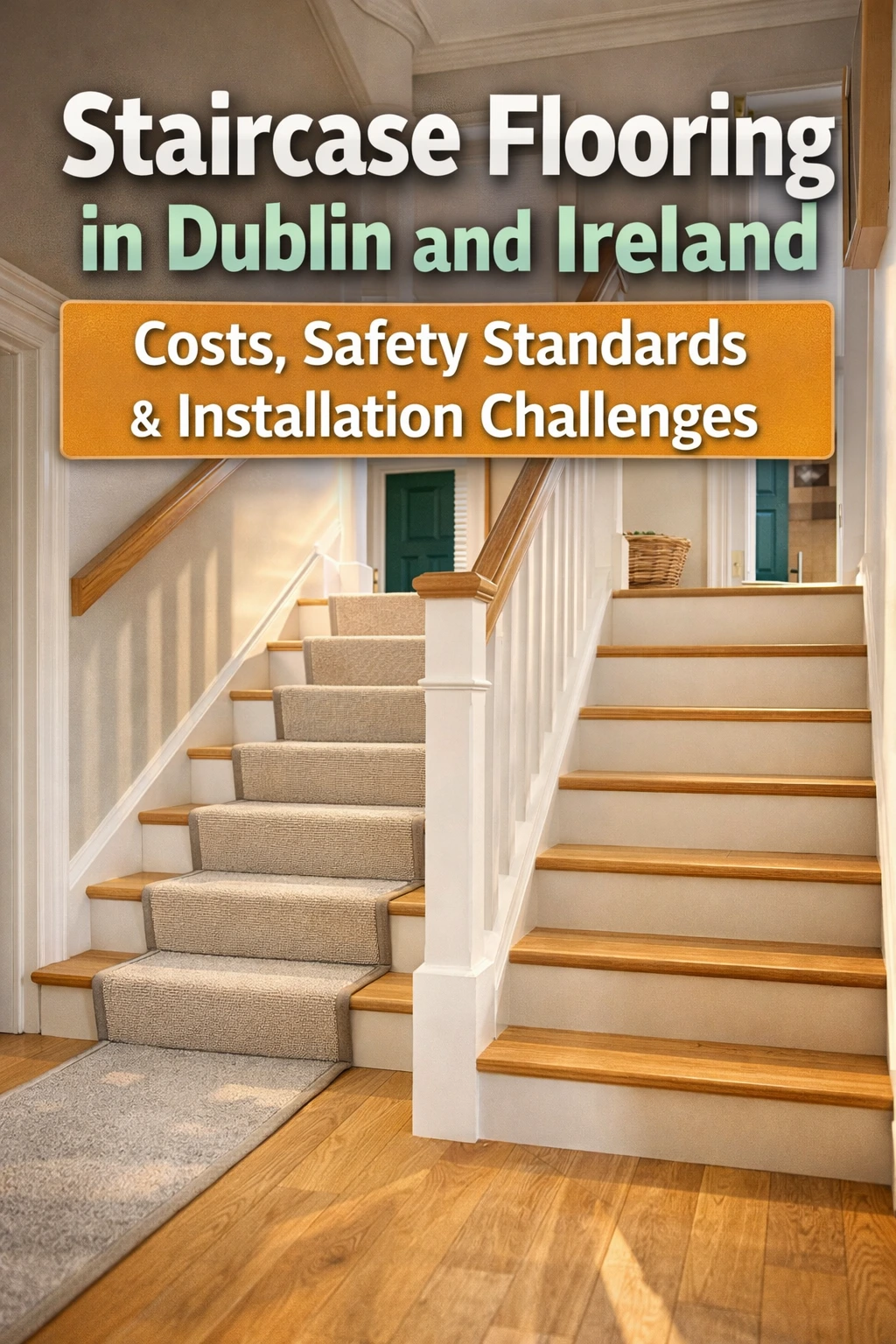
Choosing staircase flooring in Dublin and across Ireland is not just a style decision. It affects safety, noise, durability, cleaning, and cost, especially in older homes, rentals, apartments, and busy family houses where stairs take harder punishment than almost any flat floor.
What is the best flooring for stairs in Dublin and Ireland?
For most Irish homes, carpet is still the safest and most forgiving all-round option for stairs, especially where children, older residents, pets, noise, or rental wear are part of the picture. LVT can be an excellent practical option when detailed properly with the right nosings and a stable substrate. Engineered wood gives the best premium look, but only when the staircase is structurally sound and the fitting is done with real care.
How much does staircase flooring cost in Ireland?
A straightforward carpeted staircase can start in the low hundreds, while a bespoke runner, LVT stair refit, or engineered wood staircase can move into four figures quickly. Stairs are priced more like joinery and detailing work than ordinary room flooring, so per-step labour, nosings, prep, repairs, and awkward geometry usually matter more than square metres.
Table of contents
Use the quick links below to jump to the section that matches your staircase, budget, safety concerns, or flooring preference.
Why staircase flooring needs a different approach than room flooring
A staircase is a moving route, not a static surface. On a room floor, you can get away with a product that looks good and wears reasonably well. On stairs, every edge matters. Every nose matters. Every small movement in the structure gets exposed. The wrong finish can turn a perfectly decent-looking staircase into a noisy, slippery, scuffed little chaos machine.
That is why stair work often fails in places where the room flooring seems fine. A laminate plank that behaves itself in a bedroom can chip at the stair edge. A glossy timber finish that looks rich in a living room can feel too slick on descent. A loose runner can become a trip point. A hard finish over a creaking timber stair can amplify noise rather than solve anything.
In practical terms, stairs demand better detailing, more accurate measuring, more cutting, tighter edge work, and a stronger safety mindset than flat floors.
Why Dublin and Irish homes make stairs trickier
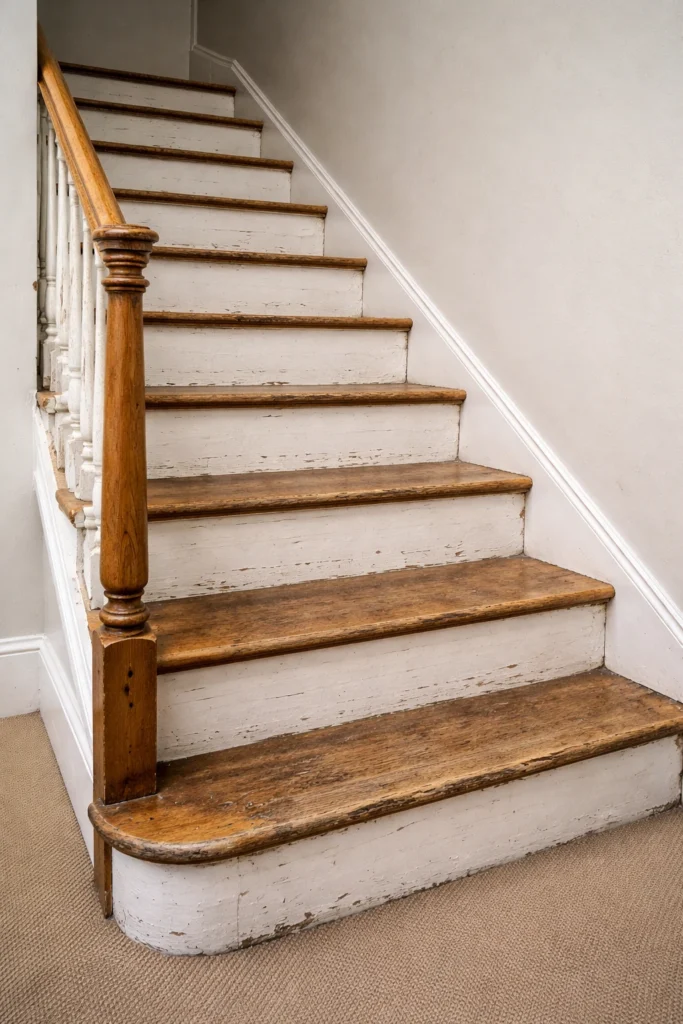
Irish staircase jobs are rarely textbook neat. In older Dublin terraces, you often find softwood stairs that have been painted three times, patched twice, and squeaked for fifteen years. In suburban semis and duplexes, the stairs may be structurally sound, but the geometry is not always perfect. In apartments, access restrictions, parking, management rules, and acoustic complaints all creep into the job before the first tread is touched.
Irish weather adds its own lovely bit of mischief. Wet shoes, grit, fine dirt, and winter moisture all hit the lower flights hard. Hallways and the first few treads usually wear first. Landings also catch a lot more traffic than homeowners expect, especially where the stair links entrance hall, family bedrooms, and attic conversion.
That is why Dublin and Ireland-wide stair renovations need more than a product brochure. They need the staircase itself assessed honestly: how stable it is, how square it is, how the existing edges are wearing, whether it is safe already, and whether the new finish will make daily life better or just more expensive.
Common staircase types in Dublin and Ireland
Not every stair takes the flooring the same way. The main layouts FBS Flooring would assess differently are these:
Closed straight stairs are usually the easiest to refit and price.
Quarter-turn stairs with winders look normal enough until you start templating each tread.
Open-sided stairs need cleaner edge finishing because the cut lines remain visible.
Bullnose first steps can add disproportionate labour.
Attic conversion stairs often involve tighter geometry and awkward junctions.
Apartment and duplex stairs may bring acoustic and management issues.
Open riser stairs look sharp, but they are far less forgiving from a safety and detailing point of view.
The type of staircase often matters more than the material. A mid-range carpet on a difficult stair can be the smarter choice than forcing premium wood onto a structure that does not want it.
Best stair flooring materials at a glance
For Irish readers comparing options quickly, this is the useful truth: there is no universal best stair finish. There is only the best fit for your style, budget, household, and tolerance for maintenance.
| Flooring type | Best for | Safety feel | Noise control | Fitting difficulty | Indicative supply and fit range |
|---|---|---|---|---|---|
| Full carpet | Families, rentals, older users, colder homes | High | High | Medium | Lower to mid range |
| Stair runner | Style-led family homes, period properties | Medium to high | Medium | Medium to high | Mid range |
| Laminate | Budget-led matching projects | Medium to low if poorly detailed | Low | High | Mid range |
| Engineered wood | Premium renovations, stable stairs | Medium | Low | High | Mid to high |
| Solid wood | Joinery-led premium work | Medium | Low | Very high | High |
| LVT / SPC | Practical homes, pet owners, easy-clean preference | Medium to high with correct detailing | Medium | High | Mid to high |
| Safety vinyl / anti-slip systems | Commercial, care, shared-use, heavy safety focus | High | Medium | Medium to high | Mid to high |
Indicative market references support the basic price ladder behind that table: Irish retail examples place laminate installation on flat floors around €10 to €20 per m², LVT products commonly around the high €20s per m² in retail listings, quality carpets around the mid €40s to low €50s per m² in one Irish example, and stair nosings from roughly the high €20s ex VAT upward depending on type. Stair packages and runners are then layered on top with bespoke labour, prep, and detailing.
Carpet on stairs: where it still wins
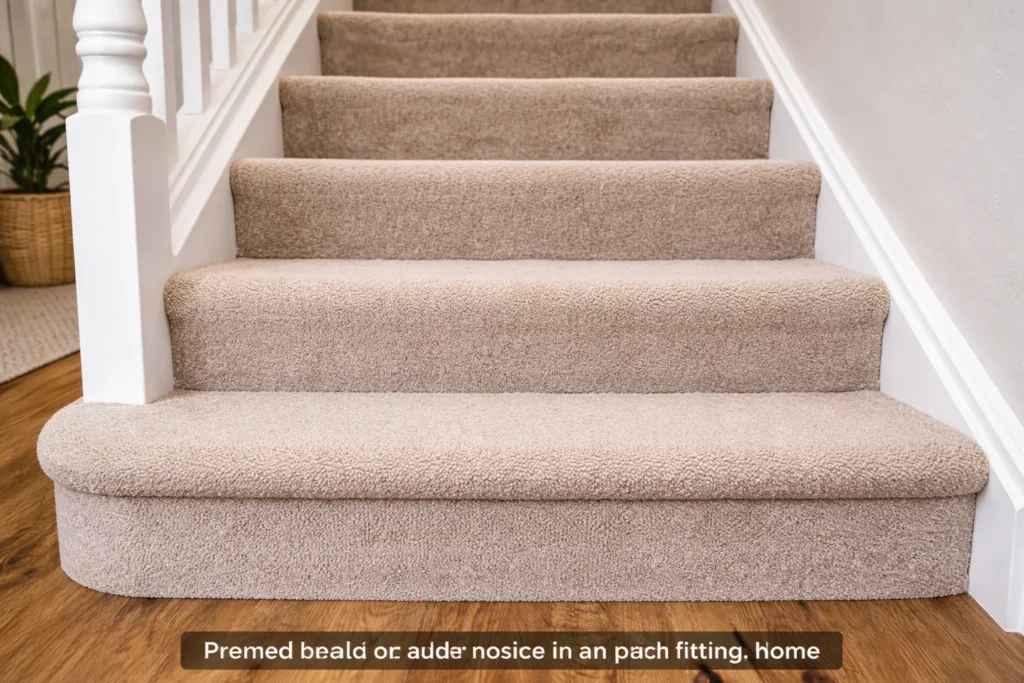
Carpet remains hard to beat on stairs where safety, grip, comfort, and noise matter more than sharp visual minimalism. In real Irish homes, that includes family semis, rental stock, duplexes, and houses with older residents.
A good stair carpet is forgiving. It softens footfall, reduces impact noise, feels warmer in winter, and is more tolerant of minor imperfections in the staircase beneath. It also hides small inconsistencies better than hard finishes. That matters in older timber stairs where one tread sits slightly proud, one riser leans a touch, and the whole thing has a bit of historical personality.
The catch is wear. Cheap carpet at the front edge of each tread can crush early. Poor fitting around the nosing looks tired fast. Light colours near the entrance flight can show Irish weather in all its muddy honesty. For busy homes, bleach-cleanable or harder-wearing ranges often make more sense than chasing a delicate luxury look.
Stair runners: style, safety, and maintenance realities
Stair runners are popular for good reason. They keep some of the softness and noise control of carpet while letting painted or timber edges frame the stairs. In period homes and hallway renovations, they can look fantastic.
But runners are not a shortcut product. They require proper alignment, accurate edge finishing, and careful thought about width, border exposure, and wear pattern. A runner that is too narrow can make the stairs feel visually mean. One that is fitted carelessly can look off-centre in the hall. One that is chosen for pattern before durability can look tired long before the rest of the house does.
For Irish buyers, runners work best when the staircase itself is worth showing off, and the household will maintain it. They are often less ideal in hard-working rentals, high-turnover lets, or homes with constant wet foot traffic from outside.
Laminate on stairs: when it works and when it becomes a mess
Laminate on stairs tempts people because they want visual continuity with upstairs flooring and the room product looks affordable. That logic is understandable. It is also where plenty of stair jobs go wrong.
Laminate can work on stairs in the right system, but it is not forgiving. Poor edge treatment, wrong profiles, movement in the substrate, cheap trims, and bad planning around the nosing can leave you with chipping, drumming, visible joins, and a finish that feels harder and slicker than expected. On a straight, closed, well-prepared stair, it can be serviceable. On a creaky old timber staircase with uneven treads, it can become a small maintenance opera.
Flat-floor laminate labour in Irish references sits around €10 to €12 per m² in one source and €10 to €20 per m² in another, with trims and accessories often adding another 5% to 10% on top. That sounds modest until you remember that stairs are not priced like flat floors at all. The minute you add shaped treads, profile work, and individual tread templating, the economics change sharply.
Engineered wood on stairs: premium look, higher fitting demands
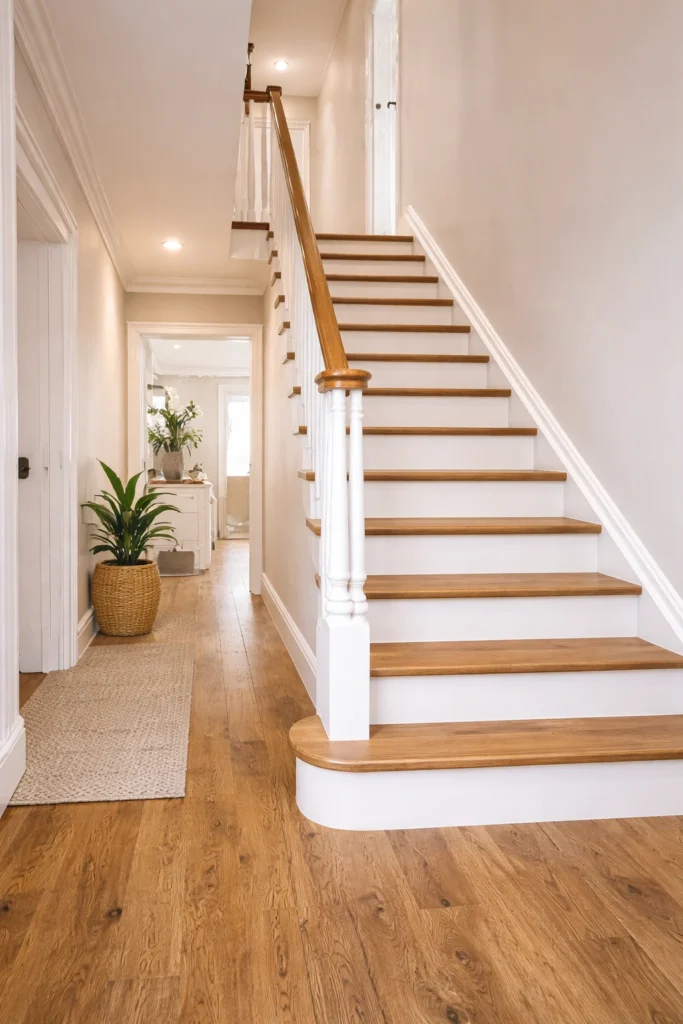
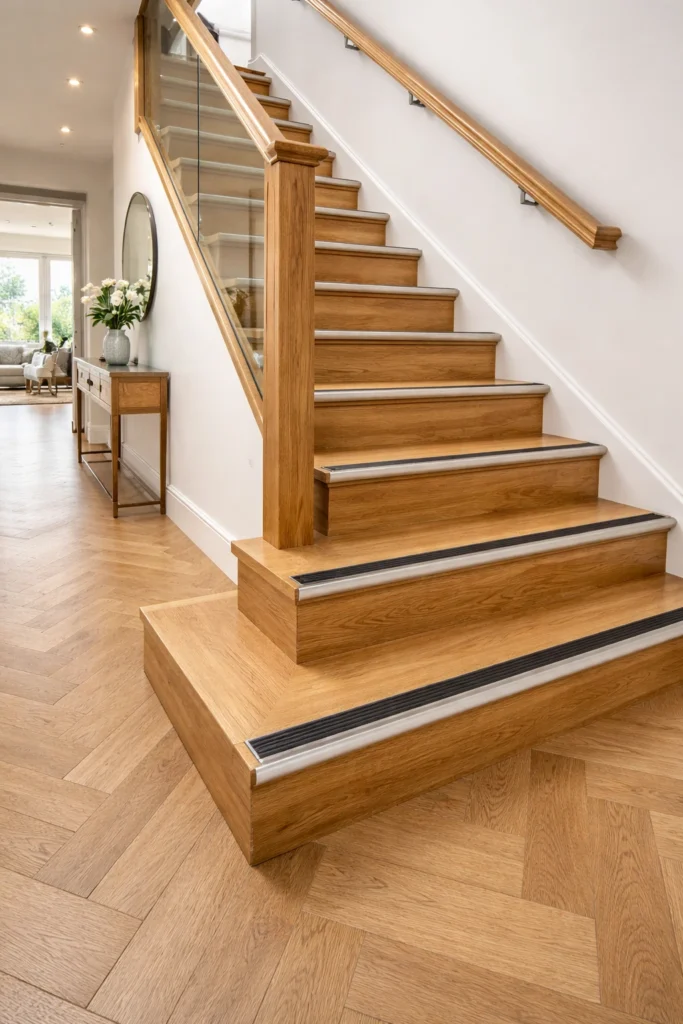
Engineered wood stairs can look superb. Done properly, they bring warmth, depth, and a stronger architectural finish than laminate. They also pair more naturally with engineered wood upstairs, which matters if you want the stairs and landing to feel like one deliberate scheme rather than a compromise.
They are not an easy fit. Stair work in engineered wood demands sound substrate preparation, tight edge accuracy, proper nosing detail, and sensible finish selection. A very smooth or glossy finish can look expensive and still feel wrong under real household use. Matt or brushed finishes usually make more practical sense.
This option suits homeowners who want a high-end result and understand that the stair needs to behave like a bespoke item, not a quick flooring add-on. Irish retail price points for engineered wood commonly land well above laminate and standard click LVT, often moving from the €50s per m² upward and frequently into the €80 to €90 per m² range for stronger premium options.
Solid wood stairs: beauty, cost, and movement risk
Solid wood is the romantic answer. It is also the answer that should come with a grown-up budget and a strong awareness of timber movement, finishing, and long-term maintenance.
In some projects, solid wood is absolutely right, especially where the staircase is being rebuilt, overclad properly, or treated as joinery rather than just flooring. In many normal residential refurbishments, though, engineered wood gives a similar visual effect with fewer movement headaches.
Irish retail solid wood pricing can range widely, from more moderate entry points into premium territory. The important point is not just the material cost. It is that solid wood stair work often pushes the job closer to joiner territory than ordinary flooring fitting. That changes labour expectations fast.
LVT or SPC on stairs: practicality, slip resistance, and detailing issues
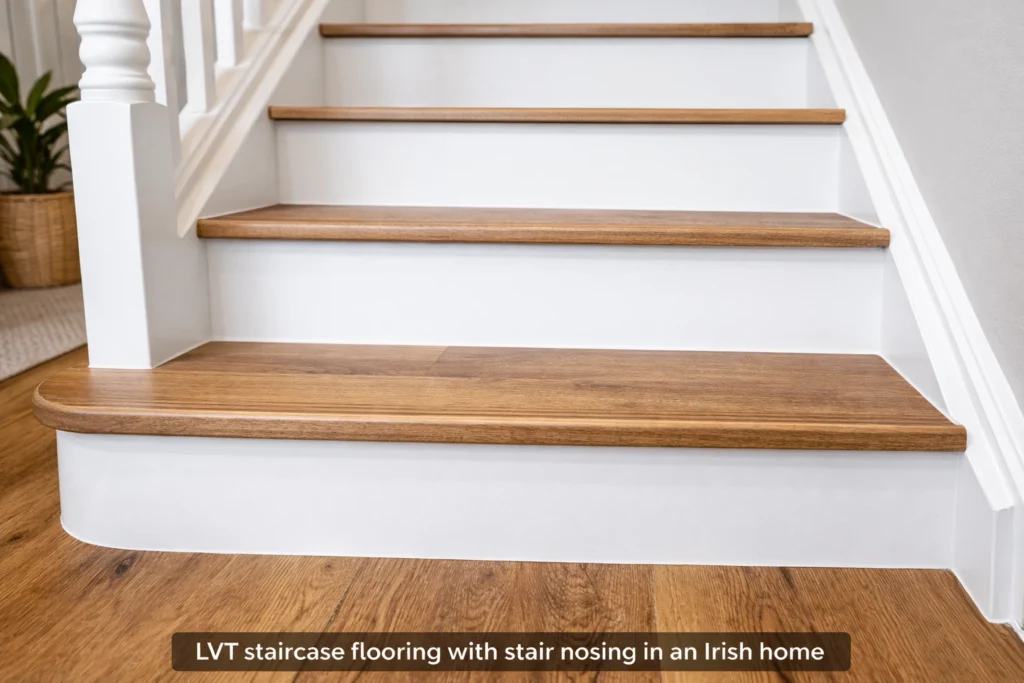
LVT has become a very strong stair option for many Irish homes because it hits the practical middle ground. It is easier to clean than carpet, usually more forgiving underfoot than laminate, and better with day-to-day mess than natural wood. For households with pets, children, frequent guests, or muddy shoes, that matters.
Still, the stair detail decides everything. Some stair jobs fail because people assume a room-floor click product can simply be wrapped onto stairs. Not so fast, tiny flooring goblin. Nosings, edge reinforcement, adhesive method, substrate stability, and tread profile all matter. A badly planned LVT stair can peel at edges, telegraph imperfections, or look patchy where the profiles do not suit the stair shape.
Retail LVT examples in Ireland commonly sit around the high €20s per m² for mainstream rigid vinyl products, rising higher for premium designs. That does not tell the full stair story, but it explains why many homeowners see LVT as a sensible value before bespoke stair labour enters the picture.
Vinyl safety flooring or specialist anti-slip options for commercial or care settings
Where safety and cleaning control outweigh domestic aesthetics, specialist safety vinyl and anti-slip systems deserve serious attention. This is especially relevant in care environments, some rental or multi-user settings, back-of-house stairs, and small commercial properties.
The look is more functional, but the performance logic is strong. If the main risk is slips, contamination, aggressive wear, or difficult maintenance, a true safety-led specification is often more honest than trying to dress a hard-working stair in a fashionable domestic finish.
This category also tends to depend heavily on correct nosings and proper substrate preparation. It is not a “stick something practical on it” category. It needs a proper specification mindset.
Stair nosings, edge profiles, trims, and transitions
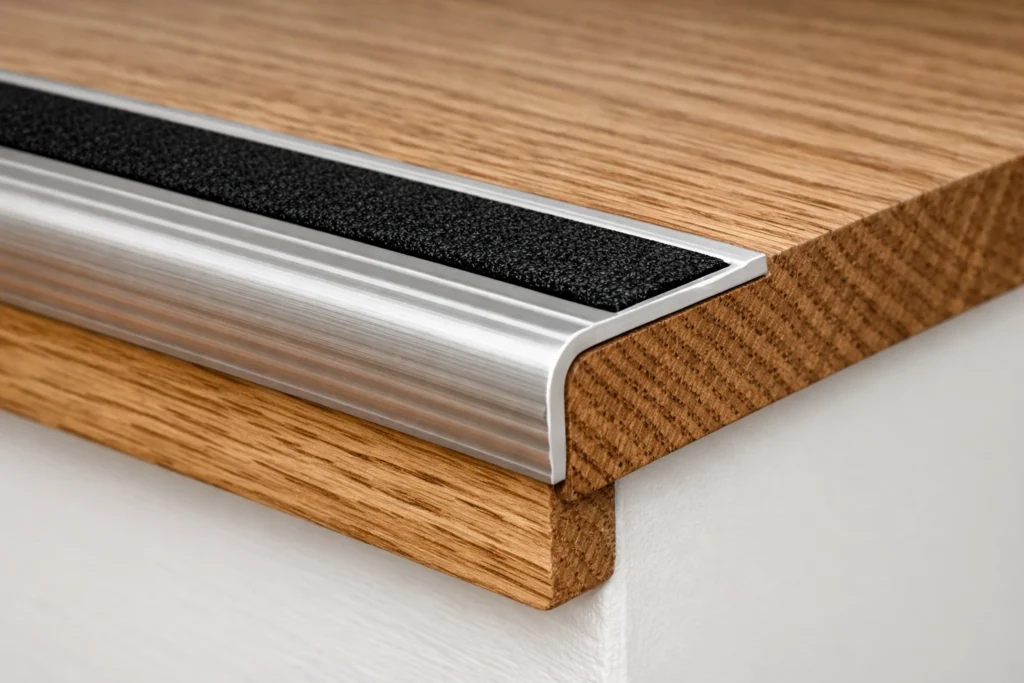
If there is one part of staircase flooring people underestimate, it is the nosing. On stairs, the front edge is the punishment zone. It takes impact, catches grit, suffers wear, and plays a major role in both safety perception and actual underfoot confidence.
Nosings do several jobs. They protect the step edge. They can help define the edge visually. They help some flooring systems transition safely over the front of the tread. In commercial and safety-led settings, they become even more important. Irish supplier references openly frame stair nosings as products tied to safety and building-regulation compliance, and show pricing that starts around the high €20s ex VAT for some specialist options.
A common Irish stair failure is using the wrong profile for the material or trying to hide a poor edge with a cheap trim. That nearly always looks worse over time, not better.
Slip resistance, underfoot feel, and household safety
The safest stair is not necessarily the one with the most expensive finish. It is the one that gives secure footing, clear edge recognition, stable hand support, and predictable behaviour day after day.
That means glossy surfaces need caution. It means the front edge of the tread matters hugely. It means wet shoes, dust, worn carpet edges, loose transitions, and poor visibility can all increase risk. It also means comfort underfoot matters more than many buyers admit. Some people feel far more secure descending carpeted stairs than hard-surface stairs, even if both are technically sound.
HSA guidance for safer stairs stresses that slippery steps are often worst at the step edge or nosing, that adequate slip resistance is essential, and that contrasting materials at the step edge and handrail can provide an effective visual safety trigger. It also warns that descending stairs is associated with many accidents and that slips are more common than trips on stairs in work settings.
Irish safety standards, access guidance, and what homeowners should ask installers
This is the part where vague sales talk should stop and practical questions should begin.
In Ireland, the core stair guidance sits in Technical Guidance Document K, while access-related guidance sits in the current edition of Technical Guidance Document M. The government’s Technical Guidance Documents are published as practical ways of showing compliance, but responsibility for compliance still sits with designers, builders, and owners.
For private stairs, TGD K guidance includes a consistent rise and going, a typical clear width of at least 800 mm, generally 2 m headroom, and no more than 16 risers in one flight. It also addresses open risers and guarding. TGD M is stricter again where stepped access routes are intended to be suitable for ambulant disabled people: it calls for permanently contrasting continuous nosing material on the tread, avoidance of projecting or overhanging step nosings, consistent rise and going, a rise between 150 mm and 180 mm, a going of at least 300 mm, and continuous handrails on each side in relevant cases.
The practical homeowner question is not “Will my flooring look nice?” It is “Will this new finish change the tread profile, nosing feel, edge visibility, or grip in a way that makes the stair better or worse to use?” That is the adult question. That is the one worth paying for.
Fire, escape route, and multi-occupancy considerations where relevant
In a standard private dwelling, most stair-flooring decisions are mainly about safety, usability, and durability. But once you step into apartments, shared buildings, mixed-use properties, or some landlord situations, the conversation gets bigger.
If the stair is part of a common route, managed block, or workplace-related escape route, do not treat it like a decorative domestic staircase. HSA emergency guidance says escape routes should be kept clear, should generally be at least one metre wide, and should lead to a place of safety. In other words, coverings, trims, storage habits, and poor edge detailing can all become part of a wider safety problem.
For apartment common areas and non-domestic settings, product fire performance, management approval, and route function may all need checking before a finish is selected. That is one of those points where a professional site survey saves trouble.
Sound and acoustics on stairs, especially in duplexes, rentals, and apartments
Noise is where many beautiful, hard stair finishes lose friends. Timber stairs already move more than concrete. Add a hard surface finish over a lively structure, and you can end up with sharp impact noise, hollow sound, and a stair that announces every journey to the whole household.
Carpet remains the best simple acoustic answer for many domestic stairs. Runners help, though less than full carpet. LVT is often a better acoustic compromise than laminate. Engineered wood and solid wood can sound excellent on a robust staircase and slightly brutal on a tired one.
In duplexes, rentals, and apartments, acoustics should be discussed early. A stair should not only look like it belongs with the upstairs floor. It should sound acceptable in everyday life.
Substrate preparation and what fitters discover after old coverings come off
Old stair coverings hide sins. Lots of them.
Once carpet, vinyl, or paint layers come off, fitters often find soft tread edges, loose risers, old staples, uneven filler, adhesive residue, split timber, squeaks, or previous DIY patching. This is where the whole job can change. The chosen finish may still be fine, but the staircase now needs repair before the flooring can go on.
That is why quotes based on photos alone can be misleading. On stairs, the hidden condition matters more than on flat floors. FBS Flooring should be positioning itself strongly here, because the difference between a proper staircase survey and a hopeful guess is the difference between a staircase that lasts and one that starts complaining almost immediately.
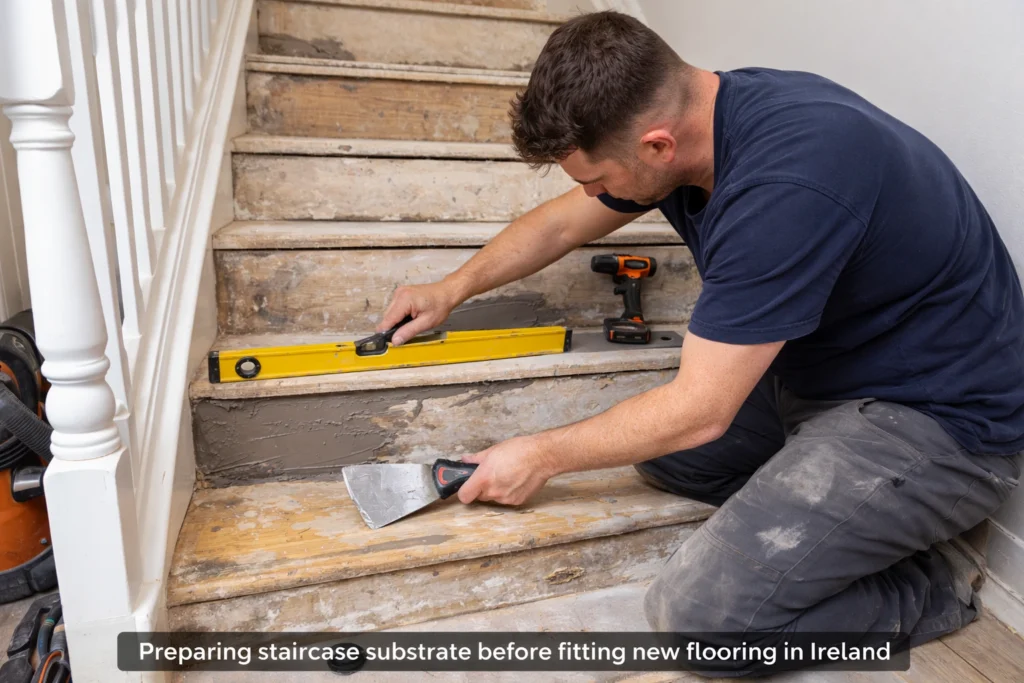
Common staircase installation challenges in Irish homes
The real headaches are not theoretical. They are maddeningly specific.
Each tread may be slightly different. The first step may be bull-nosed. The winders may have inconsistent widths. The skirts may be out. The spindles may force awkward cuts. The old stairs may squeak more on one side than the other. The landing may not match the stair height cleanly after the new finish is added.
Common stair failures include chipped laminate edges, LVT lifting at nosings, carpet gripper errors, poor alignment on runners, visible adhesive mess, badly finished cuts around spindles, and transitions that feel clumsy underfoot. Occupied homes add another problem: the staircase is usually the main route through the house, so work sequencing matters.
This is why stair fitting is a trade within a trade. It is not just flooring. It is measurement, edge strategy, repair logic, sequencing, and finishing discipline.
Moisture, cleaning, and wear patterns from Irish weather
In Ireland, the bottom of the staircase lives a harder life than the top. Wet shoes, grit, pet traffic, school runs, takeaway dashes, and general hallway mess all hit the first few treads hardest. That should influence material choice.
Carpet feels safer, but it can trap dirt if the entrance hall is constantly damp or gritty. Timber looks rich, but grit can abrade the front edge and finish. Laminate can mark at high-wear points. LVT generally handles cleaning better, but only if the detailing has not left awkward dirt traps around trims.
Households should think in wear zones, not in whole-stair fantasy. The first tread, the nosings, and the landing edge usually tell the truth long before the rest of the staircase does.
Real staircase flooring costs in Dublin and Ireland
Staircase pricing is not room-floor pricing with a few cuts added. That is the first budgeting lesson.
A simpler stairs-and-landing carpet package in Ireland can start around the mid hundreds, while bespoke stair runners can also sit in the mid hundreds before premium upgrades. Irish examples show stairs-and-landing carpet packages around €249 to €599+ and bespoke stair runners around €299 to €399+, while flat-floor laminate labour references sit around €10 to €20 per m² and quality carpet retail examples sit around the €40 to €50 per m² mark. That gives a useful baseline, but staircase labour often overrides the raw material cost.
Boxed cost explainer
A staircase quote usually combines some or all of the following: material, per-step labour, nosings or profiles, adhesive, prep, repairs, landing integration, old floor removal, disposal, finishing, and access constraints. In Dublin, parking, loading distance, and property access can add real time. On awkward stairs, bespoke labour can become the biggest part of the bill.
A sensible indicative guide for Dublin and Ireland would look like this:
- Basic full-carpet stair refresh, lower end: hundreds rather than four figures.
- Better carpet plus landing or a bespoke runner: often mid hundreds upward.
- LVT, laminate, or timber-look stair systems with proper nosings: often into four figures once detailing and prep are included.
- Premium engineered or solid timber stair work: often four figures and sometimes significantly beyond, especially if repairs, cladding, or matching landings are involved.
The honest answer is that a cheap-looking quote can become an expensive one if it ignores prep and edge detail.
How labour is priced: per step, per staircase, day rate, and hidden extras
Different contractors price stairs differently. Some quote per step. Some quote per staircase. Some use a day rate plus materials. None of those methods is automatically wrong.
Per-step pricing is useful where the stair shape is straightforward. Per-staircase pricing works when the contractor knows the typical layout well. Day-rate logic often appears where repairs, prep, and unknowns are likely. For homeowners, the key is not the pricing format. It is whether the quote clearly separates materials, prep, nosings, landing work, and repairs.
Hidden extras often include old covering removal, squeak repairs, replacing damaged tread edges, painting stringers, making good around skirts, disposal, parking, and VAT confusion.
Why staircase work costs more than many homeowners expect
Because it is slow. Because it is detailed. Because it is visible. Because mistakes scream at you every time you walk upstairs.
Flat floors reward speed. Stairs punish it. Each tread is its own mini job. Each front edge is exposed. Each side cut around spindles or skirts takes time. Each awkward junction between the hall, the stairs, and the landing needs solving. That is why a staircase can cost more per usable area than a decent-sized room.
This is also why cheap stair quotes deserve inspection. If a price looks suspiciously low, ask what has been left out.
Design choices: matching upstairs flooring, hallway flooring, and landings
One of the strongest design decisions is whether the staircase should disappear into the wider scheme or stand out as its own feature.
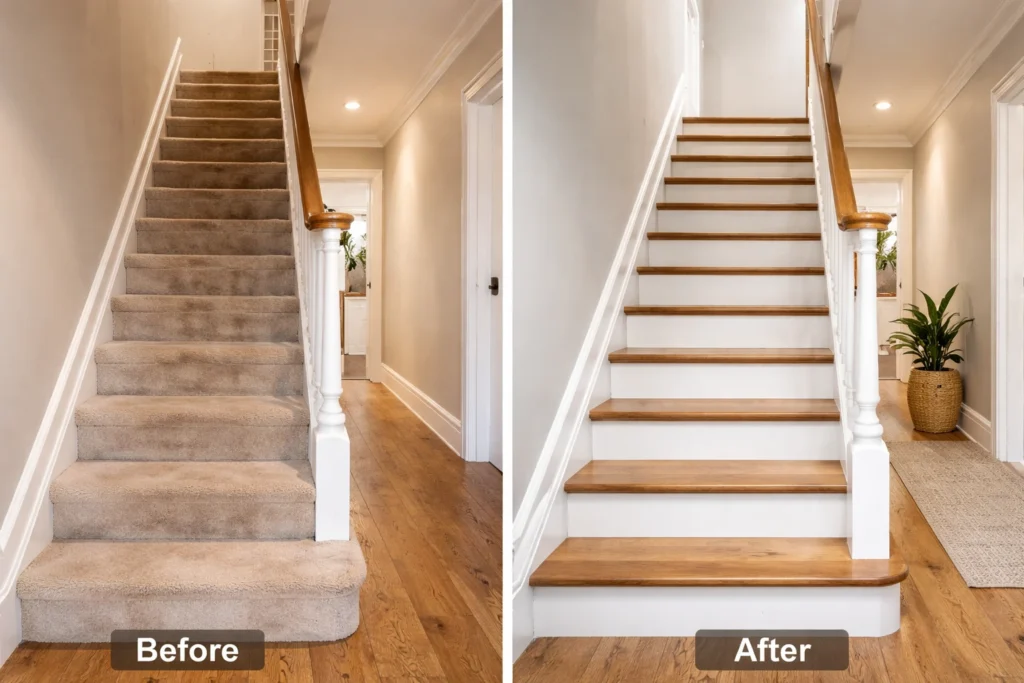
Matching the upstairs floor can look calm and expensive when done well, especially with engineered wood or coordinated LVT. Contrasting the stairs, especially with carpet or a runner, can make more practical sense where safety or noise matters. Landings should not be treated as an afterthought. They are usually the visual bridge between the stairs and the room’s flooring.
This is also where FBS Flooring can guide readers into internal service pages naturally: laminate flooring in Dublin, engineered wood installation, LVT supply and fit, staircase renovation advice, and whole-home flooring coordination all belong in the same buyer journey.
Best staircase flooring by property type
Victorian or older Dublin terrace: carpet or runner usually makes most sense unless the stair is being properly rebuilt or overclad.
Modern semi-detached family house: carpet or LVT often wins on practicality; engineered wood suits higher-budget schemes.
Apartment or duplex: carpet often wins for acoustics; LVT can work if noise and detailing are handled carefully.
Rental property: durable carpet or practical LVT usually beats fragile design choices.
Small commercial or mixed-use property: safety vinyl or tougher anti-slip systems often deserve a serious look.
Best staircase flooring by household type
Families with young children usually benefit from carpet or a grippier, softer-feeling solution. Older residents often value clear edge visibility, handrail confidence, and secure descent more than pure looks. Pet owners should think about claw noise, scratch resistance, and cleaning. Busy landlords should lean toward durability and replaceability, not delicate prestige finishes. Short-term rentals need easy cleaning, decent slip behaviour, and a finish that still looks respectable after turnover.
That is the real buyer decision filter. Not a trend, household reality.
Mistakes Irish buyers make when choosing stair flooring
The biggest mistake is copying the room-floor decision onto the staircase without rethinking the stairs themselves.
Other common mistakes include choosing a finish that is too slippery, ignoring squeaks and substrate movement, underestimating nosings, assuming all treads are equal, picking a runner for Instagram rather than real wear, trying to save money by skipping prep, and comparing quotes without checking what is actually included.
Another classic mistake is forgetting the landing. The landing is part of the staircase experience. If it clashes visually or wears differently, the whole job feels less coherent.
Questions to ask before accepting a quote
Ask what prep is included. Ask whether squeaks and loose treads are covered. Ask how the nosings will be detailed. Ask whether the landing is included. Ask what happens if hidden defects appear after removal. Ask whether waste disposal is in the price. Ask whether VAT is included. Ask how the chosen finish will behave on descent, not just how it looks from the hallway.
Also, ask whether the contractor has done your exact type of staircase before. That question can save you a load of grief.
Why professional fitting matters more on stairs than on flat floors
A badly fitted room floor can often be lived with for a while. A badly fitted staircase announces itself immediately, through movement, noise, visual crookedness, chipped edges, loose coverings, and a general sense that something is not quite right underfoot.
Professional fitting matters more on stairs because the margin for error is smaller and the safety consequence is greater. The best installers do not just fit the material. They read the stairs. They understand where movement will show. They know when a profile is wrong. They know when the job needs repair before flooring.
That is where real local experience counts more than glossy marketing.
When FBS Flooring is the right fit for the job
FBS Flooring is the right fit when the client wants practical advice, not just product pushing. It is especially strong where the staircase needs to be assessed in the round: structure, finish, household use, matching with adjoining floors, and long-term maintenance.
That means homeowners trying to coordinate hall, landing, and upstairs finishes. It means landlords who need a sensible durability answer. It means families who want the safest realistic option, not the trendiest one. It means Dublin clients dealing with awkward access, older staircases, or the usual city mix of tight halls, parking pressure, and time-sensitive renovation work.
Final verdict and buyer guidance
For many homes in Dublin and across Ireland, carpet is still the most sensible staircase flooring. Not because it is old-fashioned, but because it solves real problems well: grip, noise, comfort, and tolerance of imperfect stairs.
LVT is the strongest practical hard-surface contender when fitted properly. Engineered wood is the best premium domestic choice where the staircase is stable and the budget is there. Laminate can work, but it is far less forgiving than many buyers assume. Solid wood belongs in the right project, not every project.
The smartest staircase renovation is the one that suits the actual house, the actual users, and the actual stairs beneath the old covering. That is the bit FBS Flooring should keep owning in this market: real advice for real Irish staircases.
Book a staircase survey with FBS Flooring if you want a quote that reflects the structure, finish, safety detail, and full cost of the job, not just a hopeful number scribbled around the material:
FAQ
What is the safest flooring for stairs in Ireland?
For most homes, full carpet is the safest all-around choice because it offers grip, softness, and better noise control. In more practical or commercial settings, specialist safety flooring and correctly detailed anti-slip systems can be even more safety-focused.
Is carpet or wood better for stairs?
Carpet is usually better for grip, comfort, and sound control. Wood usually looks more premium and can match the surrounding floors better. The right answer depends on who uses the stairs, how noisy the house is, and whether safety or aesthetics comes first.
Can you put laminate on stairs?
Yes, but it needs the correct system, correct edge detail, and a stable staircase beneath. It is not as forgiving as people think, and poor detailing can lead to chipping, noise, and premature wear.
Is LVT good for stairs?
Yes, LVT can be excellent on stairs when properly specified and fitted with the right nosings and preparation. It is especially strong for practical homes, pet owners, and easier cleaning.
How much does staircase flooring cost in Dublin?
A basic carpet job can stay in the lower hundreds, while runners, LVT, and timber stair systems often move into four figures once prep, nosings, and landing work are included. The actual stair shape and hidden repairs matter a lot.
Do I need stair nosings?
In many stair projects, yes. They help protect the edge, improve detailing, and can improve visibility and safety. They are especially important with hard-surface stair finishes and commercial or shared-use stairs.
What is best for elderly people or rental properties?
For elderly users, secure footing and clear edge definition matter most, so carpet often wins. For rentals, durable carpet or practical LVT usually offers the best balance of maintenance, safety, and cost control.
Can staircase flooring be matched to upstairs rooms?
Yes, and it can look excellent when handled properly. Engineered wood and LVT are often used for continuity. The key is making sure the stair detail works technically, not just visually.
Why is stair fitting more expensive than flat floor fitting?
Because stairs require slower work, more cutting, more exposed finishing, more repair risk, and more safety-critical detailing. You are paying for precision, not just coverage.