Skip to content

Introduction
In Ireland, “subfloor issues” usually mean one (or more) of these: a ventilated void under a timber floor that’s too damp; a concrete slab build-up trapping moisture; structural movement showing up as bounce or cracking; radon entering at floor level; or (in some estates) pyrite-related slab heave.
The trap is treating the symptom: new paint, new laminate, sealing “draughts” without understanding the moisture/air path. This guide is built around a simple promise: symptom → likely causes → how to confirm safely → practical fixes → costs and disruption → when to call a pro.
Many symptoms share causes, so treat this as a detective job: confirm the pathway before you choose the product.
ROI vs NI note: Northern Ireland uses different Building Regulations/technical guidance and rental standards. This guide is Republic of Ireland–focused.
Safety & scope: Not legal advice. TGDs mainly apply to new works/alterations. Treat voids as confined spaces, don’t enter unless safe.
1. Subfloors in Ireland: the 3 common types you’ll actually meet
The three types
- Suspended timber (ventilated void): common in older terraces/semi‑Ds and some extensions.
- Ground-bearing slab: common mid/late‑20th century onward; membranes and insulation matter.
- Beam-and-block / suspended concrete: newer builds or tricky sites; still relies on ventilation at the void level.
How to identify yours without lifting floors
- Air bricks/wall vents at low level outside = likely ventilated void (timber or beam-and-block).
- “Lively” feel + squeaks = often timber; solid feel = often slab (not always).
- Threshold clues: suspended floors often sit higher; slabs can be close to the external ground if detailing is poor.

Caption: Joists carry the floor deck; the vulnerable zones are joist ends, sleeper walls, and any plumbing runs.
Credit: VeloBusDriver (Flickr) / CC BY 2.0 (via Wikimedia Commons). Publisher: confirm reuse rights.
Original visual: suspended floor vs slab (conceptual)
Suspended timber: finish ─ deck ─ joists ─ ventilated void ↔ air bricks ─ groundConcrete slab: finish ─ screed ─ insulation ─ DPM/radon barrier ─ slab ─ hardcore
Takeaway: suspended floors “work” by drying with air; slabs “work” by blocking moisture with membranes and details.
2. Why subfloor problems are so common in Ireland (and why they’re changing)
Ireland is wet and often humid, so building elements dry slowly, especially in shaded, poorly ventilated subfloor zones.
Two changes matter for 2026 homeowners:
- Retrofit airtightness: better windows/airtightness reduces uncontrolled air leakage, so purpose-provided ventilation becomes more important for moisture control.
- More impermeable finishes: modern laminates/vinyls and some underlays can trap moisture that older finishes would tolerate.
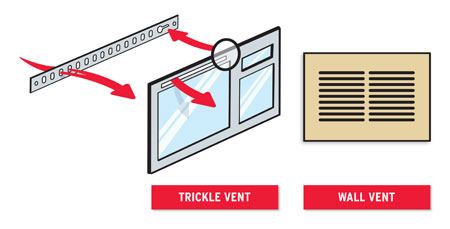
Caption: Ventilation is a system: background inlets plus extraction routes. Cutting one leg can increase damp and mould risk.
Credit: Environmental Protection Agency (Ireland). Publisher: confirm reuse rights.
3. 60-second symptom checker
| Symptom | Most likely causes (ROI) | What to check today | Urgency |
|---|---|---|---|
| Cold floor / draught at skirting | blocked/missing vents; gaps at perimeter; poor insulation | outside: are air bricks buried/blocked? | Med |
| Cold floor/draught at skirting | damp void; high RH + poor ventilation; leak | hygrometer RH%; check around plumbing | Med–High |
| Bouncy/squeaky floor | loose deck; long spans; joist-end decay | map bounce; check for “soft” spots | Med |
| Swollen skirting/cupboards | Musty smell/mould near floor | external ground level vs internal floor | Med |
| Efflorescence (white salts) | moisture migration/bridging | persistent damp at the wall base; slab edge moisture | Med |
| Laminate buckling | slab/screed moisture; leak; trapped moisture | locate source; don’t re-lay yet | Med |
| Check outside levels/render bridging | settlement/shrinkage; heave/pyrite | photograph/date; check for lifting | High |
| Slab cracks/doors sticking | Radon concern/buying | Radon has no smell | Med–High |
4. Suspended timber floors: ventilation, rot, mould, and bounce
Suspended timber floors fail in Ireland when water gets in, and air can’t get through.

Caption: If paving/soil rises above the vent, cross‑ventilation collapses and the void can become damp and stagnant.
Credit: Barbara Carr / Geograph / CC BY-SA 2.0 (via Wikimedia Commons). Publisher: confirm reuse rights.
What commonly goes wrong (Irish inspection pattern)
- Air bricks blocked by tarmac, beds, render, external insulation, or stored items.
- No cross‑flow (vents on one side only; sleeper walls blocking air).
- Bare earth + debris → persistent humidity.
- Small plumbing leaks under kitchens/bathrooms.
Timber decay (homeowner-safe overview)
- Wet rot: needs timber kept wet; often around leaks/joist ends.
- Possible dry rot: don’t DIY‑diagnose, get specialist identification if growth is widespread or fast.

Caption: Dark staining and fungal growth usually mean chronic moisture. Fixing the moisture pathway beats “treating timber.”
Credit: RASHIKA AGARWAL / CC BY-SA 4.0 (via Wikimedia Commons). Publisher: confirm reuse rights.
Safe inspection: what I do first
- Outside: count vents, check blockages, check downpipes, and ground levels.
- Inside: map smell/bounce; look for skirting swelling and finish failure.
- Targeted view: torch + phone camera/borescope to spot standing water, drips, rotten joist ends, and blocked airflow.
Do NOT: block vents to stop draughts, apply chemicals without fixing moisture, or enter a void if you can’t exit quickly or you suspect electrics/sewage gases.
5. Concrete slabs: damp, membranes, cracking, hidden moisture traps
Most slab problems come down to moisture getting past the system (edge bridging, punctures, poor laps) or moisture being trapped under impermeable finishes. TGD C sets moisture-resistance principles and includes radon-related detailing guidance in updated editions.

Caption: Real floor membranes fail at joints, edges, and penetrations—not in the middle of a sheet.
Credit: MTA Capital Construction Mega Projects (Flickr) / CC BY 2.0 (via Wikimedia Commons). Publisher: confirm reuse rights.
Quick checks: rain-linked damp suggests external/groundwater; occupancy-linked mould suggests humidity/ventilation; localised issues near kitchens/bathrooms suggest leaks. Before re-flooring, confirm the substrate is dry enough for the chosen system.
6. Radon + subfloors in Ireland
Radon is a naturally occurring radioactive gas that can enter at floor level. The EPA provides the radon map and testing guidance, and notes the national reference level for homes is 200 Bq/m³.
Practical tip: use your Eircode/address on the EPA radon map for local context, then let a long-term test tell you your home’s actual level.
Ireland-specific essentials
- Since 1 July 1998, guidance requires a standby radon sump in buildings; radon membranes are required in High Radon Areas for new builds.
- A standby sump doesn’t reduce radon without a fan; it’s a provision for later activation.
- TGD C references the latest EPA radon risk map (applies to works commencing from 1 Oct 2023).
Remediation options (overview)
- Activate an existing sump (fan) where present.
- Install a new sump (more disruptive).
- Active subfloor ventilation for ventilated voids (often helps with moisture too).
- Sealing as support, not the main strategy.
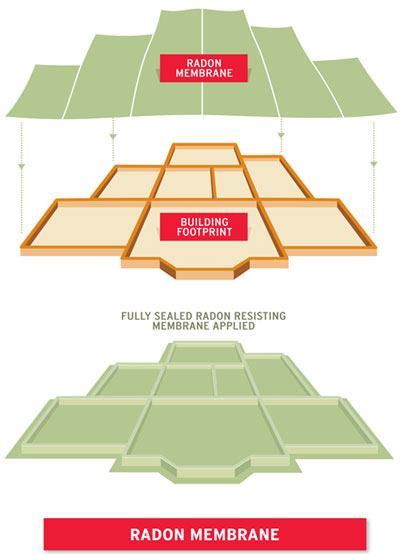
Caption: Continuity is everything—membranes must be sealed at laps and around every penetration.
Credit: Environmental Protection Agency (Ireland). Publisher: confirm reuse rights.
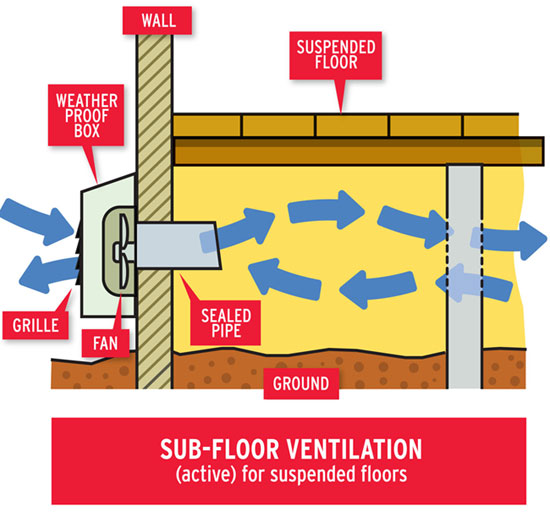
Caption: Active subfloor ventilation can dilute radon and dry a void—but design matters to avoid short-circuiting airflow.
Credit: Environmental Protection Agency (Ireland). Publisher: confirm reuse rights.
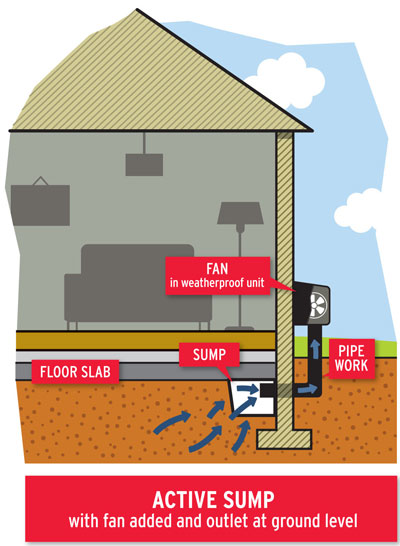
Caption: Active sump systems can be highly effective for slab-on-ground homes when installed correctly and followed by re-testing.
Credit: Environmental Protection Agency (Ireland). Publisher: confirm reuse rights.
7. Pyrite heave under slabs
Pyritic heave is an Irish-specific risk where reactive pyrite in hardcore expands and damages ground-supported floors. PRB guidance explains typical damage and the scheme pathway for eligible dwellings.
| Clue | More consistent with pyrite heave | More consistent with settlement/shrinkage |
|---|---|---|
| Floor profile | High spots / lifting (‘hogging’) | Local dips or uniform hairline cracking |
| Progression | Gradual worsening over months/years | Often stabilises after initial drying/settlement |
| Doors | Increasing binding as floor levels change | High spots/lifting (‘hogging’) |
Suspect it when cracking comes with lifting (“hogging”) and progressive door binding. Confirmation needs competent investigation/testing; NSAI’s I.S. 398 series covers testing/categorisation and remediation methodology.
8. Drainage, groundwater, flood context
Subfloor damp is often a site water management problem: overflowing gutters, broken downpipes, blocked gullies, paving falling toward the house, or external ground built up over time.
Use OPW Flood Maps to understand local flood mechanisms and OPW guidance on flooding types (including groundwater flooding during prolonged rain).
9. Insulation and retrofits: warmer floors without damp
Floor upgrades pay back in comfort, but only when you manage moisture and ventilation first. SEAI DTSS sets retrofit quality expectations and is a useful benchmark even when you’re not claiming a grant.
- Suspended timber: keep vents working; fit insulation tightly; treat vapour control as careful detailing.
- Slabs/overlays: confirm moisture suitability; watch slab edges and external ground levels.
Where product choice matters (insulation, membranes), look for NSAI Agrément or equivalent third‑party certification.
UFH can work well, but only with correct insulation and moisture checks before covering a screed/slab.

Caption: UFH is unforgiving on build-ups—insulation, moisture condition, and finish compatibility matter.
Credit: H. Raab (User: Vesta) / CC BY-SA 3.0 (GFDL option noted on Wikimedia Commons). Publisher: confirm reuse rights.
Retrofit order (don’t skip): moisture entry → ventilation strategy → insulation → finishes.
10. Diagnose a subfloor problem (like a pro)
The five-step method
- Define the pattern: where/when, weather link, occupancy link.
- External first: vents, ground levels, downpipes, gullies, paving falls.
- Internal second: skirting/flooring failure, mould/odour, bounce/softness.
- Targeted checks: torch + phone camera into the void; hygrometer indoors; cautious moisture readings.
- Escalate: radon test; surveyor; engineer; specialist contractor.
Mini-toolkit: torch, phone camera, hygrometer, tape measure, notebook; optional borescope/moisture meter (interpret carefully).
Do not enter a void if: standing water, strong sewage odour, visible heavy mould, uncertain electrics/gas, or no clear exit.
11. Fixes and typical costs in Ireland (2026 reality check)
| Problem | Typical fix | Who | Ballpark range (ROI) | Disruption |
|---|---|---|---|---|
| Blocked vents | clear/add vents; sleeves/grilles | builder | €150–€800+ | Low |
| Local joist repair | fix leak/vent; splice/replace timber | carpenter | €600–€3,000+ | Med |
| Major timber floor rebuild | rebuild + insulate + ventilation upgrades | contractor | €6,000–€20,000+ | High |
| Slab moisture under finishes | source + dry-out; replace finish | builder/flooring | €500–€5,000+ | Med |
| Activate existing radon sump | fan + pipe tweaks + retest | radon contractor | €900–€2,500+ | Low–Med |
| New radon sump | Activate the existing radon sump | radon+builder | €2,500–€7,500+ | High |
| Drainage fixes | gutters/downpipes/paving falls | roofer/builder | €200–€3,000+ | Low–Med |
| Pyrite pathway | engineer + testing; PRB scheme steps | engineer/PRB | investigation first | High |
Fees vary; budget for surveys/tests.
12. Buying or selling: subfloor questions that save thousands
Walkthrough tells: musty smell in a closed room; bounce/softness in hall; skirting swelling; lifted vinyl/laminate; and (outside) buried vents or high ground against walls.
For conveyancing, the EPA lists typical radon questions asked during a sale and explains there’s no general requirement for a homeowner to test/remediate before selling (your solicitor can advise on your case).
13. Landlords and tenants: minimum standards context (ROI)
Minimum standards for rented homes are set by S.I. No. 137/2019 and explained by the RTB and Citizens Information.
In plain language, the themes are “no damp” and “adequate ventilation” (use the official texts for specifics).
Tenant: report early and document. Landlord: diagnose root cause (leak/bridging/ventilation), don’t repaint over mould. This is not legal advice.
14. Prevention: annual maintenance calendar
| When | What to do | Why |
|---|---|---|
| Autumn | clear gutters/gullies; check downpipes | keeps water off wall bases and vents |
| Winter storms | Prolonged wetting drives damp/rot | catch issues after the wet season |
| Spring | sniff-test rooms; inspect skirting/finishes | keeps water off the wall bases and vents |
| Summer | schedule repairs/opening-up | best drying conditions |
FAQ
What are the first signs of subfloor rot?
Persistent musty odour, damp skirting, new squeaks, or localised “give” are typical early flags. In Ireland, the common triggers are blocked air bricks, high external ground levels, and slow plumbing leaks. Confirm with safe void viewing (torch + phone/borescope) or professional opening‑up.
Is it normal for a floor to feel bouncy in an Irish semi‑D?
A bit of bounce can be normal in older suspended timber floors, but worsening bounce suggests loose boards, long spans, or joist-end decay. Map where it’s worst. “Springy” often means structure; “soft” can indicate decay and needs priority inspection by a surveyor/engineer.
How do I stop draughts without blocking air vents?
Start at the room side: seal gaps at skirting/pipe penetrations and insulate the floor properly. Keep (or improve) cross‑ventilation under the floor so the void stays dry. Blocking vents can raise humidity and accelerate rot, so only change ventilation as part of a designed plan.
How do I know if damp is rising damp or condensation?
Condensation follows high indoor humidity and cold surfaces (corners/behind furniture), often linked to cooking/showers and poor ventilation. Ground/external moisture often tracks wet weather, high external ground levels, and salts at the wall base. Leaks can mimic both—rule them out early.
Is underfloor insulation worth it in Ireland?
Often yes for comfort and energy, especially on suspended timber floors—but only if ventilation and moisture risks are controlled first. Keep vents clear, fix drainage/leaks, and fit insulation tightly. For slabs, be cautious with impermeable overlays that can trap existing moisture; moisture testing matters.
Is it normal for new laminate/engineered wood to buckle in Ireland?
It’s common when moisture is trapped. Vapour‑tight finishes can buckle if slab/screed moisture is high or if moisture is entering at slab edges. Don’t re-lay until you understand the source and the substrate meets the flooring manufacturer’s moisture limits.
Do I need a radon test if I’m not in a “high radon area”?
Testing can still be sensible. The map is probability-based; construction details and ventilation affect your home’s actual level, especially after airtightness upgrades. A long-term test provides a baseline for peace of mind and for buyers. Follow EPA guidance on placement and duration.
What is a standby radon sump, and does it work without a fan?
A standby sump is the pipework provision required in buildings constructed since 1 July 1998. It’s intended to be activated by adding a fan if testing shows elevated radon. Without a fan, it does not actively reduce radon, so its presence isn’t “radon solved.”
If I’m retrofitting (heat pump/airtightness), what should I do about ventilation?
Plan ventilation alongside airtightness. As uncontrolled infiltration drops, humidity and pollutants can build up unless you provide controlled ventilation (background inlets, extract fans, or mechanical systems where appropriate). Use competent design/installation and make sure systems are commissioned and used correctly.
What professional should I call first: surveyor, engineer, damp specialist, or radon contractor?
Start with a Chartered Building Surveyor for diagnosis when symptoms are mixed. Bring in a Chartered Structural Engineer for significant cracking/movement or suspected heave/pyrite. Use an EPA-recognised radon contractor for remediation after a test confirms a problem. Be cautious of sales-led “damp” diagnoses.
How do I tell if a musty smell is a plumbing leak?
Check whether it’s localised to rooms with plumbing and whether it worsens after heavy water use. Look for staining at radiator tails, under sinks, and around wastes. In suspended floors, use a torch/camera to check for drips. Leaks can keep voids/slab edges damp without obvious surface marks.
What does a pyrite heave look like, and how is it confirmed?
It often shows as cracking plus lifting (“hogging”) of ground floors over time, with doors binding as levels change. It can resemble a settlement, so confirmation needs competent investigation/testing and careful interpretation. If relevant, consult PRB guidance on damage indicators and scheme stages.
Are there grants that help with floor insulation or ventilation upgrades?
Sometimes. SEAI programmes can support floor insulation and wider upgrades, but eligibility depends on scheme rules and dwelling type. Even without a grant, SEAI DTSS is a useful quality benchmark for moisture/ventilation/installation details. Check current SEAI guidance before pricing work.
How disruptive is subfloor remediation?
It ranges from low (clearing vents, fixing gutters) to high (opening floors for joist replacement, installing a radon sump, or pyrite remediation). The biggest disruption driver is “how much do we have to open up?” Good diagnosis reduces repeat disruption and protects finishes you’ve paid for.
I’m in a rental with mould near the skirting; what are the minimum standards?
Minimum standards for rented accommodation include requirements linked to being free from damp and having adequate ventilation in habitable rooms (see S.I. 137/2019 and RTB/Citizens Information guidance). Report the issue in writing, document with photos, and request diagnosis and repair—not just repainting.
Sources & standards used
- Moisture & radon in floors: TGD C (gov.ie) and TGD C 2023 amendment
- Ventilation: TGD F (gov.ie) and Home ventilation guidance
- Radon: EPA builders, EPA testing, EPA radon map
- Radon map update context: DHLGH press release and GSI update
- Pyrite scheme: Pyrite Resolution Board + How the Scheme works + Homeowner leaflet (PDF)
- Pyrite standards context: NSAI I.S. 398
- Retrofit quality: SEAI DTSS (PDF)
- Product certification concept: NSAI Agrément
- Climate context: Met Éireann climate
- Flood context: OPW Flood Maps
- Rental standards: S.I. 137/2019, RTB, Citizens Information
- Verify professionals: SCSI Find and Engineers Ireland Find a member
About the author
About the author (E‑E‑A‑T)
Ireland-based FBS Flooring leader and Chartered Building Surveyor with regular experience inspecting Irish housing stock (suspended timber floors, slab-on-ground, and beam‑and‑block), focusing on moisture, ventilation and structural performance.
How to verify: use the SCSI register and Engineers Ireland register.
Reviewed by: Chartered Structural Engineer; indoor air quality/radon specialist.