
Intro
This guide is written for Dublin homeowners choosing a Lignum Strata engineered wood floor and trying to avoid the classic local failures: cupping, gapping, squeaks, and cracked or damp subfloors. The key idea is simple: pick the floor that fits your building constraints first (sound rules, UFH, moisture, subfloor type), then choose colour and format.
Dublin’s coastal, damp climate, combined with a massive mix of old Georgian timber subfloors and fast-cured modern concrete slabs, creates a perfect storm for timber movement. Successful Lignum Strata installations here rely entirely on managing moisture and selecting engineered stability over solid wood risks.
Timber is hygroscopic; it breathes, expanding and contracting with the environment. Here in Dublin, we don’t just deal with rain; we deal with highly variable indoor Relative Humidity (RH). In a typical D4 period home, winter heating drops indoor humidity, causing floors to shrink. In a D8 new-build apartment, summer coastal air mixed with poor ventilation can cause the floor to swell.
At FBS Flooring, we regularly inspect jobs across Dublin where imported solid floors have cupped or crowned because the installer didn’t account for local conditions. Lignum Strata flooring, being an engineered product, is specifically constructed to combat these exact Irish climatic swings. Its multi-ply or cross-directional core counteracts the natural tendency of the top oak or walnut veneer to move, keeping your floor flat.
If you want to browse the full Lignum Strata range and shortlist options by look and size, start with the FBS Flooring category page and open each product page you like to confirm UFH notes, installation method guidance, and the published dimensions and pack size: https://fbsflooring.ie/product-category/lignum-strada/
For Dublin apartments with neighbours below, start with the management company’s sound requirement and pick a build-up that can meet it, then choose a Lignum Strata profile that fits the height and installation method that your building allows. Saying so, for apartments with tight thresholds, a 14mm profile such as Strata Fourteen Multiply is often easier to integrate, and the example product page states UFH suitability when used correctly. For house extensions with hydronic UFH, pick a product that is explicitly UFH suitable on its product page, keep temperatures steady, and follow commissioning rules so the timber is not shocked. Also, for older houses on suspended timber floors, fix stiffness and squeaks first, and do not lay a premium timber finish onto a springy base. For any slab or screed, do not guess; moisture testing and flatness checks decide whether your floor succeeds.
Dublin snapshot: what makes wood flooring tricky here
Dublin is maritime, which means the outside air tends to be humid. Met Éireann’s Dublin averages show high relative humidity across the year, which explains why many homes start from a “moist air baseline” unless ventilation and heating keep indoor conditions stable. Outdoor humidity is not the same as indoor humidity, but it influences it, especially in apartments with limited cross ventilation and in houses where ventilation habits change seasonally. Source: https://www.met.ie/cms/assets/uploads/2024/07/Dublin-1981%E2%80%932010-averages.html
Wood moves because it exchanges moisture with the air until it stabilises. When indoor humidity rises, boards can swell; when indoor humidity drops, boards shrink. Engineered wood usually behaves better than solid wood because its layered construction resists warping, but it still responds to moisture and temperature swings. In Dublin, many flooring problems are not “bad boards”; they are boards installed into the wrong moisture reality or onto the wrong base.

Dublin apartment exterior (Mitchel House, Appian Way, Dublin). Source: Wikimedia Commons. License: CC BY SA 4.0.
Apartments first: sound, neighbours, management rules
In Dublin apartments, the first decision is rarely colour. The first decision is sound performance, and what your management company will allow. Two kinds of sound matter: impact noise (footsteps, chair movement, dropped items) and airborne noise (voices, TV). Floors are usually most important for impact noise, particularly when there is another dwelling below.
Irish Building Regulations guidance on sound (Technical Guidance Document E) explains how floor constructions and resilient layers can reduce sound transmission and why edge isolation matters. In practical terms, a quiet apartment floor is a complete system: the subfloor condition, any acoustic layer, perimeter isolation, and the installation method all interact. Source: https://www.gov.ie/en/department-of-housing-local-government-and-heritage/publications/technical-guidance-document-e-sound/
If the apartment has a strict impact noise target or a list of approved underlays, treat that as a hard constraint. If UFH is present, avoid overly insulating layers that block heat transfer or encourage uneven heating. Meanwhile, if your current floor sounds hollow, the base may be uneven, and a floating buildup can amplify the tapping effect if it bridges voids.
Here is what to ask your management company, written as plain questions you can paste into an email. Ask whether there is a minimum impact sound improvement requirement or an approved underlay list. Ask whether floating installation is allowed or whether glue down is required. You should ask whether hard flooring is restricted in bedrooms or specific zones. Ask whether they require an installer sign-off or acoustic certificates for the full build-up. Ask about height constraints at apartment doors, fire doors, and balcony thresholds. Also, ask about working hours, dust control rules, and waste removal rules.
A useful approach is to shortlist Lignum Strata boards only after you know the acoustic route and total build-up height. That prevents the common Dublin apartment scenario where someone buys the “right looking” board and then discovers the approved acoustic system makes thresholds impossible.
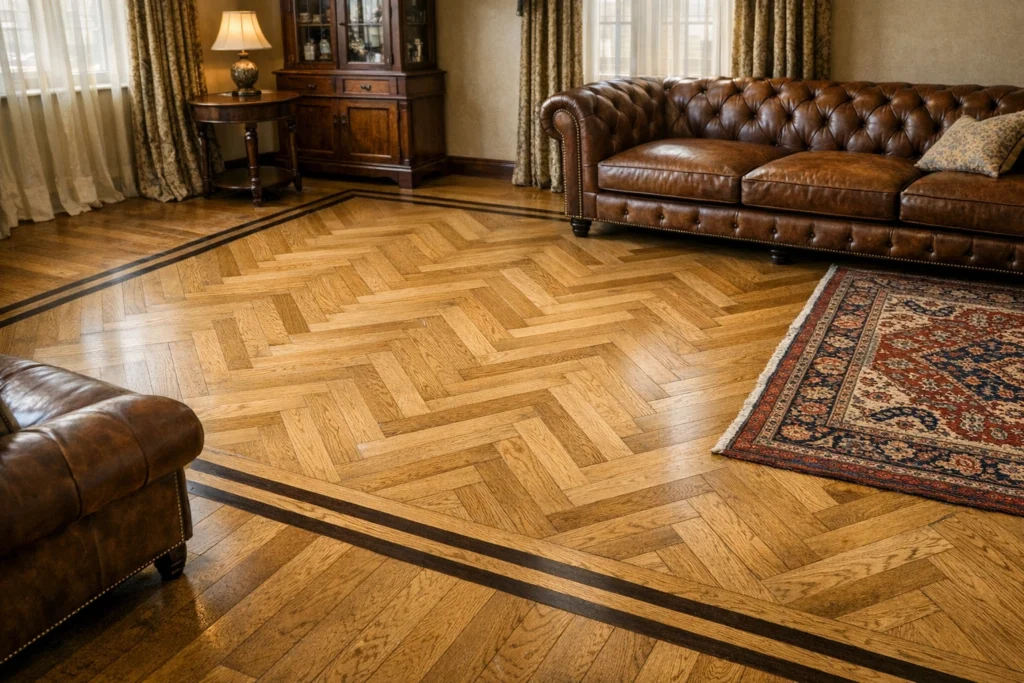
Image reference: oak herringbone floor photo
Houses next: subfloors, extensions, and old vs new Dublin stock
Dublin houses tend to split into two subfloor worlds: suspended timber floors and concrete slabs or screeds. Each world fails differently, so your choice of Lignum Strata and your installation method should match the world you are in.
Suspended timber floors can be excellent when they are stiff, ventilated, and consistent. They become problematic when they are bouncy, under-ventilated, patched with mixed-thickness boards, or loosely fixed. If you install an engineered wood finish onto a moving base, that movement shows up as squeaks, micro movement at joints, and long-term stress in the floor. The fix is almost always boring but effective: improve stiffness, eliminate squeaks, correct flatness, and confirm ventilation conditions before the finished floor goes down.
Slabs and screeds are different. Concrete does not look wet when it is wet. Many Dublin failures trace back to a slab or screed that was assumed dry. Moisture can persist because of missing or failed damp-proof membranes, leaks, balcony thresholds, plumbing issues, or ground moisture migration. Your floor might look perfect for weeks and then cup or loosen if moisture keeps moving upward.
Underfloor heating: compatibility, temperature limits, and warm-up behaviour
UFH can work very well with engineered timber when it is controlled correctly. The first step is distinguishing electric systems from hydronic (water-based) systems. Electric mats and cables can create hotter local zones if controls or sensors are poor. Hydronic UFH is usually more even and naturally aligned with low-temperature heating strategies.
SEAI guidance explains that heat pumps perform best with lower flow temperatures and that UFH is suited to heat pumps because it provides heat at lower temperatures across a large area. That steady, low temperature style is also what timber prefers. Source: https://www.seai.ie/sites/default/files/publications/Heat-Pump-Implementation-Guide.pdf
Many wood flooring and UFH guides cap the floor surface temperature at 27°C, and one of the provided FBS product descriptions references this limit in the UFH context on the product page. Treat the surface temperature cap stated for your specific product as a hard rule unless the product documentation clearly states a different limit. The reason is straightforward: higher surface temperatures increase moisture gradients through timber, especially under rugs, furniture, and south-facing glazing, where solar gain stacks extra heat on top.
UFH commissioning is where Dublin floors often go wrong. The safe pattern is steady and gradual. Before installation, UFH is often run to help drive out construction moisture in screeds, but this must be coordinated with the screed type and the overall drying plan. For installation, the system should be stabilised so you are not laying timber into a heat swing. After installation, the setpoint should be increased gradually, using proper sensors, and watching both surface temperature and indoor humidity. Avoid rapid boosts to “catch up” because timber responds to change, not to good intentions.
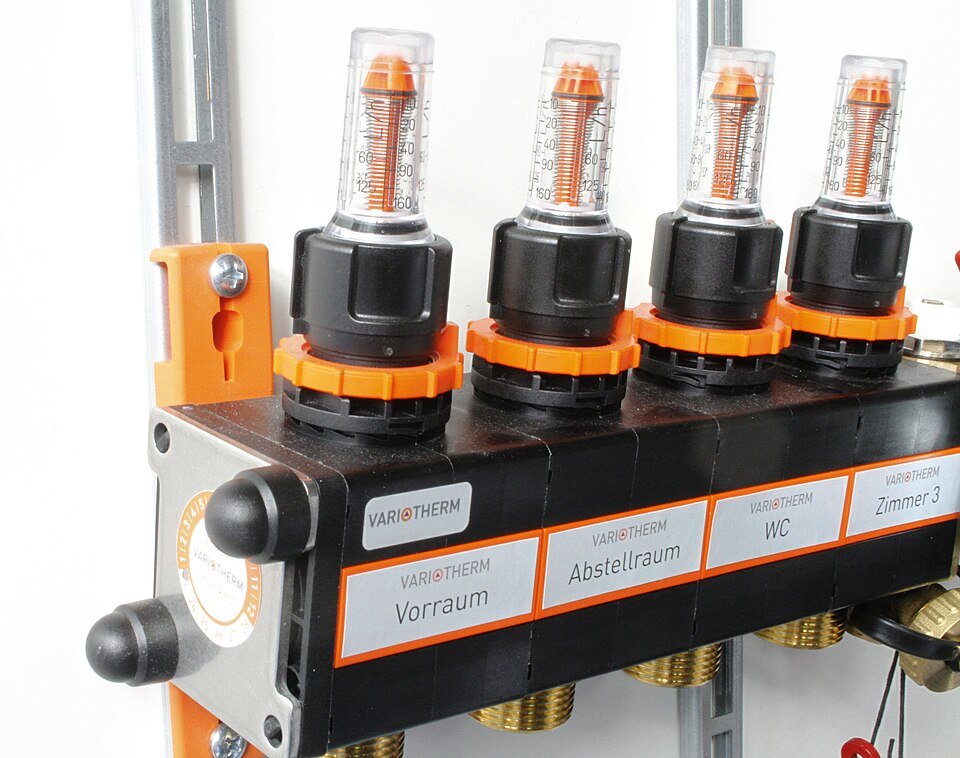
UFH manifold photo
Humidity reality: the numbers, seasonal movement, and how to control it
Dublin’s outdoor humidity baseline is high, but your indoor humidity depends on heating, ventilation, occupancy, showers, cooking, and whether clothes are dried indoors. Timber floors care about indoor relative humidity, and most guidance focuses on keeping it stable. A commonly cited performance band for wood floors is around 30% to 50% RH, though manufacturers vary, and the priority is avoiding extremes and large swings rather than chasing a perfect number every hour. Reference example for general guidance: https://rehmeyerfloors.com/wp-content/uploads/2017/02/NWHA_Relative_Humidty_Summary_020917.pdf
The most practical tool for a Dublin homeowner is a simple hygrometer. It turns guesswork into a number. If indoor RH is frequently high, dehumidification and better ventilation habits can stabilise conditions. If indoor RH is very low in winter due to heating and dry air, the risk shifts toward shrinkage and gaps.
Signs you are outside a safe humidity range are usually visible. If new gaps appear in winter, indoor air may be too dry or swing too quickly; stabilise heating patterns and monitor RH. Also, if edges curl upward (cupping), suspect moisture imbalance from subfloor moisture, indoor RH spikes, a leak, or UFH control behaviour; find the source before attempting cosmetic fixes. If doors stick seasonally, that can be another indicator of humidity swings. If you see frequent window condensation or musty smells, the moisture load is likely high, and you should treat the home as a higher-humidity risk environment.

hygrometer photo

dehumidifier photo
Subfloor truth: moisture testing, flatness, and preparation that prevent disasters
Your Lignum Strata floor will only perform as well as the surface it sits on. In Dublin, most failures trace back to moisture in slabs and screeds or movement in timber subfloors. Moisture testing is not theatre; it is decision-making.
There are fast mapping tests and deeper confirmatory tests. Non-destructive electronic meters are commonly used to map comparative moisture conditions across a slab or screed and identify damp zones that require further investigation. Tramex’s overview of ASTM F2659 describes this approach as a preliminary evaluation of comparative moisture condition. Source: https://tramexmeters.com/moisture-testing/concrete/non-destructive-concrete-moisture-test
Flatness matters because engineered boards bridge voids and telegraph bumps. If the base has dips and ridges, floating systems can become hollow and noisy, and glue-down systems can fail at weak points. Temperature also matters because installing into a cold, damp shell and then heating aggressively later is a reliable path to movement problems.
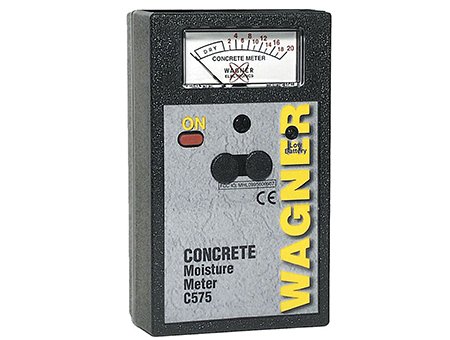
Concrete moisture meter photo.
Here is the installer style checklist rewritten as plain sentences. Confirm the subfloor type; do not assume it. Test moisture, map the area, and investigate damp zones near balconies, bathrooms, kitchens, and external walls. Check flatness and plan levelling where needed. Store the product according to manufacturer guidance and avoid acclimating timber in a damp, unventilated shell. Plan expansion gaps at perimeters, columns, and thresholds, and do not squeeze the floor tight to walls. Coordinate UFH commissioning and keep to the product’s stated surface temperature limit. Plan doorway transitions and kitchen island details so movement has somewhere to go.
Common failure modes in Dublin homes and fixes
Cupping (edges higher than centre) usually indicates a moisture imbalance. The fix starts with identifying the moisture source, stabilising indoor RH, checking subfloor moisture, and verifying UFH control behaviour. Sometimes boards recover when conditions stabilise; sometimes replacement is required, but the cause must be removed first.
Gapping in winter is usually shrinkage from drier indoor air or faster swings from heating patterns. Stabilise humidity and avoid aggressive heating changes. Some seasonal movement is normal; extreme gaps indicate environmental or installation detail issues.
Squeaks usually come from movement in the subfloor or friction points in floating builds. The fix is to stiffen the base, eliminate voids, and choose an installation method and acoustic layer that does not compress unevenly.
Cracked screeds and debonded levellers usually come from poor preparation, contamination, moisture issues, or thermal stress. The fix is to stop, diagnose, and reprep correctly rather than trying to bridge problems with quick fixes.
Lignum Strata ranges: what to buy for each Dublin scenario
Start your Lignum Strata selection by browsing the range on the FBS category page, then confirm your exact product on its product page. This matters because UFH suitability, finishes, and dimensions are product specific. Link: https://fbsflooring.ie/product-category/lignum-strada/
From the provided example product page, Lignum Strata Fourteen Multiply Smoulder Oak 150 is described as an engineered multiply floor with a matt lacquered finish, tongue and groove locking system, and suitability for underfloor heating when used correctly. The product page lists a pack size of 1.44m² and dimensions of 300 to 1200mm by 150mm by 14mm. Link: https://fbsflooring.ie/product/lignum-strata-fourteen-multiply-smoulder-oak-150/
From the provided Lignum Strata Twenty Premium American Walnut 190 product page, the published details include a pack size of 2.394m² and dimensions of 2100mm by 190mm by 20mm. Confirm UFH notes and limits on the product page you are buying, because UFH suitability and limits should be checked board by board. Link: https://fbsflooring.ie/product/lignum-strata-twenty-premium-american-walnut-190/
Apartment quiet comfort. In an apartment, the best Lignum Strata choice is the one that fits the acoustic requirements and height constraints. If thresholds are tight, a 14mm profile like Strata Fourteen Multiply is often easier to integrate, and the example product page includes UFH suitability notes. The installation method should be chosen based on acoustic performance and subfloor condition, because floating builds can increase hollow sound on imperfect bases. The management company’s approval and the full build-up details matter as much as the timber choice.
UFH modern extension. For a Dublin house extension with hydronic UFH, choose a product explicitly stated as UFH suitable and follow commissioning rules and temperature limits. A stable engineered profile like Strata Fourteen Multiply suits many UFH setups because it reduces movement risk compared to solid wood. If you want a long plank visual and the build-up height allows it, a profile like Strata Twenty Premium (20mm thick, long boards) can work well on a flat, dry base with conservative UFH control, but it demands more planning around thresholds and flatness.
Busy family home. For daily wear, the practical choice is an engineered floor with a finish you can live with and a plan for grit control. Dublin weather brings grit and moisture to the door; a good mat strategy and regular grit removal protect any finish. The best timber choice here is usually the one that stays stable and looks decent under real life, rather than the one that looks perfect under perfect conditions.
Rental durability. For rentals, prioritise predictable performance and straightforward maintenance. Choose a profile and finish that tolerates normal tenant use and plan for a stable installation method that avoids movement noise complaints. Avoid unnecessary complexity in transitions and thresholds because small installation details become big problems when occupants change.
If you think you want solid wood. If solid Lignum Strata is not explicitly confirmed on the product pages, treat solid wood as a separate alternative category rather than a Lignum Strata product. Solid timber can look beautiful, but in Dublin, it is less forgiving of humidity swings and UFH constraints. If you want solid, you need tighter indoor RH control, stricter temperature discipline, and you should expect more seasonal movement.
herringbone parquet texture
Installation choices: float vs glue, underlays, adhesives, and transitions
The installation method is a performance decision. In Dublin, floating installations can create hollow tapping or squeaks when the base is not flat or when the underlay compresses unevenly. Glue-down installations can reduce hollow sound and improve the feel underfoot, which can help in apartments, but glue-down must be compatible with slab moisture conditions and preparation standards.
A good way to decide is simple. Float when you need reversibility, when the acoustic system is designed for floating floors, and when the subfloor is flat enough to avoid voids. Glue down when you want a more solid feel, less drum effect, and better control over micro movement, particularly on large spans and in apartments where sound complaints are a risk. Avoid floating over a chaotic base, because that is a common route to squeaks and joint stress.
Adhesives and moisture interact. If you are gluing to a slab or screed, confirm the moisture condition of the subfloor and the adhesive or DPM system compatibility. This is one of the main reasons why moisture testing comes before final installation decisions.
Transitions are movement management. Doorways serve as natural break points, managing expansion and contraction. Kitchens and islands can pin a floating floor if not detailed properly. Balcony doors and sliders are moisture risk zones and need threshold planning and checks for water ingress risk.
Maintenance in Dublin: cleaners, scratches, and long-term refinishing reality
In Dublin, maintenance is mostly about grit control and moisture discipline. Vacuum regularly with a soft brush head, wipe spills quickly, use felt pads under chairs, and use entrance mats to stop grit from acting like sandpaper. Avoid over-wet mopping. Many timber problems blamed on “poor finish” are actually water and grit problems.
Refinishing capacity depends on the engineered floor’s wear layer thickness, which varies by product. Do not assume refinishing is unlimited. If refinishing potential matters to you, check your exact Lignum Strata product page or documentation for the wear layer information and follow the manufacturer’s guidance on sanding and recoating.
FAQ-s
Which Lignum Strata is best for a Dublin apartment?
The best option is the one that meets your building’s sound requirements and fits your threshold height. Start with management rules, then confirm the subfloor type and whether UFH is present, then choose a Lignum Strata profile that fits the approved build-up.
Is Lignum Strata engineered or solid?
The example products provided are described as engineered multiple constructions on the FBS pages. Do not assume solid unless a product page explicitly confirms it.
Can I use Lignum Strata with underfloor heating in Dublin?
Yes, when your specific product is stated as UFH suitable, and you follow temperature limits and commissioning rules on that product’s documentation.
What is the biggest UFH mistake with wood floors?
Rapid heat changes and poor sensor control. Use gradual changes, keep surface temperatures within the stated limits, and avoid trapping heat under rugs.
My Dublin apartment feels humid. Should I avoid timber?
Not necessarily. Engineered timber can perform well if we stabilise indoor RH, and if we verify slab moisture. If we find limited ventilation, plan dehumidification.
Do I need a moisture test on an old slab?
Yes. Age does not guarantee dryness. Leaks, missing DPMs, balcony thresholds, and ground moisture can keep a slab wet.
What causes cupping in Dublin homes?
Moisture imbalance, often from a wet subfloor or indoor RH spikes, sometimes intensified by UFH control behaviour. Identify the moisture source first.
What causes winter gaps?
Shrinkage from drier indoor air or fast swings from heating patterns. Stabilise humidity and avoid aggressive temperature changes.
Is a floating installation louder in apartments?
It can be, especially on imperfect bases. Floating systems can amplify tapping and drum sounds without the right acoustic build-up and flatness.
What underlay should I buy for a Dublin apartment?
Choose an acoustic system that meets the building requirement and, if UFH is present, does not over-insulate. Ask for test data and full build-up approvals.
Can I install over suspended timber boards in an older Dublin house?
Yes, but fix movement, ventilation issues, and flatness first. Otherwise, squeaks and joint stress are likely.
Do herringbone floors need more preparation?
Yes. Herringbone shows subfloor defects quickly and often needs excellent flatness and stability. Confirm UFH compatibility per product.
Should I choose 14mm or 20mm for Dublin?
Choose based on thresholds, flatness, and performance goals. 14mm often suits apartments and tight door clearances; 20mm can deliver long plank visuals but needs more planning.
How do I protect timber floors from Dublin rain grit?
Entrance mats and regular grit removal are the highest return actions. Treat grit as the main scratch source.
What should I do before ordering Lignum Strata?
Confirm your subfloor type, test moisture where relevant, check flatness, and for apartments, get acoustic requirements in writing. Then choose the Lignum Strata profile that fits those constraints.
About the author
FBS Flooring (Dublin) supplies and supports flooring projects across Dublin, including apartments with acoustic constraints and houses with UFH and mixed subfloors. The aim of this guide is practical: prevent expensive mistakes by matching product choice to building physics and Dublin site realities.
How this guide was researched
This guide referenced Met Éireann Dublin climate averages, Irish Technical Guidance Document E (Sound), SEAI heat pump and domestic technical standards guidance, a moisture testing overview referencing ASTM F2659, and the Lignum Strata product pages provided on the FBS Flooring site. Met Éireann link: https://www.met.ie/cms/assets/uploads/2024/07/Dublin-1981%E2%80%932010-averages.html.
Sound guidance link: https://www.gov.ie/en/department-of-housing-local-government-and-heritage/publications/technical-guidance-document-e-sound/.
SEAI heat pump guide link: https://www.seai.ie/sites/default/files/publications/Heat-Pump-Implementation-Guide.pdf.
SEAI domestic standards link: https://www.seai.ie/sites/default/files/publications/Domestic-Technical-Standards-and-Specifications.pdf.
Moisture testing overview link: https://tramexmeters.com/moisture-testing/concrete/non-destructive-concrete-moisture-test.
FBS Lignum Strata category link: https://fbsflooring.ie/product-category/lignum-strada/.
Example product pages: https://fbsflooring.ie/product/lignum-strata-fourteen-multiply-smoulder-oak-150/ and https://fbsflooring.ie/product/lignum-strata-twenty-premium-american-walnut-190/.
Sources and references
FBS Flooring Lignum Strada category: https://fbsflooring.ie/product-category/lignum-strada/
FBS Flooring Lignum Strata Fourteen Multiply Smoulder Oak 150: https://fbsflooring.ie/product/lignum-strata-fourteen-multiply-smoulder-oak-150/
FBS Flooring Lignum Strata Twenty Premium American Walnut 190: https://fbsflooring.ie/product/lignum-strata-twenty-premium-american-walnut-190/
Met Éireann Dublin 1981 to 2010 averages: https://www.met.ie/cms/assets/uploads/2024/07/Dublin-1981%E2%80%932010-averages.html
Gov.ie Technical Guidance Document E Sound: https://www.gov.ie/en/department-of-housing-local-government-and-heritage/publications/technical-guidance-document-e-sound/
SEAI Heat Pump Implementation Guide: https://www.seai.ie/sites/default/files/publications/Heat-Pump-Implementation-Guide.pdf
SEAI Domestic Technical Standards and Specifications: https://www.seai.ie/sites/default/files/publications/Domestic-Technical-Standards-and-Specifications.pdf
Tramex overview referencing ASTM F2659: https://tramexmeters.com/moisture-testing/concrete/non-destructive-concrete-moisture-test
Practical next step in Dublin
Book a site check to confirm subfloor type, flatness, and moisture risk, then do a moisture test where needed, and view samples so you can choose a Lignum Strata profile that fits your apartment rules or house build up without surprises.