Skip to content
Choosing the best flooring for conservatories and sunrooms in Ireland is different from choosing a floor for an ordinary sitting room. Extensive glazing can create strong solar heat gain by day, followed by rapid cooling after sunset. External doors also bring in rain, grit and condensation.
In many higher-risk rooms, SPC is the strongest practical starting point because its rigid, waterproof core offers good dimensional stability. A suitable premium laminate can still work in a heated, well-controlled sunroom, but only where the product instructions permit the conditions.
Quick answer: What is the best flooring for an Irish conservatory?
For most Irish conservatories exposed to condensation, garden traffic and significant temperature changes, a correctly specified SPC floor or tile is usually safer than standard laminate or natural wood.
However, no flooring type is automatically “conservatory-proof”. Suitability depends on orientation, hours of direct sunlight, heating, subfloor moisture, installation method, permitted temperature range and warranty conditions.
FBS Flooring’s Irish humidity guide identifies SPC and tile as the strongest general choices for sunrooms while warning against treating laminate as a default option in extreme conditions.
Why does conservatory flooring face greater stress
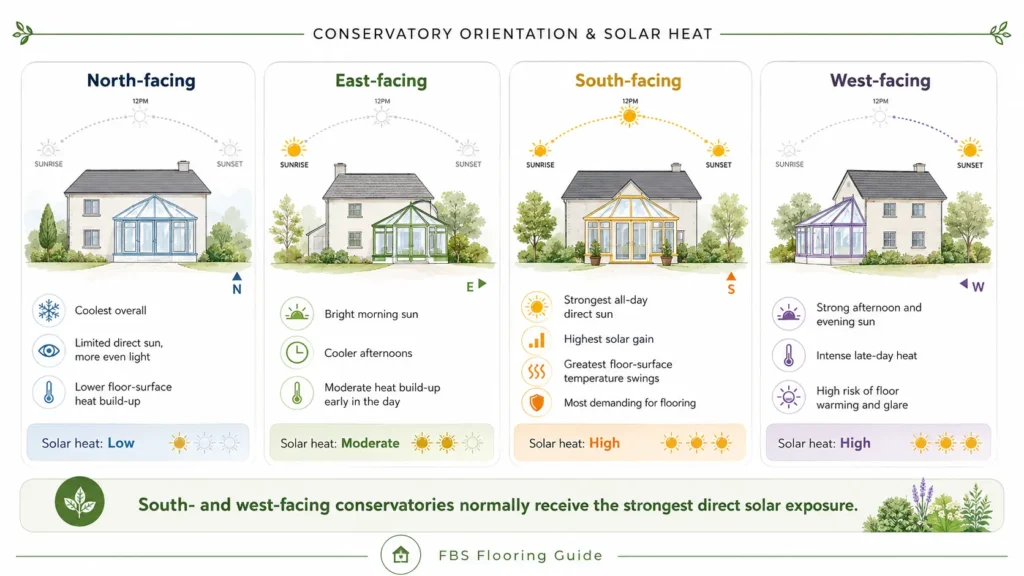
Solar heat gain is the rise in indoor temperature caused by sunlight passing through glazing and warming internal surfaces. South-facing rooms usually receive the longest exposure, while west-facing conservatories can overheat sharply in the late afternoon.

North-facing or shaded rooms may stay cooler but can feel cold and retain condensation near glass, external walls and thresholds.
The floor may therefore experience:
- Rapid temperature changes
- Changing humidity
- UV exposure
- Condensation
- Wet garden traffic
- Seasonal expansion and contraction
Dimensional stability means a flooring material’s ability to retain its size and shape as temperature and moisture change.
Waterproofing helps with spills and wet footwear, but it does not guarantee resistance to unlimited heat, UV fading or thermal expansion. Manufacturer guidance varies considerably: some resilient floors permit conservatories under controlled conditions, while other products exclude sunrooms entirely.
| Flooring | Temperature and moisture performance | Comfort and care | Conservatory suitability | Main limitation |
|---|---|---|---|---|
| SPC rigid core | Stable and waterproof, subject to product limits | Easy to clean; relatively firm | Strong all-round option | Direct-heat and sunlight rules still apply |
| Laminate | Reasonably stable; HDF core remains moisture-sensitive | Warm feel; simple routine care | Controlled, heated rooms only | Joints can swell if moisture enters |
| Engineered wood | More stable than solid timber | Natural and comfortable | Possible in carefully controlled rooms | Responds to humidity changes |
| Flexible or glued LVT | Moisture-resistant; specialist adhesives can manage heat | Quiet and easy to maintain | Strong when correctly specified | Subfloor and adhesive preparation are critical |
| Porcelain or ceramic tile | Excellent heat and water tolerance | Cold without heating; very durable | Excellent for severe exposure | Hard underfoot and includes grout lines |
| Solid wood | High movement risk | Natural and repairable | Usually unsuitable | Expansion, cupping and fading |
| Carpet | Warm and soft | Retains dirt and moisture | Limited to dry, stable rooms | Condensation, garden debris and fading |
The product specification and installation instructions should always override a general category comparison.
Why SPC flooring is often suitable for conservatories
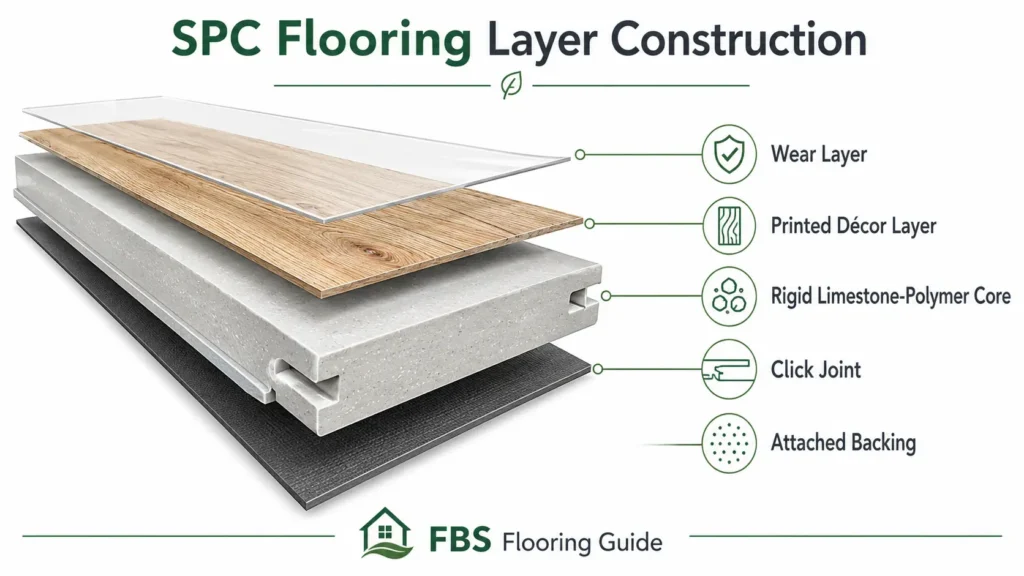
SPC means Stone Plastic Composite or Stone Polymer Composite. It is a rigid vinyl board built around a dense limestone-and-polymer core.
A floating floor installation means that boards lock together over the subfloor rather than being permanently fixed through each plank.
SPC’s dense core, waterproof construction and resistance to everyday dents make it useful near glazed garden doors. Attached underlay can also improve footfall sound and comfort.
FBS Flooring describes SPC as more dimensionally stable than flexible vinyl and suitable for underfloor heating within the relevant product limits.
That does not make every SPC product suitable for an unheated conservatory. Confirm the permitted room and surface temperatures, sunlight restrictions, expansion requirements and warranty before ordering.
Recommended FBS Flooring SPC products
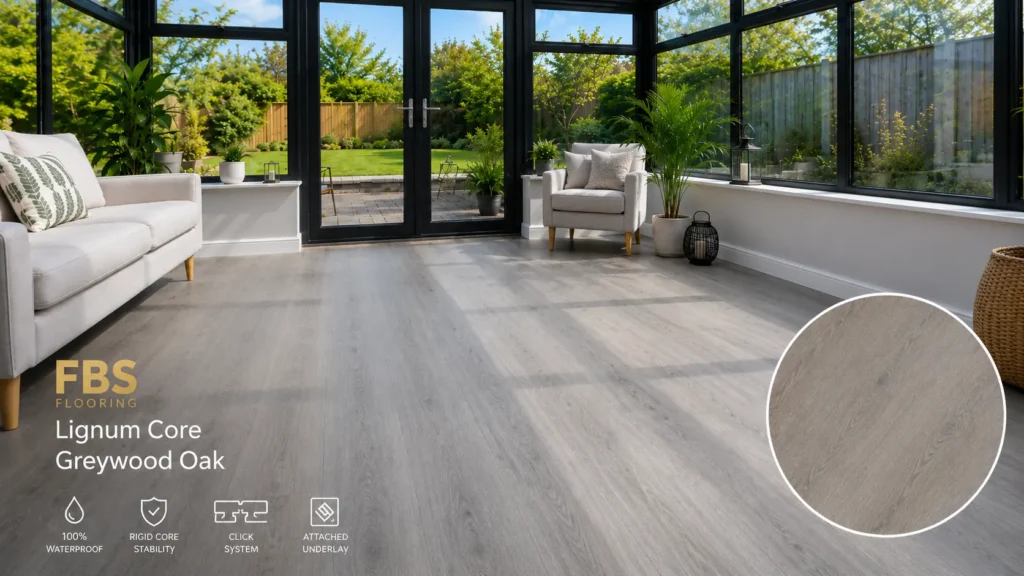
Lignum Core Greywood Oak
Lignum Core Greywood Oak is a 5mm engineered luxury-vinyl plank with a limestone-and-stabiliser core, 0.55 wear layer, built-in 1mm underlay, DocLoc system, waterproof construction and stated underfloor-heating compatibility.
Its cool grey wood appearance suits contemporary glazed extensions and busy garden-access rooms. FBS Flooring lists a 20-year guarantee, but conservatory and direct-sun suitability should be confirmed for the exact installation conditions.
Lignum Core Barley Oak
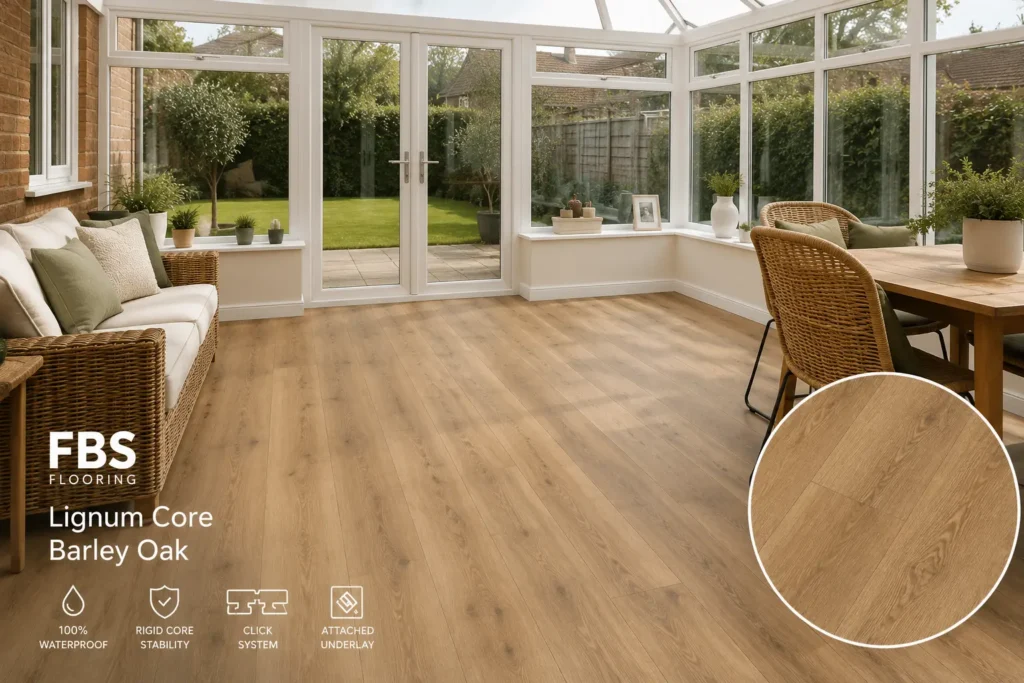
Lignum Core Barley Oak uses a 1220 × 180 × 5mm plank format and limestone-based rigid construction, with a warmer combination of light and deep brown tones.
FBS Flooring states that it is waterproof, has an attached 1mm underlay, uses the DocLoc system, supports underfloor heating and carries a 15-year guarantee. It is worth considering for dining sunrooms, family conservatories and traditional interiors, subject to confirmation of the room’s temperature and sunlight conditions.
Ask FBS Flooring to review the conservatory’s orientation, glazing, external access and heating before selecting an SPC finish.
Can laminate flooring be used in a conservatory?
Yes, but only in a conservatory that behaves like a normal heated interior and where the specific laminate manufacturer permits the application.
Standard laminate contains a high-density fibreboard, or HDF, core. Waxed or water-resistant edges reduce risk but do not transform laminate into waterproof SPC.
The room requires:
- A dry and level subfloor
- Stable indoor temperatures
- Suitable underlay
- Protected plank joints
- Correct acclimatisation
- Unobstructed expansion space
- Manufacturer approval for direct sunlight and heating
FBS Flooring recommends laminate primarily for more stable living spaces. Its Irish sunroom guidance favours SPC or tile when moisture and temperature swings are severe.
Recommended FBS Flooring laminate products
Vienna Classic Oak 12mm AC5
Vienna Classic Oak 24601-1pla/2601-6 is a light, warm-beige oak-effect laminate.
It has 12mm HDF planks, waxed edges, an AC5 wear rating, painted V-grooves and a Unilin click system. Its pale appearance can help a sunroom feel bright without adding the visual weight of a very dark floor.
Use it only in a climate-controlled conservatory after FBS Flooring confirms direct-sunlight and warranty suitability.
Milan Honey Oak 12mm AC5
Milan Honey Oak 24601-03pla/2601-6 offers a warmer golden-amber appearance with the same 12mm HDF, waxed-edge, AC5 and Unilin-click specification.
It suits dining conservatories and traditional interiors where moisture and temperature are controlled. The available technical sheet indicates Grade 4 colour-fade resistance and underfloor-heating use for the 12mm format, but the exact heating system and conservatory exposure still require approval.
| Question | SPC | Laminate |
|---|---|---|
| Condensation and wet footwear | Waterproof core offers greater tolerance | Prompt cleaning is essential; HDF joints remain vulnerable |
| Temperature movement | Generally offers stronger dimensional stability | Performs best in stable indoor conditions |
| Direct sunlight | Product-specific restrictions apply | Product-specific fading and heat limits apply |
| Comfort and sound | Firm; attached backing may help | Often feels warmer with approved underlay |
| Maintenance | Vacuum and damp mop | Vacuum and lightly damp clean |
| Best application | Higher-risk entries and moisture-prone rooms | Heated, controlled sunrooms |
| Unheated conservatory | Only when explicitly permitted | Usually avoid unless explicitly approved |
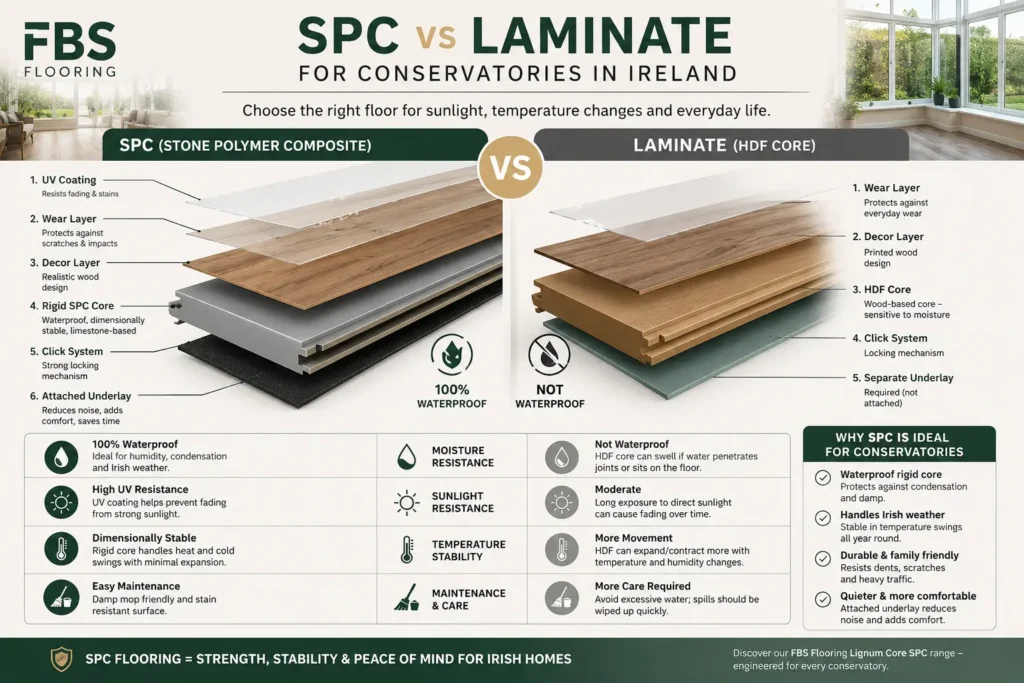
These differences explain why SPC is normally the safer recommendation, while laminate remains a conditional choice rather than an automatic exclusion.
| Use case | Practical recommendation |
|---|---|
| South- or west-facing conservatory | Approved SPC, glued LVT or tile; add blinds or solar control |
| North-facing or shaded room | SPC; approved laminate may work if the room stays dry and heated |
| Unheated conservatory | Tile or a product specifically rated for the full temperature range |
| Heated sunroom or home office | Approved SPC or suitable 12mm laminate with compatible underlay |
| Dining room, children or pets | SPC for spills, grit and easy cleaning |
| Garden room with external access | Waterproof SPC or tile with an effective entrance mat |
| Rental property | Durable SPC with straightforward maintenance |
| Underfloor heating | Only an approved flooring, underlay and heating-system combination |
Room conditions and manufacturer restrictions should decide the final product, not the room name alone.
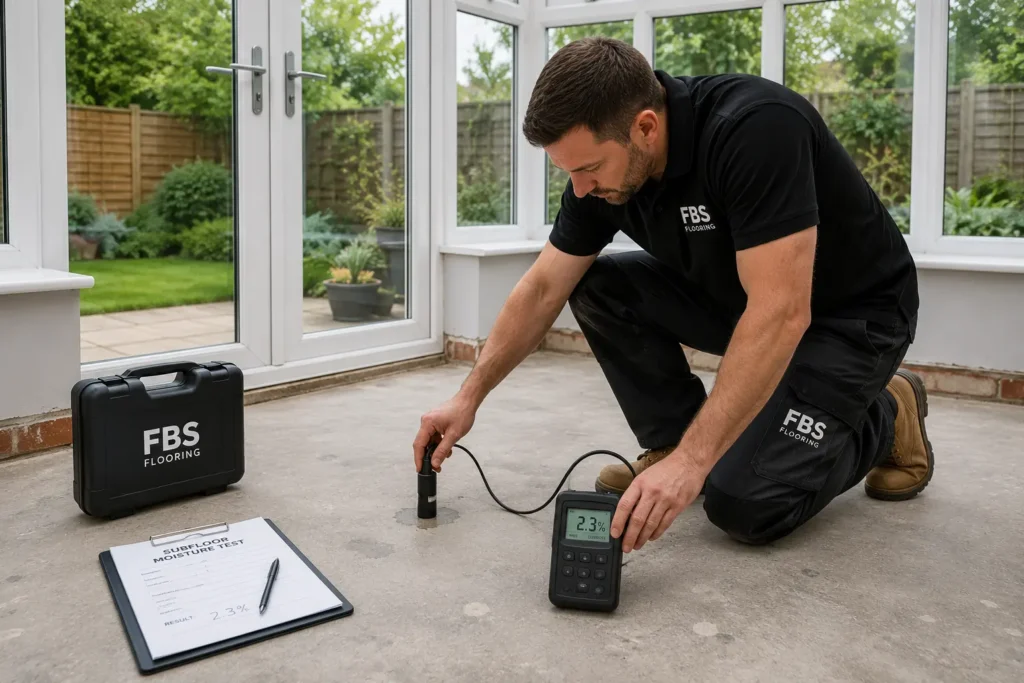
Subfloor preparation and moisture control
A premium floor can fail over a damp, weak or uneven base.
Concrete should be moisture-tested rather than judged only by its age. Timber subfloors must be dry, rigid and free from excessive movement. Existing tiles may remain only when they are secure, flat and compatible with the proposed flooring system.
Use a damp-proof membrane or moisture-suppression system where test results and manufacturer instructions require one.
FBS Flooring notes that resilient coverings are commonly assessed against a 75% RH subfloor threshold, although the flooring product, adhesive and applicable installation standard always take priority.
Check transitions between the conservatory and adjoining rooms carefully. Differences in subfloor height, movement and moisture exposure may require suitable threshold profiles rather than an uninterrupted floating installation.
Expansion gaps and temperature management
An expansion gap is the free space left around walls, door frames, pipes, thresholds and fixed objects so a floating floor can move naturally.
Never pin a floating floor beneath:
- Fixed cabinetry
- Heavy built-in furniture
- Skirting fixed through the boards
- Tightly fitted door frames
- Rigid trims that prevent movement
Follow the exact product measurement rather than applying one universal expansion-gap figure. Larger installations, adjoining rooms and doorways may also require movement profiles.
Store and acclimatise flooring according to the manufacturer’s instructions. FBS Flooring advises storing packs flat inside the installation room, away from cold walls, direct sunlight and concentrated heat.
Direct sunlight, fading and overheating
Protect high-glare rooms with blinds, curtains, solar-control glazing or suitable UV film. Ventilate the room during periods of overheating.
Rugs can create uneven UV ageing or trap heat, particularly when they have dense or rubber-backed constructions. Move rugs periodically and check whether their backing is approved for the selected floor.
Window coverings can reduce surface temperatures and UV exposure, but they do not replace correct flooring selection. Manufacturer guidance confirms that direct sunlight and extreme surface temperatures can require shading, specialist adhesives or a different flooring system.
Underfloor heating in conservatories
Both water-based and electric underfloor-heating systems can work with suitable SPC or laminate, but compatibility must be verified.
Confirm:
- Flooring approval
- Underlay approval
- Combined thermal resistance
- Thermostat and floor-sensor requirements
- Maximum permitted surface temperature
- Installation restrictions
- Commissioning and heat-up procedure
The heating system should be commissioned before flooring installation. Reduce or switch it off as instructed during fitting, then raise the temperature gradually afterwards.
FBS Flooring lists Greywood Oak and Barley Oak as underfloor-heating compatible and advises an approved low-TOG underlay for suitable laminate flooring.
Cleaning and maintenance
Vacuum grit regularly, place a non-staining mat beside garden doors and wipe condensation, mud and spills promptly.
Use felt furniture pads, manufacturer-approved cleaner and a well-wrung mop. Avoid steam cleaners and excessive water unless the product instructions expressly permit them.
Common mistakes to avoid
- Choosing flooring by colour alone
- Assuming waterproof means heat-proof
- Ignoring room orientation
- Skipping subfloor moisture testing
- Using unsuitable underlay
- Blocking expansion gaps
- Fitting over cracked or uneven surfaces
- Placing fixed furniture over a floating floor
- Overlooking warranty exclusions
- Leaving dark boards exposed to concentrated solar heat
Incorrect moisture control, climate management and movement provision are recurring causes of premature flooring failure.
How much does conservatory flooring cost in Ireland?
The final cost depends on:
- Room dimensions
- Flooring range and format
- Cutting wastage
- Subfloor levelling
- Moisture control
- Underlay
- Removal of old flooring
- Door trimming
- Thresholds
- Skirting or beading
- Delivery and access
- Professional installation
The FBS Flooring product pages checked on 14 July 2026 did not publish unit prices, so request a room-specific quotation rather than relying on a generic square-metre figure.
The FBS Flooring Cost Calculator includes room dimensions, flooring type, doors, underlay, removal, skirting and delivery to help create an initial budget.
How to choose the right conservatory flooring
- Record the room orientation and hours of direct sunlight.
- Note summer overheating and minimum winter temperatures.
- Identify the heating type and how consistently it operates.
- Inspect condensation and garden-door moisture.
- Identify and moisture-test the subfloor.
- Consider children, pets and muddy external traffic.
- Compare light, mid-tone and dark samples inside the room.
- Define cleaning and maintenance expectations.
- Obtain written temperature, UV, UFH and warranty limits.
- Select the approved underlay, DPM and expansion details.
- Compare the complete installed cost, not the board price alone.
- Use professional fitting where the room has strong sunlight, damp or complex thresholds.
Why consult FBS Flooring?
FBS Flooring supplies laminate, SPC and other flooring ranges, offers free home consultations, measurements and tailored product guidance, and works with professional fitting specialists.
Its website also provides an Ireland humidity map, temperature information, a flooring cost calculator and technical articles. This positions FBS Flooring as an advisory resource as well as a flooring supplier.
The company’s showroom is at Unit J2, Malahide Road Industrial Estate, Coolock, Dublin.
Relevant FBS Flooring guides and internal links
- What Is SPC Flooring? The Complete Irish Guide
- Moisture and Humidity in Irish Homes
- Best Flooring for Underfloor Heating in Ireland
- How to Acclimatise Flooring in Ireland
- FBS Flooring Professional Services
- Browse FBS Flooring Products
Final recommendation
The best flooring for conservatories and sunrooms in Ireland is usually an approved SPC product or tile where moisture and temperature variation are substantial.
Premium laminate can be attractive and durable in a heated, controlled sunroom, but it should never be selected without checking direct-sun restrictions, room-temperature limits, subfloor readiness, expansion instructions and warranty terms.
Explore FBS Flooring’s SPC and laminate ranges, request samples, use the cost calculator, or contact the team for a room assessment, quotation and professional installation.
Frequently Asked Questions
What is the best flooring for a conservatory in Ireland?
Approved SPC or tile is usually the safest choice where temperature swings, condensation and wet garden traffic are significant. A permitted laminate may suit a consistently heated, dry sunroom.
Is SPC flooring suitable for a conservatory?
It can be. SPC is waterproof and dimensionally stable, but the exact product must permit the room’s temperature range and direct-sun exposure.
Can laminate flooring be installed in a sunroom?
Yes, in a controlled interior with stable heating, low moisture and manufacturer approval. Ordinary laminate should not automatically be used in an unheated or overheating conservatory.
Does conservatory flooring fade in direct sunlight?
Any decorative flooring surface may change under prolonged UV exposure. Product fade ratings, window shading and room orientation should be reviewed before purchase.
What flooring handles temperature changes best?
Tile is highly tolerant, while suitable rigid-core SPC often performs well. The stated temperature limits of the individual product matter more than the flooring category name.
Can flooring be installed in an unheated conservatory?
Only flooring specifically approved for the complete expected temperature range should be used. Many floating vinyl and laminate warranties exclude uncontrolled rooms.
Is waterproof flooring enough for a conservatory?
No. Waterproof refers to water exposure. It does not automatically cover UV fading, surface overheating, thermal expansion or conservatory warranty exclusions.
Can SPC or laminate work with underfloor heating?
Yes, when the product, underlay and heating system are approved together and all temperature, commissioning and gradual heat-up instructions are followed.
Do I need an expansion gap?
Yes. Floating SPC and laminate need unobstructed movement space around perimeters and fixed objects. Use the dimensions stated in the manufacturer’s instructions.
Should conservatory flooring be professionally installed?
Professional fitting is advisable where there is high solar exposure, subfloor moisture, underfloor heating, large glazed doors or complex transitions because small specification errors can cause premature failure.