Skip to content

Acclimatising flooring in Ireland means letting your boards adjust to the temperature and humidity of the actual room before they are fitted. Store the packs flat inside that room, never in a garage or shed — for at least 48–72 hours (and up to one to two weeks for solid wood), keep the space at normal living conditions, and confirm the subfloor is dry before you start. Skip this step, and you risk gaps, cupping, or buckling that no fitter can hide.
Key takeaways
- Acclimatise in the room of installation, at the temperature and humidity the floor will actually live in — not in an empty, unheated building.
- Typical windows: 24–72 hours for laminate and LVT, 48–72 hours for engineered wood, and up to 1–2 weeks for solid hardwood but the manufacturer’s instructions always override generic advice.
- The subfloor matters more than the calendar. Test it: British/Irish practice (BS 8201 and BS 8203) treats a screed as dry enough at ≤75% relative humidity for resilient floors and ≤65% RH for timber.
- Ireland’s damp, maritime climate makes this step non-negotiable — and getting it wrong is one of the fastest ways to void your warranty.
What is flooring acclimatisation (and why it matters in Ireland)
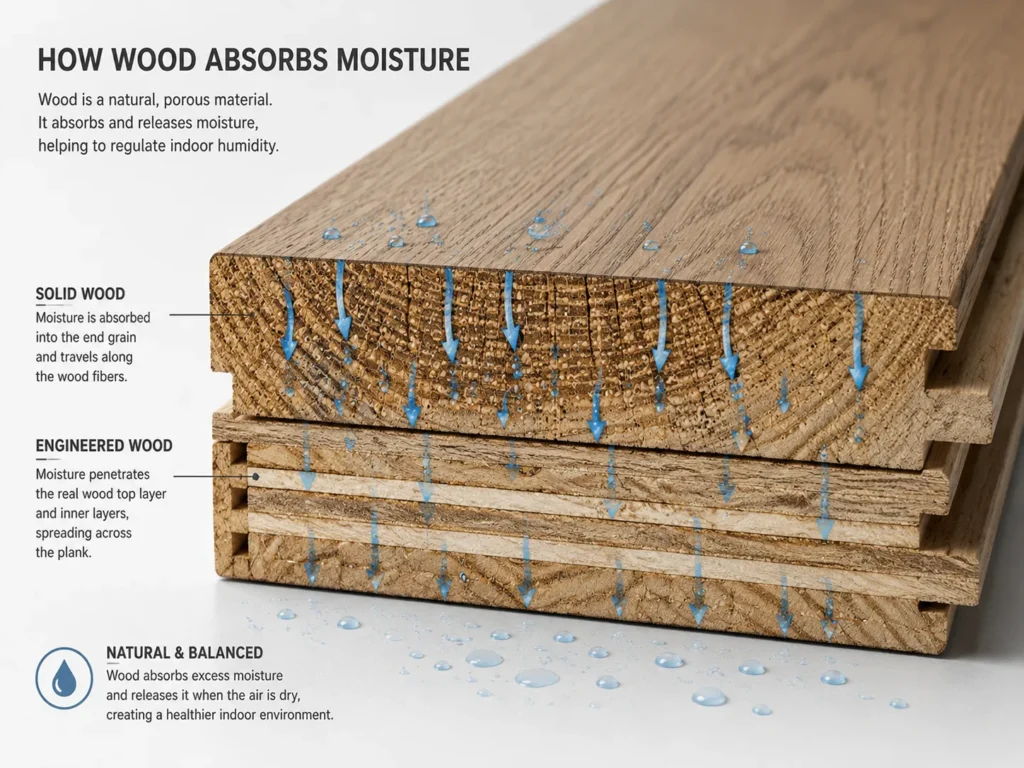
Acclimatisation is the process of letting the flooring reach moisture balance with the room before it is installed. Wood and wood-based products are hygroscopic — they constantly absorb and release moisture from the surrounding air. In a damp room, they swell; in a dry, heated one, they shrink. Left long enough in a stable environment, the boards settle at their equilibrium moisture content (EMC): the point where they stop gaining or losing moisture for those conditions. The National Wood Flooring Association (NWFA) defines acclimation in exactly these terms — conditioning the flooring to the environment in which it is expected to perform.
The common misconception is that acclimatisation is about “warming the boards up.” It isn’t. It is about moisture, not temperature. And it isn’t only a solid-wood issue. Engineered wood has a real timber wear layer and a timber-based core that both exchange moisture with the air. Even laminate and luxury vinyl, though largely synthetic, expand and contract with heat and humidity. That is why nearly every category needs some settling-in time.
In Ireland, this matters more than almost anywhere. Our climate keeps indoor air damp for much of the year, then central heating dries it out sharply each winter — a wide annual swing that timber floors feel keenly.
Why Irish homes are harder on flooring than most
Here is the direct answer: Ireland’s mild, humid maritime climate keeps ambient moisture high year-round, so floors are under more strain here than in drier continental climates. Met Éireann describes the Irish climate as humid and changeable, dominated by moist Atlantic air. Climate data for Dublin puts average relative humidity at around 73% across the year, climbing into the low-to-mid 80s in winter — far above the roughly 40–60% RH a wood floor is happiest at indoors.


That gap creates two distinct seasons of risk. Through the damp shoulder months, boards stored carelessly soak up moisture and arrive at the job over-expanded. Then, when the heating runs hard in winter and indoor humidity drops, those same boards shrink and gap. Coastal homes face an extra challenge from salt-laden air, and humidity itself varies noticeably from county to county — a coastal Galway property behaves differently from a dry east-Dublin terrace.
Ireland’s housing stock pulls in opposite directions too. New, airtight builds often pair underfloor heating with liquid screed that holds construction moisture for weeks. Older and period homes frequently sit on suspended timber floors with their own damp and ventilation quirks — exactly the kind of subfloor problems we see across Irish homes. If you want the regional detail, our moisture and humidity guide, county by county breaks it down further.
Where and how to store flooring before installation
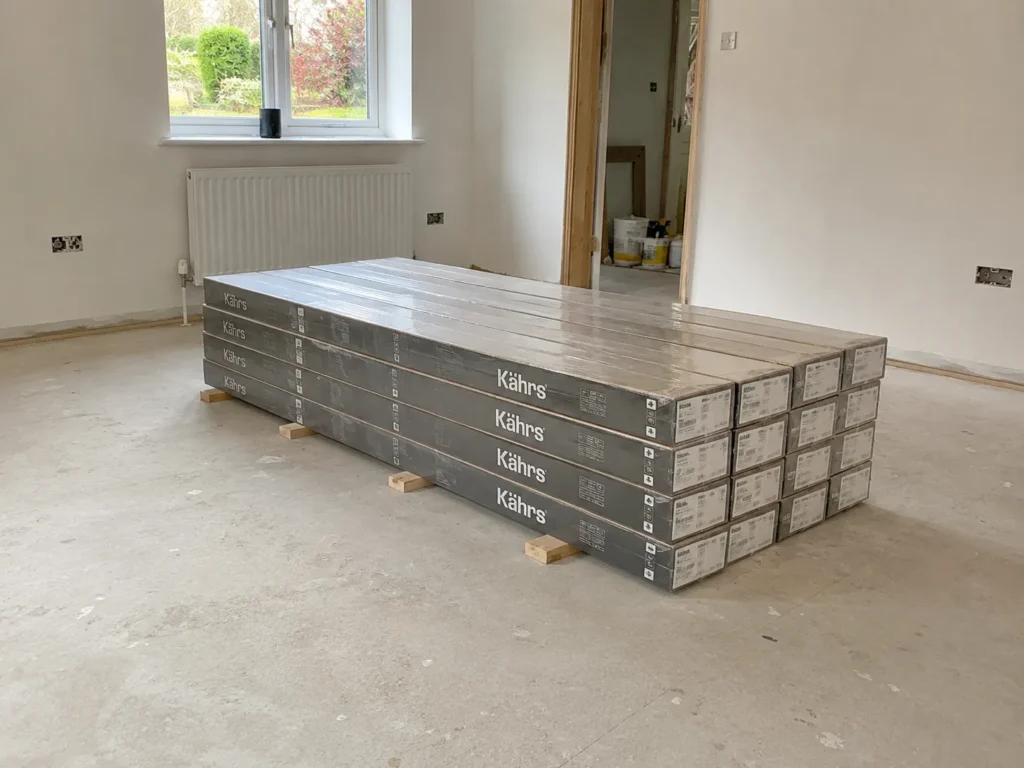
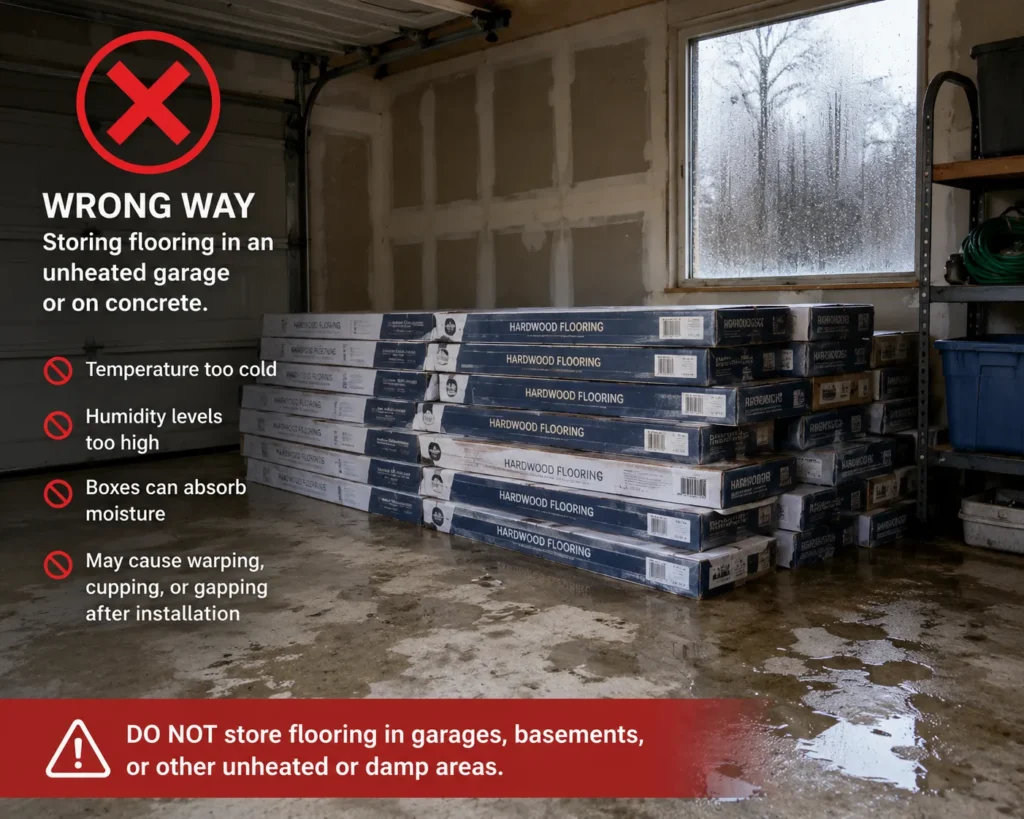
Store the flooring inside the room where it will be fitted — this is the single most important rule. The boards can only adjust to the conditions they actually experience, so a garage, shed, conservatory, unheated extension, or any building that isn’t yet watertight is the wrong place. We routinely see Dublin jobs go wrong because packs sat in a cold garage “to keep them out of the way,” then were carried into a warm house on fitting day with no time to settle.
A few practical rules from the tools-down side of the trade:
- Lay packs flat and fully supported, ideally raised off a bare concrete subfloor on battens, offcuts or the packaging itself, so cold and residual moisture can’t wick straight into them.
- Never stack packs hard against external or cold walls, and keep them away from direct sunlight, radiators and heat sources that create uneven conditions.
- Follow the manufacturer on packaging. Many engineered and laminate products are designed to acclimatise in their sealed packs in-room — some are even meant to be installed straight from just-opened boxes. Some solid-wood products are better unboxed and cross-stacked with spacers (“stickered”) for airflow. The datasheet decides.
- Don’t open more boxes than you’ll lay in the next few hours, and only open enough to mix plank lengths and shades for a natural finish.
If you’re tackling a click-system floor yourself, our step-by-step laminate installation guide walks through the fitting once acclimatisation is done.
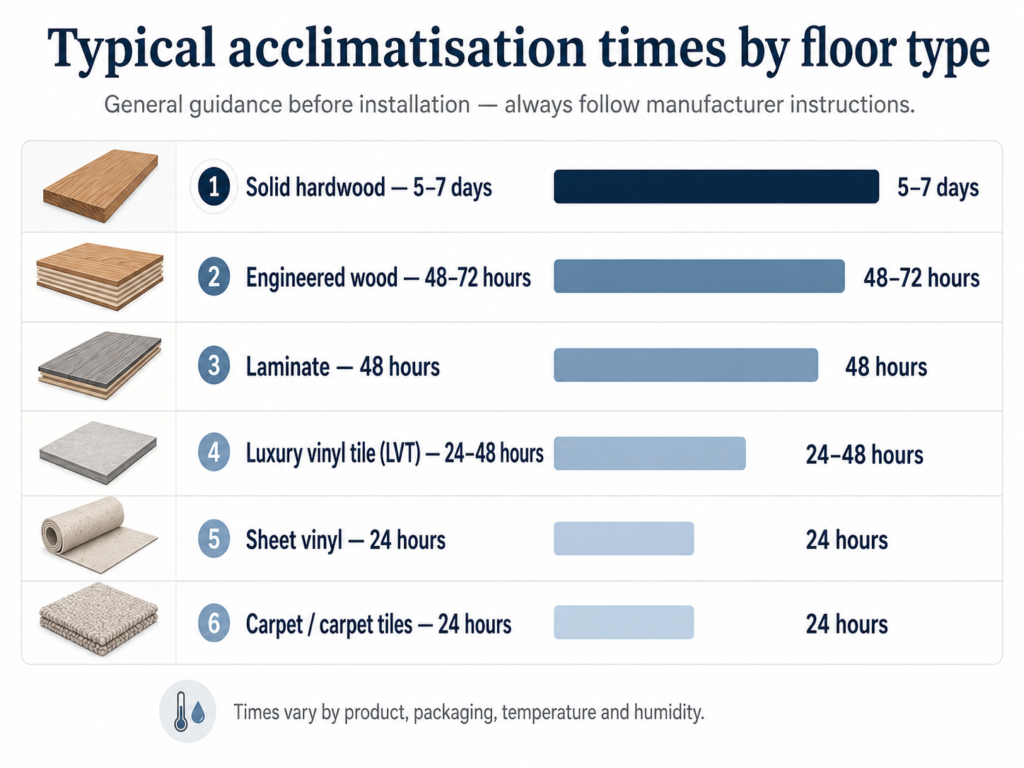
How long to acclimatise — by floor type
There is no single number, because different materials behave differently. As a working guide for Irish conditions:
| Floor type | Typical acclimatisation window | Notes |
|---|---|---|
| Solid hardwood | 7–14 days (sometimes longer) | Most sensitive; tropical species and site-finished floors need longer. Aim for ≤2–4% moisture difference between floor and subfloor. |
| Engineered wood | 48–72 hours (some up to 1 week) | More stable than solid, but still real timber. Target ≤1–2% moisture difference. |
| Laminate | 48–72 hours | Synthetic core still expands and contracts with heat and humidity. |
| LVT / vinyl (flexible) | 24–48 hours | Needs time to relax and adjust to room temperature. |
| Rigid SPC | 24–48 hours, or per manufacturer | Some rigid products state little or no acclimatisation — always check the datasheet. |
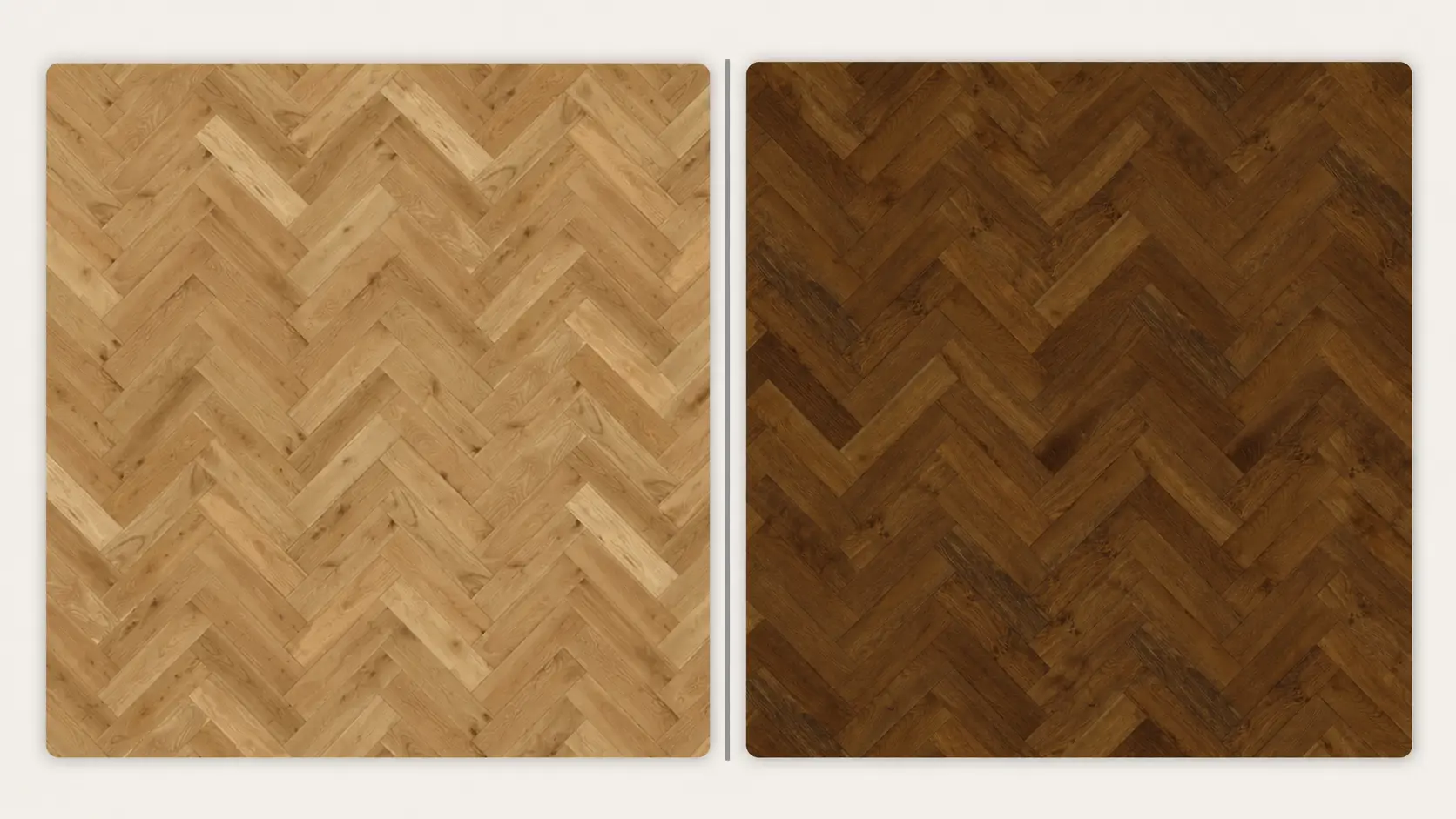
| Parquet / herringbone | As per the wood type above | Small blocks plus complex layouts make movement especially unforgiving. |
Treat these as starting points. The manufacturer’s instructions always win, and the moisture readings matter more than the clock — if the figures aren’t right, you wait longer.
The correct temperature and humidity for acclimatising
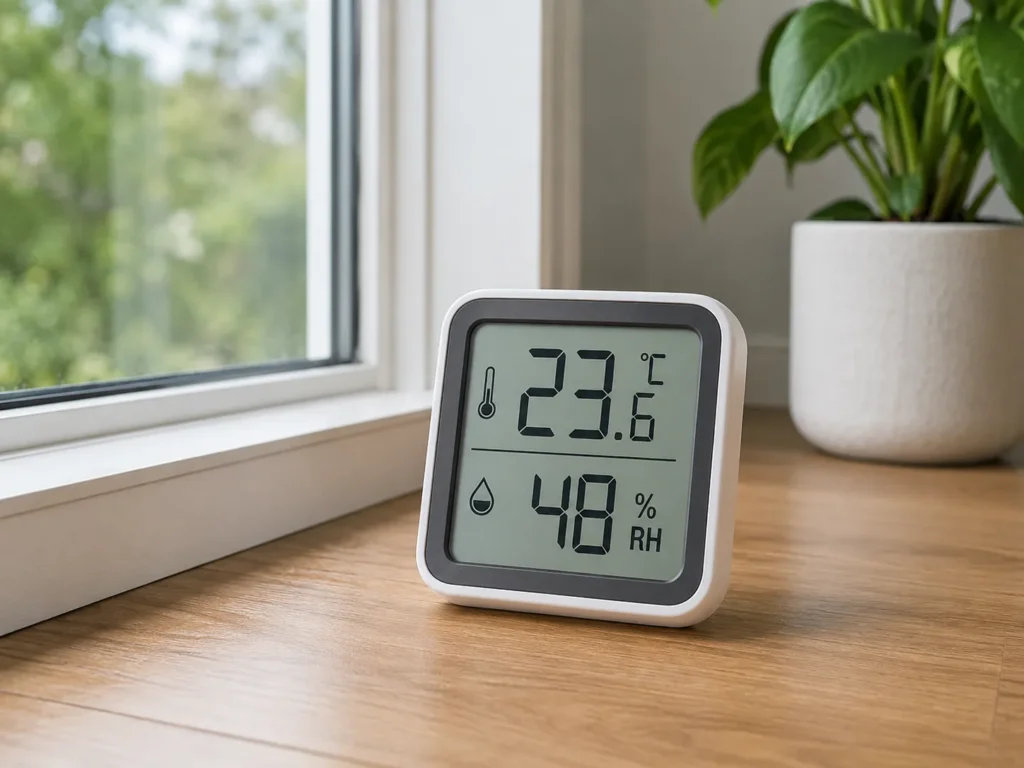
Aim to hold the room at normal living conditions throughout: roughly 18–22°C and around 40–60% relative humidity (some manufacturers specify a tighter band, such as 35–55%). The principle that matters most is this — acclimatise to in-use conditions, not building-site conditions. If the house will be lived in and heated, the heating should be running and settled before and during acclimatisation, so the boards adjust to how the room will genuinely be used rather than to a cold, empty shell.
Don’t guess at the numbers. A simple hygrometer tells you the room’s relative humidity, and for larger or higher-value jobs a data logger left in place gives you a record of conditions over the full acclimatisation period. Stable, consistent conditions are the goal — wild swings during acclimatisation are as harmful as the wrong average.
Subfloor moisture and site readiness (test, don’t guess)
Acclimatising the boards is only half the job — the subfloor and the site have to be ready too. Before any flooring goes down, the wet trades must be finished and dry (plaster, screed and paint), the building must be watertight with glazing in, and the heating commissioned.
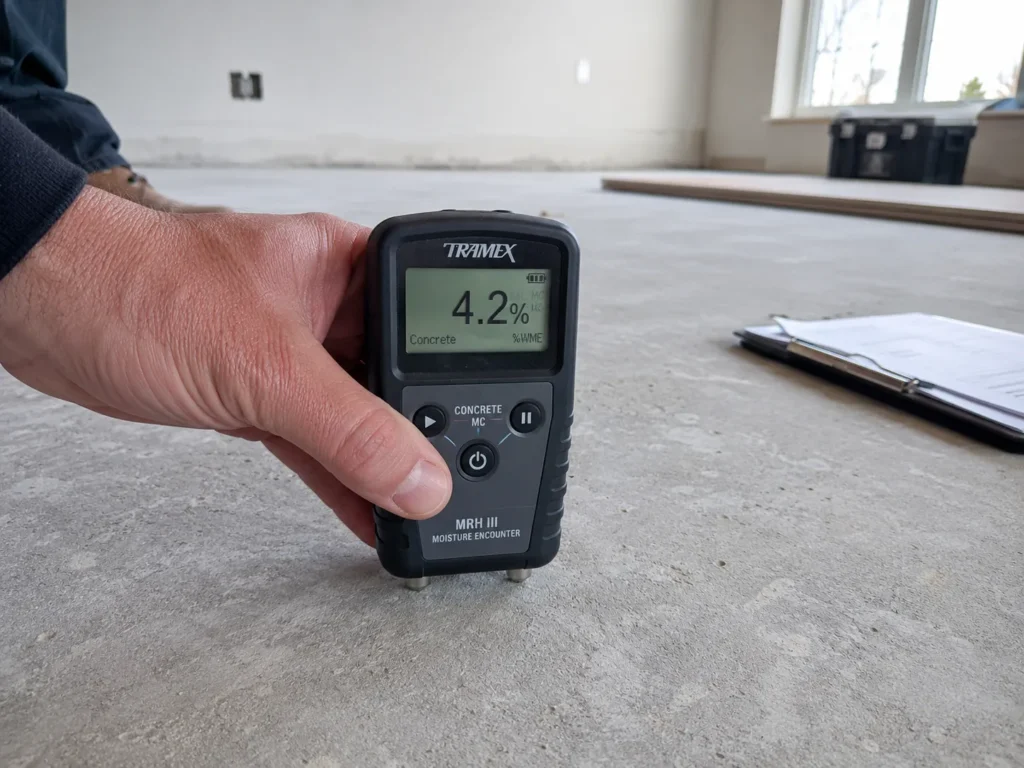
Then test the subfloor rather than trusting the calendar. The British Codes of Practice used across Ireland — BS 8201 for wood floor coverings, BS 8203 for resilient coverings, and BS 5325 for textiles — recognise the insulated hygrometer box as the definitive test. The box is sealed to the floor and left in place for around three to seven days so the trapped air reaches equilibrium with the slab. Under BS 8203, a floor is generally considered dry enough at 75% RH or lower for resilient coverings, and 65% RH or lower for timber (and for timber over underfloor heating). Carbide (CM) testing is an accepted alternative for some screeds, while handheld impedance and pin meters are useful for quick indicative checks but aren’t the definitive measure. For a timber subfloor, the moisture content should typically sit below about 12% and within a couple of percent of the new flooring.
Screeds are where Irish new builds catch people out. A traditional sand-and-cement screed dries at only about 1mm per day for the first 40–50mm, then slower — so a 50mm screed can realistically need around two months before it’s ready, and anhydrite screeds dry slower still. If the subfloor reads too wet, a surface damp-proof membrane (DPM) may be needed before fitting. Pairing the right underlay for Irish conditions with a sound subfloor protects the finished floor for the long term.
Underfloor heating: the special steps
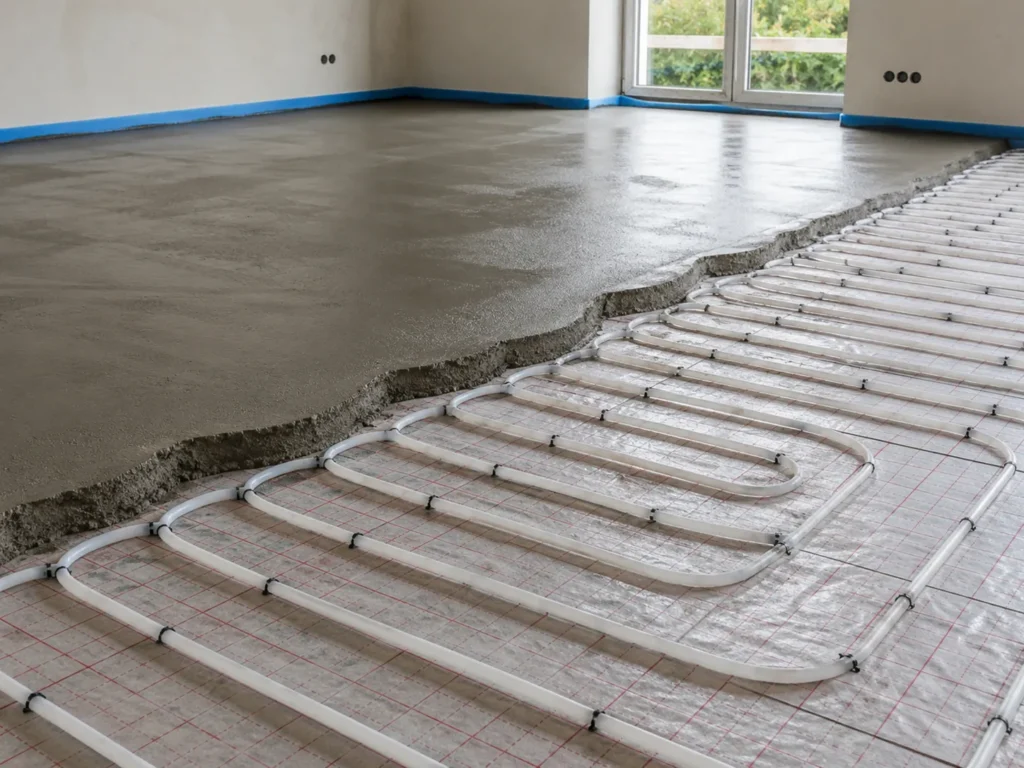
Underfloor heating (UFH) is increasingly standard in Irish new builds, and it changes the routine. First, the screed must be fully cured and then commissioned — taken through a gradual heat-up and cool-down cycle — before any flooring is laid, to drive off construction moisture and prove the system. Skipping commissioning traps moisture beneath the new floor.
Second, manage the heat during acclimatisation and fitting. Many manufacturers ask you to turn the UFH down (often to around 18°C) or off while the boards acclimatise and during installation, then ramp the temperature back up slowly over several days afterwards to avoid thermal shock. Choosing a floor designed for UFH and Irish humidity makes all of this far more forgiving — our best flooring for underfloor heating guide covers the options, and our Lignum Strata engineered range is built specifically for UFH, humidity and subfloor performance in Irish homes.
Step-by-step: acclimatising flooring in Ireland the right way
- Check the site is ready — wet trades dry, building watertight, glazing in, heating commissioned.
- Test the subfloor with a hygrometer (or CM test) and confirm it meets the manufacturer’s limit (e.g. ≤75% RH resilient, ≤65% RH timber).
- Get the room to living conditions — heating on and settled at ~18–22°C and ~40–60% RH.
- Deliver the flooring into that room and lay the packs flat, supported, off bare concrete and away from external walls.
- Read the datasheet for packaging (sealed or stickered) and the exact acclimatisation window.
- Measure conditions with a hygrometer; for bigger jobs, log them over the full period.
- Wait the full window — 48–72 hours for most floors, up to 1–2 weeks for solid wood.
- Confirm the moisture readings line up between flooring and subfloor before opening more than you’ll fit.
- Fit the floor, leaving the correct expansion gap around the perimeter.

What happens if you skip or rush acclimatisation
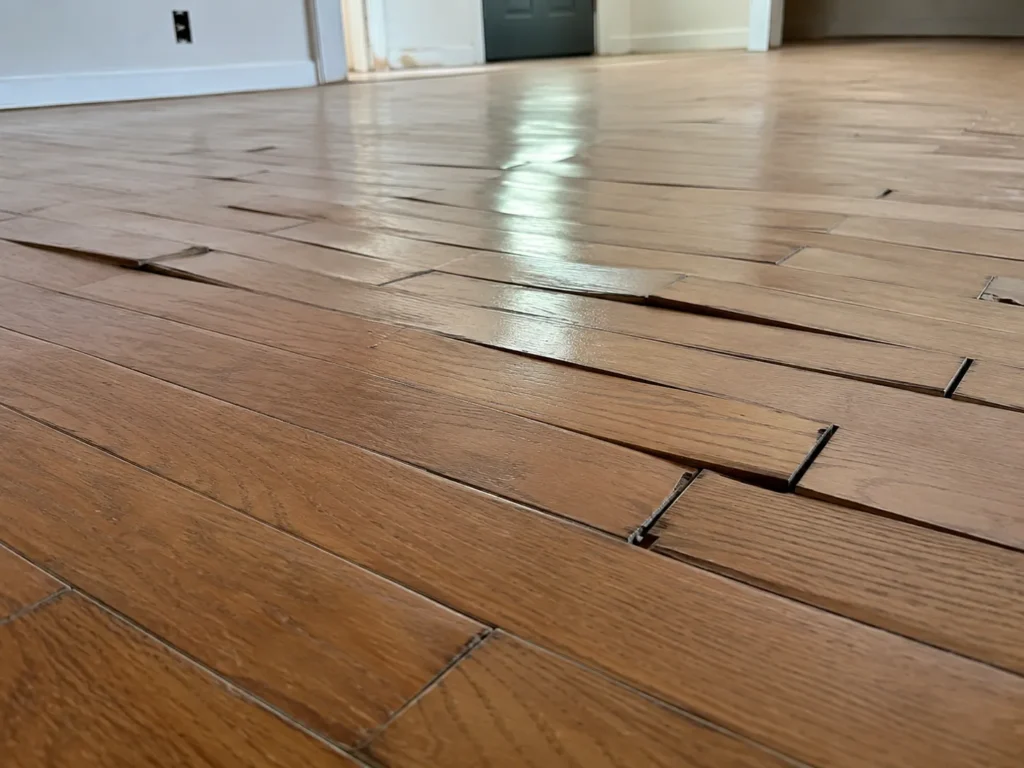
Skipping this step doesn’t prevent the wood from moving — it just delays the damage until after it’s fitted, when it’s far harder and more expensive to fix. The classic failures we’re called out to are:
- Gapping — boards fitted while over-damp shrink as the room dries, opening visible lines between planks.
- Cupping — board edges rise above the centre, usually from moisture reaching the underside (a wet subfloor is a common culprit).
- Crowning — the centre sits proud of the edges, often when a damp or cupped floor is sanded too soon.
- Peaking and buckling — with no expansion room, swelling boards push against each other and lift off the subfloor.
- Telegraphing and delamination — subfloor or moisture issues show through the surface, and engineered layers can separate.
These are the most common flooring problems we see in Ireland, and almost all of them trace back to moisture and skipped preparation. A failed floor often means re-supplying and re-fitting — exactly the kind of hidden cost of a flooring installation that a few days of patience would have avoided.
Common storage and acclimatisation mistakes
- Storing packs in the garage, shed or conservatory instead of the installation room.
- Acclimatising in a cold, empty building, then turning the heat on only after fitting.
- Leaving packs sealed when the manufacturer wants them open — or opening them all at once.
- Allowing too short a window, especially for solid wood.
- Ignoring the subfloor and trusting the calendar instead of a moisture test.
- Fitting straight after wet trades while plaster or screed is still drying.
- Stacking against external walls or beside radiators, creating uneven conditions.
- Leaving no expansion gap, or applying the same window to every product regardless of type.
Warranties, standards and getting it right
Acclimatisation isn’t just best practice — it’s usually a condition of the warranty. Manufacturers commonly require documented acclimatisation and subfloor moisture readings within their stated limits, and when a claim is assessed, skipped acclimatisation or a too-wet subfloor is one of the first things investigated. Get it wrong and cover is routinely refused.
Protect yourself by keeping a simple record: the moisture readings (room and subfloor), the dates, and the conditions held during acclimatisation. Work to the relevant British Standards (BS 8201 and BS 8203) and the specific manufacturer datasheet for your product. It’s worth understanding how flooring warranties work in Ireland before you buy — and choosing flooring that’s built for Irish conditions in the first place.
Let FBS Flooring handle it
Acclimatisation is straightforward in principle and easy to get wrong in practice — especially against an Irish climate that works against you all year. That’s where we come in. FBS Flooring supplies correctly conditioned flooring and fits it to manufacturer and warranty standard, including the subfloor moisture testing and acclimatisation that protect your investment. It’s all part of our flooring services across Ireland.
If you’re still choosing a floor, the Continental Collection is built for everyday durability in Irish homes, while Lignum Strata is engineered for underfloor heating, humidity and demanding subfloors.
Book a free survey or talk to our fitters — we’ll test your subfloor, acclimatise your floor correctly, and fit it so it lasts.
FAQ
How long should flooring acclimatise in Ireland?
Most floors need 48–72 hours in the room where they’ll be fitted, but solid hardwood can need one to two weeks, and flexible vinyl as little as 24–48 hours. Always follow the manufacturer’s window, and don’t fit until the moisture readings line up — in a damp Irish climate, rushing is the main cause of failure.
Do I need to acclimatise laminate or vinyl flooring?
Yes. Although they’re largely synthetic, laminate and vinyl still expand and contract with temperature and humidity. Laminate typically needs 48–72 hours and flexible LVT around 24–48 hours. Some rigid SPC products state little or no acclimatisation — check the datasheet, because it varies by product.
Can I store flooring in the garage or shed?
No. A garage, shed, conservatory or any unheated, non-watertight space has different conditions from your living space, so the boards adjust to the wrong environment and then move once installed. Always store and acclimatise the flooring inside the actual room where it will be fitted.
What humidity should a room be before fitting a floor?
Aim for roughly 18–22°C and around 40–60% relative humidity, held at the room’s normal in-use conditions with the heating running. A simple hygrometer confirms it. This matters in Ireland, where outdoor humidity often sits in the 70s and 80s — well above what a wood floor wants.
Does skipping acclimatisation void my flooring warranty?
Very often, yes. Manufacturers commonly require documented acclimatisation and subfloor moisture readings within their limits, and skipped acclimatisation is one of the first things checked in a claim. Keep a record of your readings, dates and conditions to protect your cover.
How do I know if my subfloor is dry enough?
Test it rather than guessing. British practice (BS 8201 and BS 8203) uses an insulated hygrometer box sealed to the floor for several days; a screed is generally considered dry enough at 75% RH or lower for resilient floors and 65% RH or lower for timber. Traditional screeds dry at only about 1mm per day, so a thick screed can take weeks.
Should underfloor heating be on while flooring acclimatises?
The screed must be fully cured and commissioned first. During acclimatisation and fitting, many manufacturers ask you to turn the heating down (often to about 18°C) or off, then raise it gradually over several days afterwards to avoid thermal shock. Always follow your flooring and UFH manufacturer’s instructions.