Skip to content

A clean overview of the main sections in this Irish guide comparing 2mm, 3mm, and 5mm underlay choices.
Underlay Thickness Comparison Ireland
Most people picking floors care about shade and plank shape right away. Yet a too-thin layer beneath might dull warmth return, soften footfeel, shift sound levels, even tilt how steady things stay.
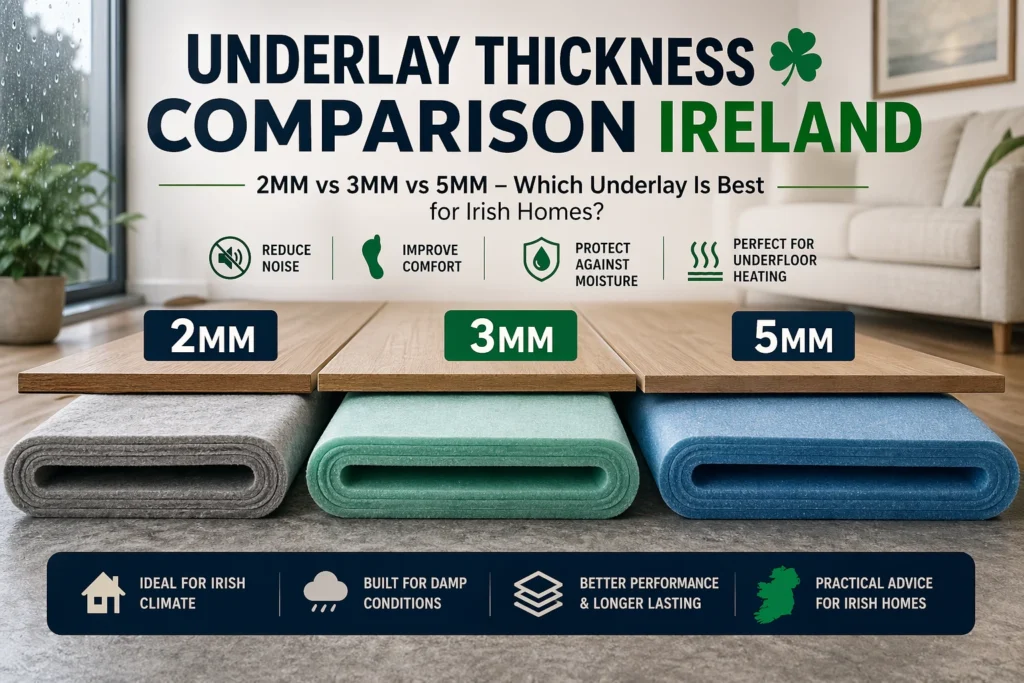
Underfoot thickness matters more than you might think. Two millimeters keeps things slim where space is tight. Three offers a middle ground when comfort and stability both matter. Five steps up for serious give beneath your feet. Laminate planks tend to prefer something steady but not too soft. Engineered wood likes support that also quiets sound. Concrete below can be cold hard and uneven – thicker helps smooth it out. Water-based underfloor heating needs material thin enough not to block warmth yet strong enough to protect pipes. Each option balances trade-offs depending on what’s underneath and who walks above. Choice shifts based on floor type, heat presence, and how solid the base feels.
One way to look at underlay is by how thick it comes – some pick 2 millimetres, others go thicker with 3 or even 5. Thickness shifts how soft the floor feels plus affects noise control. For homes in Ireland using laminate planks, a proper base layer matters just as much as the top surface. Engineered wood floors need support too, especially when laid above concrete. When heat runs beneath the floorboards, the underlay must handle warmth without warping. Moisture resistance plays a role where damp might rise from below. Sound reduction becomes key in multi-level buildings or busy households. Brands like FBS Flooring supply options suited to Irish conditions. Installation services across Dublin often recommend matching underlay traits to room needs. Each choice links back to what lies underneath before the finished floor appears
What underlay thickness actually changes
Thicker underlays can change how a floor sounds when walked on. Because of added cushioning, footsteps may seem quieter. Even so, no amount of padding will stop moisture creeping up from below. Floors still need proper prep before laying planks. Click joints might lock more smoothly with support beneath them. On uneven bases, slight imperfections get masked – just not large ones. Heat retention improves a little, thanks to trapped air layers. Yet warped boards won’t straighten just by adding foam underneath. Some bounce is nice, if you like softer steps. Still, nothing replaces solid groundwork.
Most people don’t notice how crucial this is in Ireland. Homes there usually sit on concrete, face moist air near the ground, shift with indoor moisture changes, while wanting warm floors beneath the surface. Floor performance isn’t only shaped by comfort when walked on. Stability under weight plays a role too, along with how fast warmth moves up through layers. Joints stay tighter longer depending on what lies below them.

Most people miss it. Thickness alone won’t tell you if an underlay works – your floor type might need less cushion, your subfloor could demand more support. A living room above a garage behaves differently than one on solid concrete. Heat rising through wood changes how materials compress. Wrong choice? Floors shift. Joints strain. Sounds echo strangely. Warmth lags. Right fit keeps things still, steady, silent.
If you want a broader Irish overview of flooring systems, installation realities, and subfloor preparation, see Flooring Services Ireland: https://fbsflooring.ie/flooring-services-ireland-the-complete-locally-informed-guide-2026/
2mm underlay: best use cases, strengths, and limits
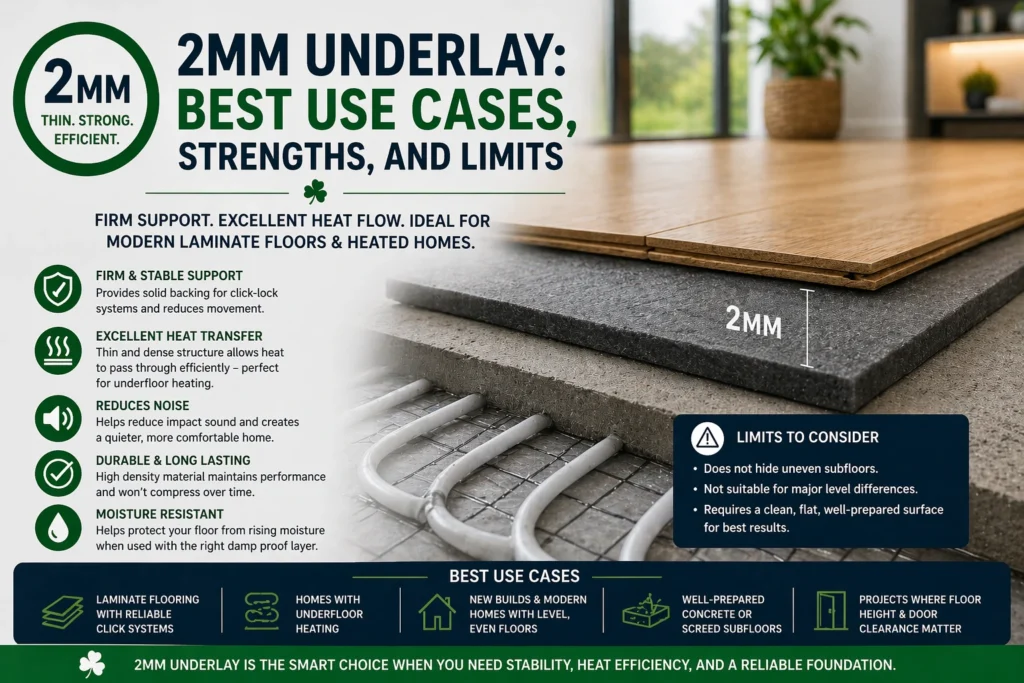
A solid pick for today’s laminate floors, 2mm underlay gives steady backing while helping locks engage smoothly. Firmness here pairs well with heated subfloors beneath. Clicks stay secure when the base doesn’t shift. Heat moves through efficiently without soft layers slowing transfer. Stability wins out where even pressure matters most.
Most new builds across Ireland handle 2mm just fine. Where floors sit level without major dips, that thickness fits right in. Stability tends to matter more than cushioning there. Click-together planks stay put easier when supported by something firm underneath. Less bounce means fewer creaks over time. Dense material at 2mm keeps everything steady during daily use.
What stands out next is how well it handles heat. Because these underlays tend to be both thinner and more compact, they interfere less when placed over underfloor heating – making them a smarter fit if warmth delivery counts. Heat moves easier through tighter layers, so that helps too.
Less than two millimeters leaves little room for error. When flaws exist underneath, they show right away – no hiding them. Uneven spots stay uneven, even after laying it down. A shaky foundation stays shaky. Thickness alone won’t fix what’s broken below. What matters most? Fixing the base first. Problems start long before the top layer goes on. The solution hides beneath, not above.
If you’re looking at different laminates while also needing tips on putting them down, check out:
Where to Buy Laminate Flooring in Dublin: https://fbsflooring.ie/where-to-buy-laminate-flooring-in-dublin-2026-homeowners-guide/
How to Install Laminate Flooring in Dublin: https://fbsflooring.ie/how-to-install-laminate-flooring-in-dublin-step-by-step-guide-from-local-fitters/
When 2mm underlay makes most sense
Laminate flooring with a reliable click system
Homes with underfloor heating
Stability takes priority over comfort in these apartments. Where firmness wins out, ease comes second. These homes value strength more than give. Not about plush – more about lasting. What holds up matters most here
Well-prepared concrete or screed subfloors
Projects where floor height and door clearance matter
3mm underlay: the best all-round option for many Irish homes
Most Irish households find that a 3mm layer beneath the floor hits a sweet spot – comfort doesn’t take over, noise stays manageable, yet the base still feels steady. What surprises shoppers? How much it does without drawing attention.
Most townhouses, row houses, flats, and typical home updates go for this depth. Homes usually want something sturdier underfoot compared to flimsy 2-millimeter padding – yet they arent after anything too soft either. Right there, in that balance, 3 millimeters stands out. It holds its shape without sacrificing cushion.
A solid 3mm layer beneath laminate helps cut down echo while keeping steps comfortable, yet firm. When it comes to engineered wood that floats, three millimeters works well right out of the gate – particularly if the space stays dry, the subfloor is ready, and slim height isn’t top priority.
What really counts isn’t what the tag says. A top-grade 2mm layer might work better than a weak 3mm version. Because how dense it is, how well it resists squashing, if it handles damp, and whether it fits your setup – those weigh just as heavy as depth.
For a broader look at domestic flooring choices in Ireland, see Residential Flooring in Ireland: https://fbsflooring.ie/residential-flooring-in-ireland-the-complete-2026-guide-by-fbs-flooring/
Why 3mm is often the smartest middle ground
Most of the time it feels better but stays firm enough
Real homes tend to find more even sound through it
It suits many floating floor systems
It works well in standard Irish domestic renovations
Most times, it beats going with 5mm right off the bat
5mm underlay: where it helps and where it backfires
A half-centimeter pad might help sometimes. Yet folks often grab that size without good cause.
Most people think thick carpet underlay must be superior. Yet 5 millimeters tends to suit niche needs instead of being the default top option. Where minor cushioning helps during refurbishments that size finds its place. Upper floors sometimes prefer it too since quiet steps beat thermal performance there.
Thicker underlay isn’t always better. While it adds cushion, less firm support might wobble beneath click-lock planks. Each step could feel slightly looser than expected. Heat rises slowly when insulation gets too dense. Door gaps sometimes shrink enough to cause scraping. Transitions between rooms may need extra adjustments. Even small bumps add up in tight spaces.
Most people get it wrong when they treat 5mm like a fix for poor prep work. Not meant to replace leveling, yet often used that way. When moisture shows up underfoot, skipping real solutions backfires fast. Uneven surfaces demand attention before anything else goes down. Fix the root cause – always.
Check out real-life examples of floor fitting in Dublin plus other spots across Ireland here:
Flooring Installation Dublin: https://fbsflooring.ie/flooring-installation-dublin-the-complete-local-guide-costs-preparation-fitters-aftercare/
Flooring Installation Dublin Guide for Homes & Businesses: https://fbsflooring.ie/flooring-installation-dublin-the-complete-2025-guide-for-homes-businesses/
At times, half a centimeter works just fine
Selected renovation jobs with mild irregularities
Rooms where softness underfoot is a major priority
Installations with no UFH concerns
Where the floor setup obviously works well enough. Cases that show how strong the foundation really is. Times when support from below makes all the difference. Instances proving stability comes from beneath. Moments the base proves its worth without question
2mm vs 3mm vs 5mm: what really separates them
Most of the time, 2mm stands out because it handles details well and holds steady. When laminate goes down over underfloor heating, this thickness tends to fit just right – particularly if the base layer underneath is flat and solid.
A third of a centimeter tends to strike the right balance. For plenty of households across Ireland, it delivers a mix of steady support, sound control, and underfoot ease that fits well.
Most pick 5mm thinking it’s best. Yet that choice often comes from habit, not logic. Useful? Yes – when applied with purpose. But rarely because it outperforms others. Assumptions lead to misuse. Careful thought must guide its use, never default preference.
Take off the polish, then it comes down to this
Pick 2mm if precision, steady results, or moving heat efficiently are key. Yet go this route only when those details truly shape how well things work
For everyday life in an Irish house, three millimeters brings the most reliable mix of toughness. A bit thicker might resist dents better, yet feels heavier to handle daily. This size stands up well without making windows harder to open. Most families find it covers what they need without surprises later on
Only go for 5mm if both the entire flooring setup and the space itself make it obvious
Best underlay thickness for laminate in Irish homes
Laminate? Go with 2mm or 3mm – skip the 5mm unless sure. Most times it’s just too thick for smooth results.
Most times, a 3mm underlay works well when fixing up a typical Irish half-joined home or flat. It cuts noise and adds comfort beyond what thinner base layers offer. Yet when heat pipes hide below the floor, every millimetre counts – so 2mm might fit just right. Some locking planks also prefer firmer backing, making the thinner option smarter in those spots.
Here’s how FBS Flooring stands out beyond just offering products. When it comes to solid laminate performance, the right underlay makes a difference – one that aligns with the plank type, foot traffic level, floor beneath. People looking for cost-effective yet practical solutions might find useful insights at Budget-Friendly Flooring Options in Dublin: https://fbsflooring.ie/budget-friendly-flooring-options-in-dublin-real-prices-best-value-expert-advice-from-fbs-flooring/. What matters most shows up after installation, not before
Simple laminate rule
Start with 2mm or 3mm when picking laminate in Ireland – that’s the smarter move. Only go for 5mm if there’s a real reason to step up.
Most suitable padding depth for fitted timber floors across Ireland’s climate zones
Wood made by people asks for extra thought since how it’s built, the size of each piece, where you put it, along with whether it works above floor heating changes every time.
Most Irish households find 3mm works well for floating engineered wood floors. Comfort and sound control tend to balance nicely at that thickness. Wider planks? Then a slimmer, firmer pad might suit better. Tight specs or underfloor heating below? A thin, dense layer could handle those demands more easily.
Glued floors shift everything about what goes underneath. Because of this, knowing exactly which materials fit where makes a difference. Instead of just laying things down, each layer connects – board to glue to base – with air moisture and temperature playing their part too. Wrong choices here cause problems later on.
Peeking at wood-look flooring? Check here
Engineered Wood Flooring in Dublin: https://fbsflooring.ie/engineered-wood-flooring-in-dublin-a-true-locals-guide/
Hardwood Flooring Dublin: https://fbsflooring.ie/hardwood-flooring-dublin/
Parquet Flooring Dublin: https://fbsflooring.ie/parquet-flooring-dublin-guide/
Best practical rule for engineered wood
Most times, 3mm makes a solid beginning – yet the maker’s specs for flooring take priority every time.
Underlay thickness on concrete subfloors in Irish homes
Out here in Ireland, it is often the floor beneath that brings up these questions. A good number of houses – think ground level rooms, newer additions, even lower areas – sit right on poured concrete or smooth screed layers. Because of this setup, knowing how dampness behaves becomes necessary almost immediately.
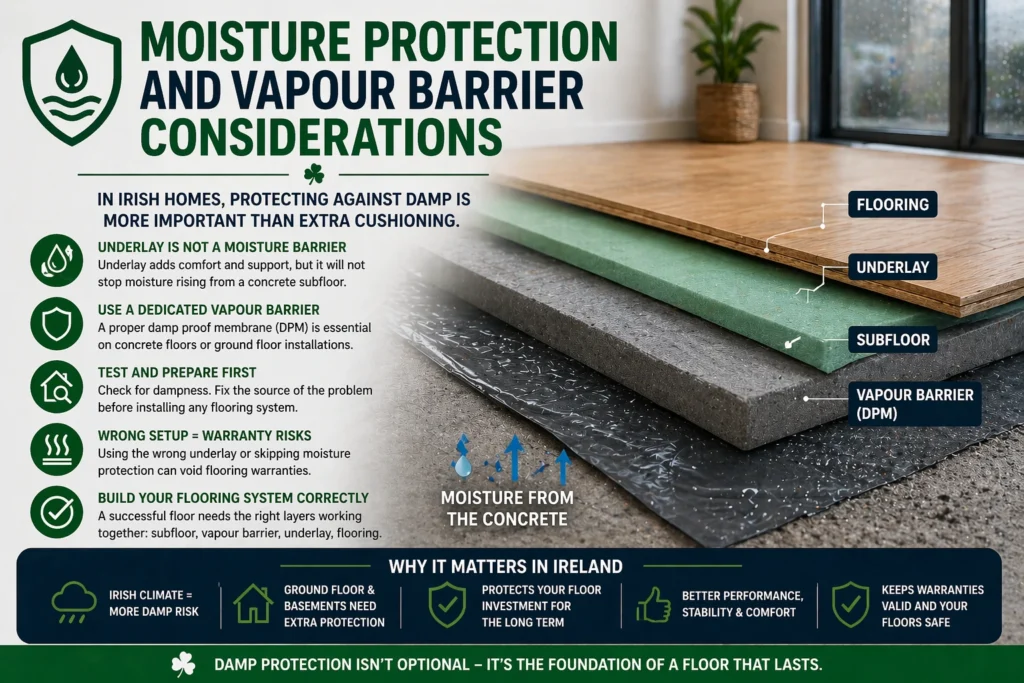
Here’s what matters most: even a thick underlay won’t stop moisture. It acts as cushioning, yet offers zero barrier against damp. When vapour resistance is required, relying on padding depth misses the mark entirely. Protection has to come from proper materials built into the full assembly. Skipping dedicated measures risks long-term issues beneath the surface.
Most solid Irish concrete floors settle between 2mm and 3mm when making choices. Flat surfaces that need strength or underfloor heating often work best at 2mm. When quiet steps and slight cushioning count, plus space permits, 3mm makes sense. Only reach for 5mm if the situation really demands it.
Check here for more on Ireland’s damp conditions and what lies beneath floors
Moisture & Humidity in Irish Homes: https://fbsflooring.ie/moisture-humidity-in-irish-homes-2026-flooring-suitability-guide-county-by-county-data/
Flooring Solutions for Irish Basements: https://fbsflooring.ie/flooring-solutions-for-irish-basements-considering-damp-prevention-air-flow-and-hazard-evaluation/
Underlay thickness and underfloor heating compatibility
Most times, go thin and tight with underlay when heat hides below the floorboards.
This change gains importance since plenty of people upgrading homes in Ireland link new floors with better warmth and efficiency. Though a denser underlay might seem cozy at first glance, within underfloor heating setups it tends to slow response times, actually fighting how the system operates.
Most Irish underfloor heating setups work better when the underlay is thin but suitable, the flooring has the right rating, while prep of the base stays thorough. This often beats using a plush, bulky pad – since those trap warmth and shift too much underneath.
For deeper UFH guidance, see Best Flooring for Underfloor Heating in Ireland: https://fbsflooring.ie/best-flooring-for-underfloor-heating-in-ireland-2026-expert-guide/
UFH rule in simple terms
Thicker isn’t always better when it comes to underlay on a heated floor. Pick one that actually supports how the heat moves through the flooring.
Quietness comes through softer steps. Comfort shows up when your feet stop aching. The way floors respond changes how you move across them
Just because it’s thicker doesn’t guarantee less noise.
Most Irish households, particularly those in flats or terraced houses, tend to notice echo more than hardness underfoot. This makes 3mm padding a frequent favorite in professional settings. Its effect smooths footsteps while reducing noise, yet stays firm enough to avoid springiness.
If the main issue is acoustic comfort, the smarter question is not “Should I go to 5mm?” but “Which dense acoustic underlay best suits my floor system?”
Check out tips just for apartments here
Soundproof Flooring in Ireland: https://fbsflooring.ie/soundproof-flooring-in-ireland-2026-best-choices-for-apartments-semi-detached-houses/
Flooring for Small Irish Apartments: https://fbsflooring.ie/flooring-small-irish-apartments-2026/
Moisture protection and vapour barrier considerations
When it comes to Ireland, weather shapes everything here. Before talking about how cozy a material feels – or how thick it seems – think first about dampness. That shift in air matters more than personal taste ever could.
Should moisture be present – whether on a ground-level slab, within a basement area, extending off an old foundation, or beneath aged flooring – a professional check makes sense. Without fixing damp first, even thick padding underneath won’t help much at all.
Here’s when warranty trouble shows up. Pick the wrong base under a poorly chosen floor, costs rise fast.
If you’re curious about the links between dampness, setup problems, and guarantee limits, check here:
Flooring Warranties in Ireland: https://fbsflooring.ie/flooring-warranties-ireland/
Flooring Solutions for Irish Basements: https://fbsflooring.ie/flooring-solutions-for-irish-basements-considering-damp-prevention-air-flow-and-hazard-evaluation/
Irish Buyers Often Overlook These Errors
Most people think more thickness means better quality. Wrong. A dense pad isn’t always best. Heavier doesn’t equal higher grade. Density can fool you. What feels solid might trap heat. Too much bulk may block airflow. Comfort fades fast when breathability fails. Real performance hides in structure, not size.
Wrong moves happen when folks toss down padding to fix shaky floors. A wobbly base gets ignored while extra layers pretend to help. Trouble creeps in later – bounces, creaks, slips. The ground needs firmness first, not a soft patch on weak support. Skipping solid prep leads straight back to problems.
Most people get it wrong by picking underlay separately from the floor choice. Truth is, everything – the plank, padding, base layer, damp barrier, even heat elements – works together like parts of a single system.
Bought just because it feels nice? That overlooks how well it lasts. Stability matters more over time.
Wrong step number five? Ignoring what products are available alongside expert help. People checking out different setups might want to peek at FBS’s current lineups right here instead
Products: https://fbsflooring.ie/products/
Shop: https://fbsflooring.ie/shop/
When thicker underlay causes problems
When there’s too much give, a thick underlayment backfires. Bounce builds up where stability should be. Click joints lose their grip over time. Heat moves slower through the added layer. The false sense of readiness makes people skip needed repairs below. What feels like cushion ends up costing more down the line.
Height changes sneak up during renovations, catching owners off guard. Floors rise when underlayment thickens – door gaps shrink because of that. Transitions stumble without warning, thanks to uneven rises. Skirting gets messy where walls meet new layers. Appliances? They might not fit beneath counters anymore. Neighboring rooms expose level mismatches fast. Apartments feel every millimeter, even if it seems small at first.
A bouncy floor might seem cozy, yet wobble beneath your feet ruins it. Stability matters more than softness when walking on any surface.
Room-by-room recommendations
Most Irish households find that 3 millimetres hits the sweet spot across lounges and sleeping areas. Comfort gains come through more clearly here, while sound dampening improves too – on top of steadier performance underfoot.
Most flats work better with a tight 2mm or 3mm layer beneath flooring instead of piling on bulk just to add depth.
Start at 2mm in UFH spaces if nothing else guides you. Most systems leave it open – this fits. Where setup details step in, follow those instead. Otherwise? Begin here.
Older houses often hide surprises beneath floors – test for dampness first. Skipping inspections might cost more later. Thicker padding won’t fix hidden wet spots. Wait on extra layers until the base is sound. Problems underneath show up fast once covered. Better readings early mean fewer headaches after install.
When it comes to engineered wood in feature spaces, 3mm tends to work well as a general baseline – unless guidance from the maker or installer says otherwise.
Why professional fitting matters
Flat floors change everything. Moisture levels matter just as much as what kind of heat lives below. Room by room, needs shift – thickness isn’t one-size-fits-all. The way planks click together plays a role too. Build-up height can make or break the fit. Labels rarely tell the full story.
Flooring choices become simpler for people in Ireland when they look at what FBS offers. Rather than picking floor coverings and padding in two steps, shoppers find advice that covers both together – this cuts down mismatch mistakes.
For a look at what’s offered, or to reach out right away, go here:
Services: https://fbsflooring.ie/services/
Contact Us: https://fbsflooring.ie/contact-us/
Home: https://fbsflooring.ie/
So, what really works best when it rains all the time? Depends on how deep the mud gets.
Here’s the simplest way to see it
For laminate floors on solid bases with heated systems below, 2mm frequently works most effectively. Though small, that thickness handles temperature shifts well when installed properly over even surfaces.
A third of a millimeter often works just right in Irish households since it pairs cushioning with quiet and steadiness nicely. Most homes find that thickness handles daily wear without complaint, holding up while staying soft underfoot. It fits neatly beneath floors, neither too thin nor bulky, keeping things even across rooms.
A different pick for certain updates or feel-focused setups – 5mm skips being the go-to high-end by default. Though slim, it suits only particular uses rather than standing first in line across the board.
Most of the time, performance comes down to how pieces work together, not which one seems fancy on its own. So it happens that pairing matters more than peak specs alone. A thicker pad might look impressive until you lay it beneath the wrong surface. Matching materials shapes results, not just picking big numbers off a shelf.
If you are comparing laminate, engineered wood, parquet, or UFH-ready floors, browse the current FBS range here: https://fbsflooring.ie/products/ and contact the team here: https://fbsflooring.ie/contact-us/
FAQ
Is 3mm underlay better than 2mm?
It depends. While 3mm tends to suit most Irish households better when balancing ease and acoustics, 2mm holds up more reliably under underfloor heating plus rigid laminate setups.
Is 5mm underlay too thick for laminate?
Maybe it is. Too much cushioning beneath might make the surface feel cozier but weaken stability at connecting edges, possibly causing shifting down the line.
For Irish concrete floors, what thickness works best beneath the surface?
Most often between two and three millimeters thick. Size shifts based on what kind of floor it is. Moisture resistance plays a role too. When underfloor heating exists, that changes things as well.
Does thicker underlay reduce more noise?
Just because it’s thicker doesn’t mean it’s better. What counts is how tightly packed the material feels, along with how well it’s made. Sometimes a firm 3mm layer works harder than a plusher one at 5mm.
What underlay works best with underfloor heating?
A layer like this tends to be slim yet firm, built to work with warm floors beneath. It fits just right under the type of flooring picked for the room.
Is thicker underlay better for engineered wood?
It depends on the setup. Some installed floating wood floors work fine using a solid 3mm padding layer, yet manufacturer advice must guide every choice.
Can underlay fix an uneven floor?
Just tiny flaws here and there. Proper prep of the surface still matters more.
Buying underlay on your own might save money. Yet getting it from the floor seller ensures compatibility. One option skips extra shopping trips. The other gives more control over quality. Some suppliers bundle deals that seem convenient. But independent brands can perform better. Matching materials matters most in the end.
Most often handled by someone who knows floors well, since the padding underneath must work with how the floor itself is built – what it sits on, dampness levels, even if there’s heat below – all pieces fit together like parts of a single machine.