 Skip to content
For most Irish families with young children, click-fit luxury vinyl tile (LVT/SPC) is the best all-round choice, it’s waterproof, scratch- and impact-resistant, warm and quiet underfoot, easy to clean and cheap to maintain. Budget-conscious homes do well with AC4+ laminate, while carpet still wins in bedrooms for warmth and soft landings.
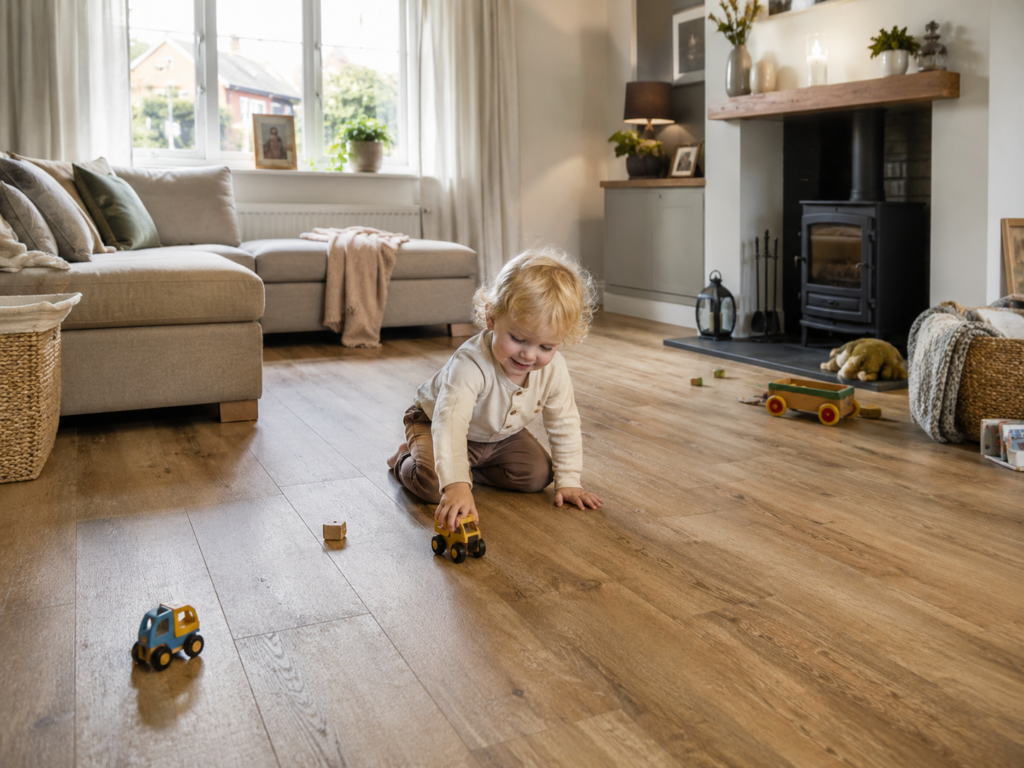
Choosing flooring for families with children in Ireland means planning for dropped toys, spilled Ribena, ride-on tractors, muddy football boots, and the odd felt-tip “masterpiece” on the skirting. Add Ireland’s damp, humid climate and the popularity of underfloor heating, and the floor that looked perfect in a showroom can disappoint within a year.
This guide cuts through the noise with practitioner-tested advice: how to judge impact and scratch resistance, what each floor type really costs to buy and maintain in euros, room-by-room recommendations for Irish homes, and how to get the longest life from your investment.
Why is family flooring different in Ireland?
Family flooring has to survive concentrated abuse that ordinary floors never see. The three big threats are impact (dropped toys and furniture), abrasion (grit dragged in on shoes), and moisture (spills, accidents and muddy paws). On Irish fits we most often see laminate edges swell where a child’s spilled drink sat overnight, and carpet matting in hallways within two winters.
Ireland’s climate raises the stakes. Our damp, temperate air means subfloors can hold moisture, so a non-waterproof floor laid without a proper test can cup, lift or grow musty. Underfloor heating — now standard in many new builds — also demands floors rated for it, with the right low-tog underlay and temperature limits.
The upside: pick correctly and a family floor can outlast the childhood that tests it.

What should you look for? The 7 buyer criteria
Before comparing materials, score every option against these seven factors. Each matters more in a busy household than in a show home.
- Impact resistance — how well the surface resists denting from dropped objects and heavy furniture. Rigid cores (SPC vinyl, tile) win; softer laminate cores can dent.
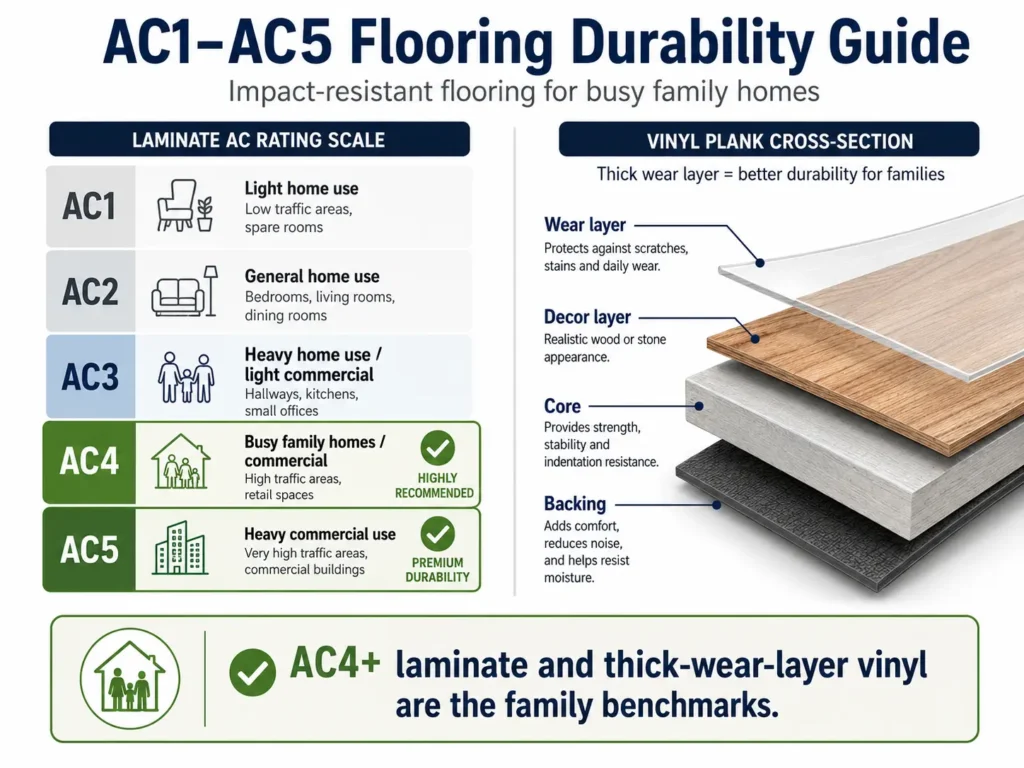
- Scratch/abrasion resistance — measured for laminate by the AC rating (AC1–AC5) and for vinyl by wear-layer thickness in microns. More is better.
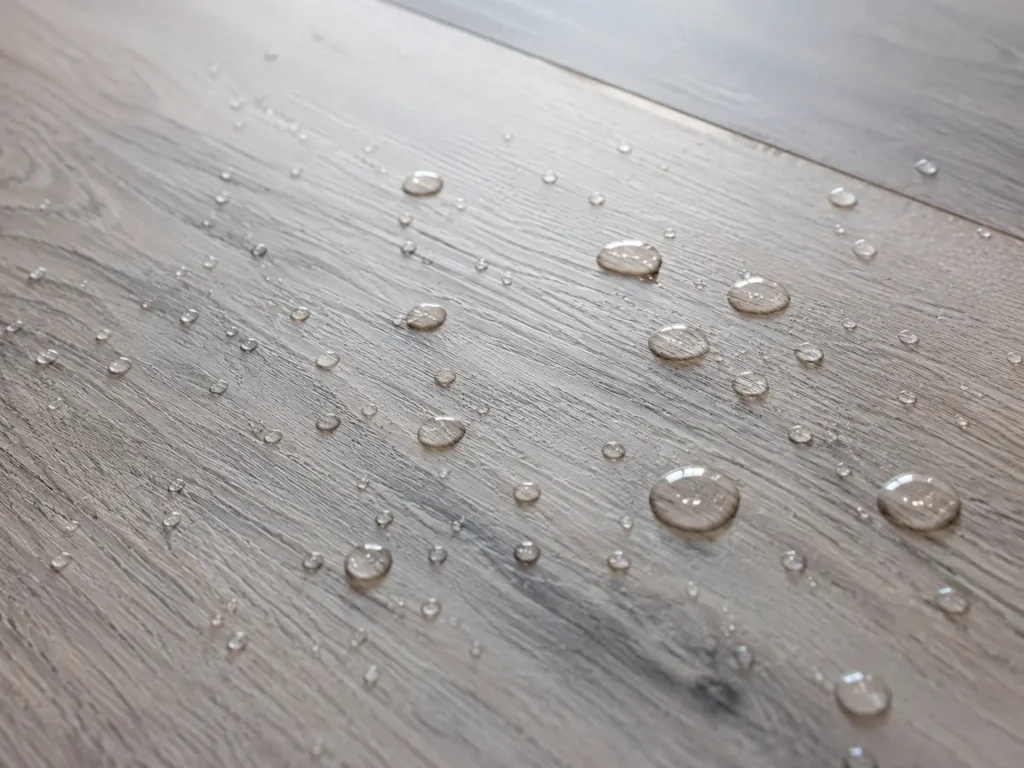
- Water resistance — Water resistance is a floor’s ability to withstand spills without swelling, staining or lifting. Fully waterproof beats “water-resistant”.
- Slip resistance — graded by R-rating (R9–R13); higher numbers grip better, which matters on stairs and in kitchens.
- Comfort and cushioning — softer, slightly warmer floors reduce the sting of toddler tumbles.
- Indoor air quality — look for low-VOC products carrying FloorScore or EU Ecolabel certification, especially in well-insulated Irish homes.
- Noise reduction — a good acoustic underlay stops that hollow “drum” and keeps peace in semi-ds and apartments.
Best flooring types for families, compared
Luxury vinyl tile (LVT/SPC) — the all-rounder
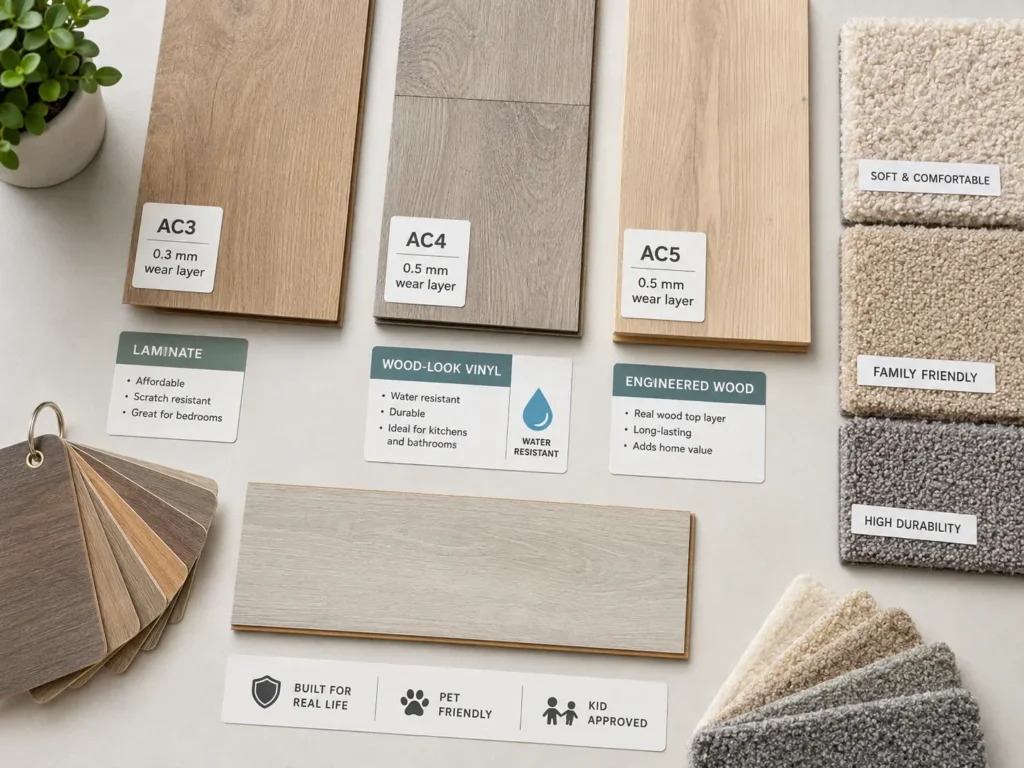
LVT, especially rigid SPC, is our top family recommendation. It’s 100% waterproof, warm and quiet underfoot, forgiving of falls, and a damp mop is all the maintenance it needs. Quality ranges (think Karndean or Tarkett) carry thick wear layers that shrug off toy cars and dog claws.
Weakness: it needs a smooth, level subfloor and sharp grit can mark cheaper budget tiles. Indicative supply: €20–€45/m². Browse options in the FBS Flooring product range.
Laminate — the value pick
Modern AC4/AC5 laminate is hugely scratch-resistant and the most affordable wood look going. It suits living rooms, hallways and bedrooms beautifully.
Weakness: standard laminate is moisture-sensitive at the joints and cannot be sanded back — damaged planks are replaced, not refinished. Choose a water-resistant range for kitchens. See our full laminate vs vinyl comparison. Indicative supply: €10–€25/m².
Engineered wood — the premium choice
Engineered wood gives real-timber warmth with far better stability than solid hardwood in our climate, and a hardwearing top layer can be sanded once or twice over its life.
Weakness: dearer, and it still scratches and dents, so it favours older children. Indicative supply: €35–€80/m² (verify against current stock).
Carpet — comfort where it counts
Carpet is the warmest, softest and safest underfoot — ideal for nurseries and bedrooms where toddlers crawl and fall.
Weakness: stains, traps allergens and wears fastest in family homes (5–10 years). A stain-resistant, solution-dyed nylon is worth the premium. Indicative supply: €12–€40/m².
Tile (porcelain/ceramic) — tough but hard
Porcelain tile is nearly indestructible and brilliant with underfloor heating in kitchens and utility rooms.
Weakness: cold and unforgiving — dropped mugs shatter and so, sometimes, do little knees. Best paired with rugs and UFH. Indicative supply: €20–€60/m².
Cork and rubber — the niche softies
Cork is naturally warm, quiet and cushioned; rubber is bulletproof in playrooms. Both are niche in Irish homes and need careful sealing, but they’re worth knowing about for dedicated kids’ spaces.
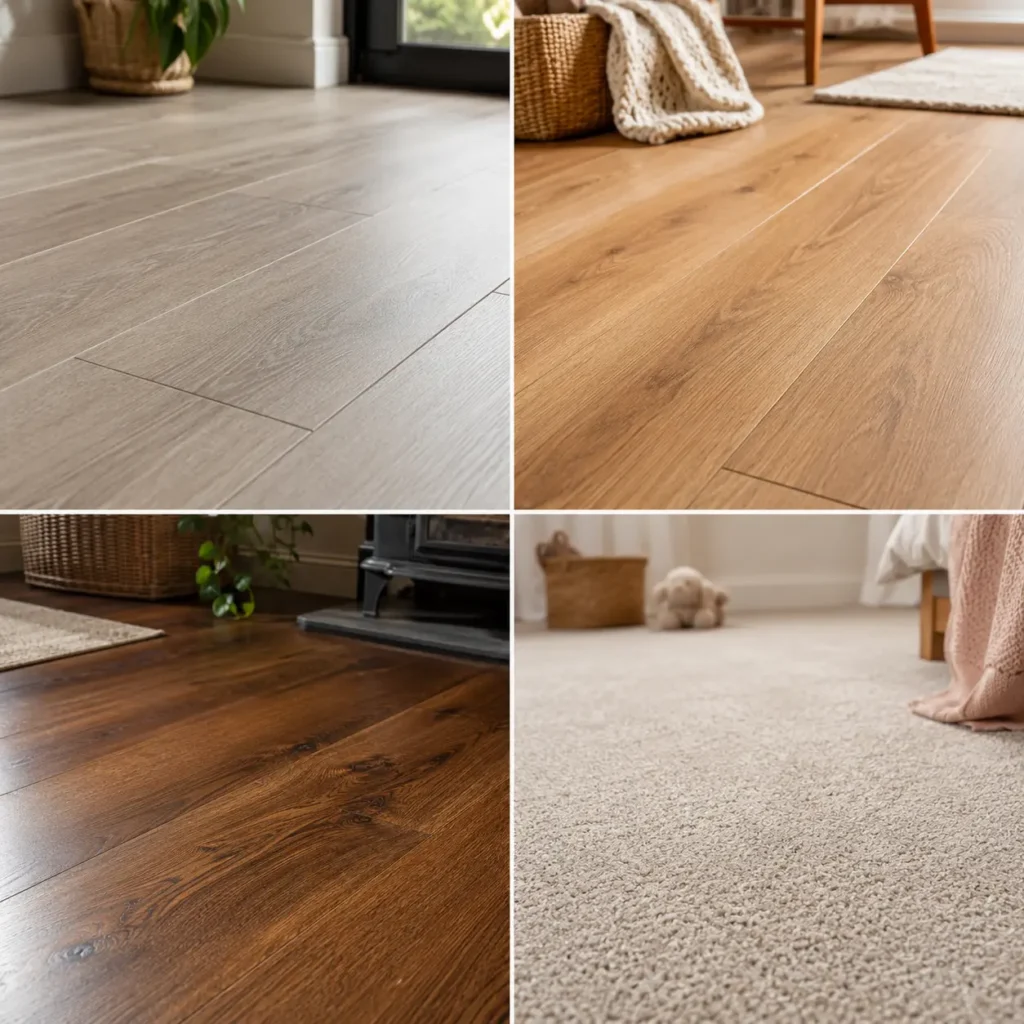
Impact resistance explained: what do the ratings mean?
Impact resistance is how well a floor resists denting and surface damage from dropped or dragged objects. For families, two numbers matter most. For laminate, the AC rating runs from AC1 to AC5 under the European standard EN 13329 — aim for AC4 or AC5 for a busy family home. Also, for vinyl, the wear layer (measured in microns) is the key figure; 0.3mm (300 micron / 12 mil) and up handles heavy domestic use.
For real wood, Janka hardness indicates dent resistance — oak and ash sit comfortably mid-range, while softer species like pine bruise easily under toy boxes. The practical rule: the harder the core and the thicker the wear layer, the better a floor copes with childhood.
Maintenance costs compared
Here’s the real-world picture: upfront price tells only half the story — lifespan and upkeep decide value. The figures below are indicative 2026 Irish ranges; confirm exact pricing with a current quote, as costs vary by subfloor, room size and brand.
| Flooring type | Supply €/m² | Typical fitted €/m² | Lifespan (busy family home) | Annual upkeep | Repair vs replace |
|---|---|---|---|---|---|
| LVT / SPC vinyl | €20–€45 | €45–€80 | 15–20+ years | Low (~€10–€20) | Click planks swap out fairly easily |
| Laminate (AC4/AC5) | €10–€25 | €30–€50 | 8–15 years | Low (~€10–€20) | Replace planks; can’t refinish |
| Engineered wood | €35–€80 | €70–€130 | 20–30+ years | Moderate (~€20–€40) | Sand & refinish 1–3 times |
| Carpet | €12–€40 | €20–€55 | 5–10 years | Moderate–high (deep cleans) | Patch or replace section |
| Porcelain/ceramic tile | €20–€60 | €55–€120 | 25+ years | Low (grout care) | Replace individual tiles |
| Solid hardwood | — | €70–€120 | 30+ years | Moderate | Sand & refinish many times |
Fitting labour in Ireland in 2026 typically runs €15–€25/m² for laminate/vinyl, €30–€50/m² for wood, and €5–€10/m² for carpet, with floor levelling adding €8–€25/m² where needed.

Room-by-room recommendations for Irish family homes
Playroom/nursery: Cushioned LVT or cork for soft landings and easy wipe-downs; add a thick play mat over the busiest patch.
Living room: AC4/AC5 laminate or wood-look LVT balances looks, comfort and cost — the heart of most family homes.
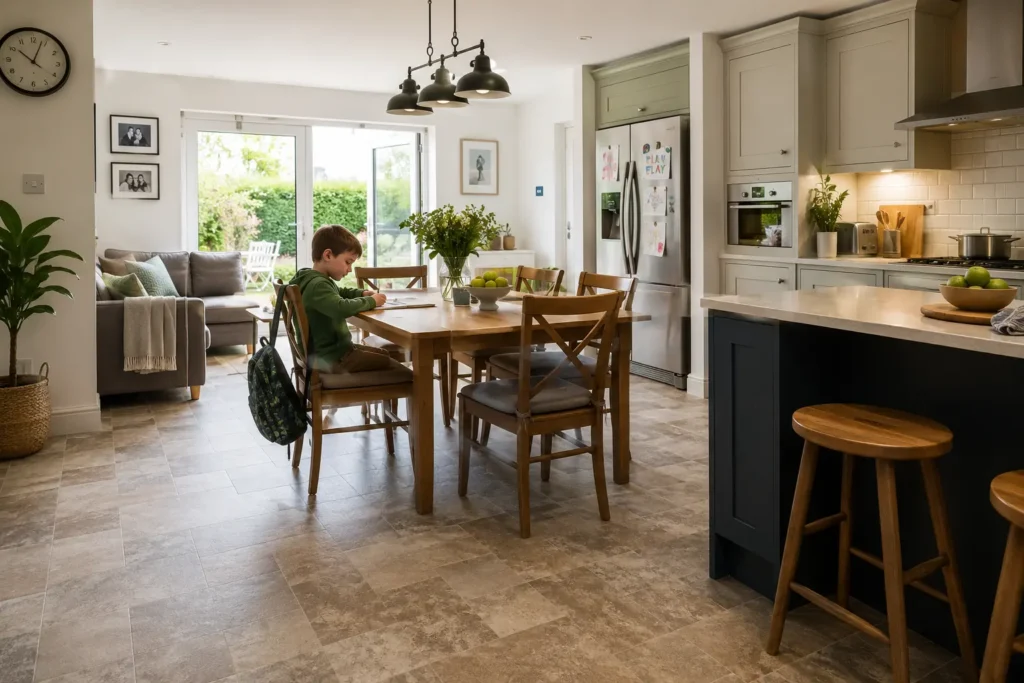
Kitchen/diner: Waterproof SPC vinyl or porcelain tile, ideally over underfloor heating to take the chill off.
Hallway and stairs: The hardest-working zone — choose your most scratch- and slip-resistant option, mind the R-rating on steps, and consider a carpet runner for grip and noise.
Bedrooms: Carpet for warmth and quiet, or LVT softened with a large rug.
Open-plan/UFH areas: Use one continuous UFH-rated floor for flow; see our underfloor heating guide before committing.
Safety and wellbeing
Beyond durability, the right floor protects little ones. Prioritise slip resistance (R-rating) on stairs and in kitchens, softer surfaces where toddlers fall, and certified low-VOC, FloorScore-rated products for healthy indoor air in our airtight modern homes.
There’s also the allergen question. Hard floors (LVT, laminate, tile, wood) don’t trap dust mites and are easier for asthma-prone households to keep clean, whereas carpet feels cosier but needs frequent hoovering with a HEPA vacuum. Many Irish families compromise with hard floors throughout and washable rugs in soft-landing zones.
📷 Image suggestion: A baby crawling safely on a soft rug over a hard floor. — Source/search: Unsplash → “baby crawling rug living room” — Alt text: “” — Caption: “Combine easy-clean hard floors with washable rugs for safe, healthy play.”
How to make any floor more child-proof
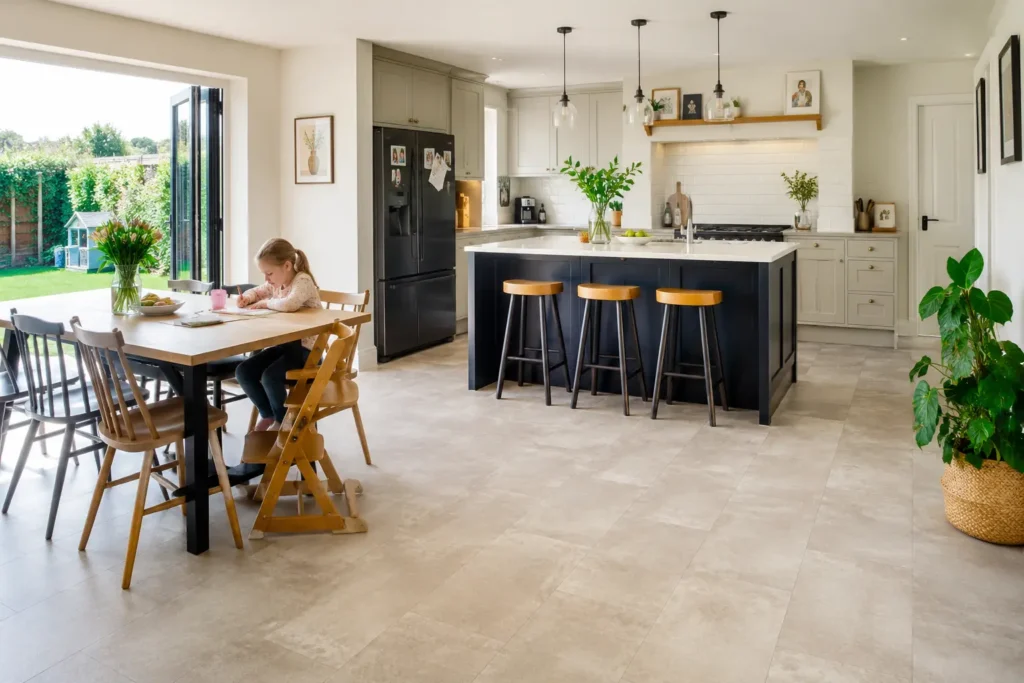
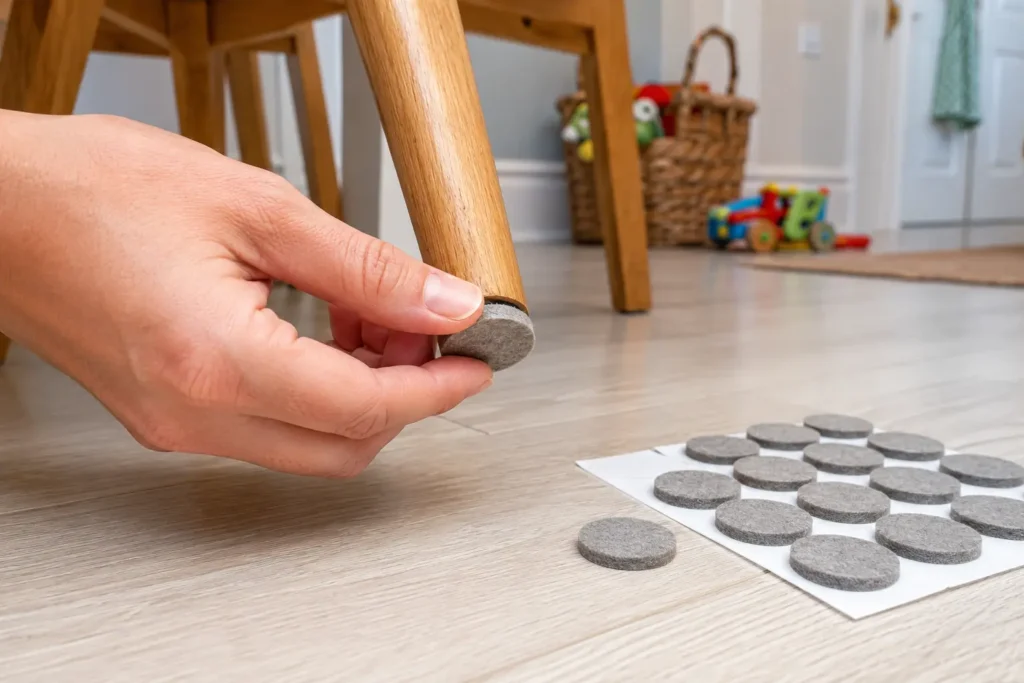
Small habits dramatically extend a floor’s life. Put felt pads under furniture legs, keep rugs and mats in high-traffic and play zones, and adopt a gentle no-shoes-indoors rule to keep grit out — grit is the silent scratcher. Wipe spills promptly, especially on laminate joints, and don’t skimp on a quality acoustic/thermal underlay, which improves comfort, warmth and noise all at once.
For long-term durability, get the basics right at installation: a moisture-tested, level subfloor and correct expansion gaps prevent most of the failures we’re called out to fix. Browse practical setups in our eco-friendly flooring guide.
Total cost of ownership: a 10-year worked example
Sticker price can mislead. Consider a 30m² family living-dining area over ten years (illustrative figures — confirm with a quote):
- Mid-range LVT/SPC, supply-and-fit at ~€60/m²: €1,800 upfront. It comfortably lasts the full decade, with roughly €15/year in cleaning. 10-year total ≈ €1,950.
- Budget laminate, supply-and-fit at ~€40/m²: €1,200 upfront — but a low-grade board in a heavy-use room may need replacing around year 8. A second fit (€1,200) plus ~€12/year upkeep pushes the 10-year total to ≈ €2,520.
The lesson isn’t “laminate is bad” — a good AC5 laminate can last the full period. It’s that buying the right grade for the room beats chasing the lowest headline price. For tighter budgets, see budget-friendly flooring options in Dublin.
Why choose FBS Flooring?
FBS Flooring helps Irish families pick floors that survive real life — not just showroom photos. As a fully insured, manufacturer-accredited team working with leading brands like Quick-Step, Pergo, Karndean, Tarkett and Polyflor, we back our work with written warranties (1–10 years on workmanship, 15–25+ years on products), line-itemed quotes, documented moisture testing, and before/after galleries with contactable local references across Dublin, Leinster and beyond.
We’ll match each room to the right impact rating, water resistance and budget, then fit it properly so it lasts. Order samples or book a free in-home survey to get a clear, no-pressure quote.
Conclusion
The best flooring for families with children in Ireland is the one matched to how each room is actually used: waterproof, impact-resistant LVT or SPC for living and wet zones, hardwearing AC4/AC5 laminate for value, and cosy carpet for bedrooms — all installed over a properly prepared subfloor. Factor in lifetime maintenance, not just the upfront price, and you’ll buy once rather than twice.
Ready to choose with confidence? Talk to the FBS Flooring team for a free survey and a transparent, line-itemed quote tailored to your family home.
FAQ
What is the most durable flooring for kids in Ireland? Rigid SPC luxury vinyl is the most durable all-round option for Irish family homes. It’s 100% waterproof, dent- and scratch-resistant, warm and quiet underfoot, and needs only a damp mop. Porcelain tile lasts even longer but is hard and cold, so it suits kitchens and utility rooms rather than play spaces.
Is laminate or vinyl better for a family home? Vinyl (LVT/SPC) is generally better for families because it’s fully waterproof and softer underfoot, which matters with spills and tumbles. Laminate is cheaper and very scratch-resistant at AC4/AC5, but its joints can swell if water sits on them. Choose vinyl for kitchens and bathrooms, and laminate for budget-friendly living rooms and bedrooms.
What flooring is easiest to clean with toddlers? Luxury vinyl, laminate and tile are the easiest to clean with toddlers — a quick sweep and damp mop handle most spills, and they don’t trap allergens like carpet does. Waterproof vinyl is the most forgiving of accidents and sticky messes, making it the favourite for kitchens, diners and playrooms.
How much does child-friendly flooring cost per m² in Ireland? In 2026, expect roughly €10–€25/m² to supply laminate, €20–€45/m² for LVT/SPC vinyl, €35–€80/m² for engineered wood and €12–€40/m² for carpet, before fitting. Installation typically adds €15–€25/m² for laminate or vinyl. Always get a line-itemed quote, as subfloor prep can change the final price.
Is carpet bad for allergies? Carpet isn’t necessarily “bad”, but it traps dust mites, pet dander and pollen, so allergy- or asthma-prone families often prefer hard floors that can’t hold allergens. If you love carpet’s warmth, choose a low-pile, stain-resistant style, hoover regularly with a HEPA vacuum, and keep hard floors with washable rugs in main living areas.
What’s the cheapest flooring that lasts with children? A good AC4 or AC5 laminate is the cheapest flooring that genuinely lasts in a family home, often 8–15 years if installed and maintained well. Pair it with a quality underlay, felt pads under furniture and prompt spill clean-up. For wet rooms, budget water-resistant vinyl is a better long-term value despite the slightly higher price.
Does underfloor heating work with family flooring? Yes — LVT, engineered wood, tile and many laminates are rated for underfloor heating, which is increasingly common in Irish new builds. The key is choosing a UFH-rated product, a low-tog underlay, and respecting the manufacturer’s surface-temperature limit (often around 27°C). Always confirm compatibility before fitting to protect your warranty.
One Response