Skip to content

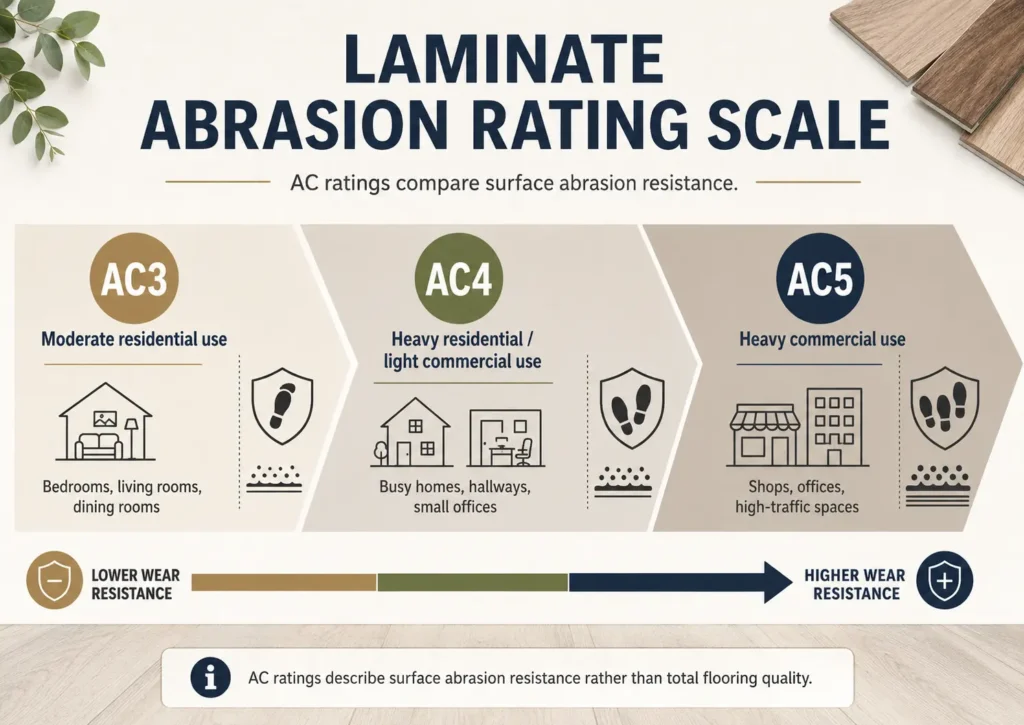
AC ratings indicate how well a laminate floor’s surface resists abrasion. AC3 is suitable for many domestic rooms, AC4 is a strong all-round residential option, and AC5 provides additional wear resistance for demanding homes and appropriate commercial spaces.
However, the highest number is not automatically the best purchase. Moisture resistance, board construction, usage class, subfloor preparation and installation quality can matter just as much as the AC rating.
AC3, AC4 and AC5 at a glance
| Rating | General performance | Typical use in an Irish home |
|---|---|---|
| AC3 | Good domestic abrasion resistance | Bedrooms, guest rooms and quieter living areas |
| AC4 | Strong residential wear resistance | Living rooms, dining rooms, halls and home offices |
| AC5 | Heavy-duty surface wear resistance | Busy hallways, rentals, large households and suitable commercial areas |
These descriptions are buying guidelines rather than universal guarantees. Always check the manufacturer’s declared usage class, approved rooms, installation instructions and warranty conditions.
What does an AC rating mean?
AC stands for Abrasion Class. It grades the ability of the laminate’s upper surface to resist wear caused by repeated contact and foot traffic.
European laminate abrasion resistance is assessed using a rotating abrasion test commonly known as the Taber test. The measured result contributes to classifications from AC1 to AC6. European laminate products are also classified under EN 13329 and broader usage classifications under ISO 10874.
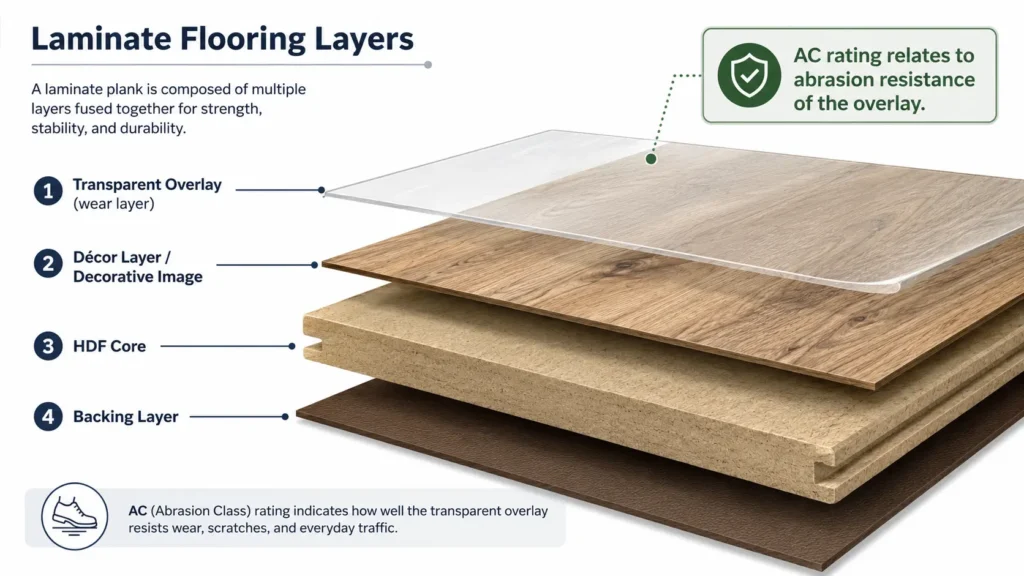
A typical laminate board contains:

- A transparent protective overlay
- A printed decorative layer
- A high-density fibreboard core
- A balancing or stabilising layer
The European Producers of Laminate Flooring notes that aluminium oxide or corundum particles in the surface overlay help provide abrasion resistance.
The AC rating does not, by itself, tell you:
- Whether the floor is waterproof
- How well the joints resist water
- How dense the HDF core is
- How well the floor resists impact or dents
- Whether it suits underfloor heating
- How quiet or solid it will feel
- Whether it can tolerate an uneven or damp subfloor
Think of AC as one important specification rather than a complete quality score.
AC rating versus usage class
AC ratings and usage classes are closely related but technically different.
Manufacturers commonly market products using pairings such as:
- AC3/Class 31
- AC4/Class 32
- AC5/Class 33
Swiss Krono, for example, presents AC3/31, AC4/32 and AC5/33 as progressively stronger product categories.
The AC figure concentrates on surface abrasion. A usage class considers the intended area and intensity of use. The broader European classification also examines requirements such as impact, staining, furniture movement, castor chairs and dimensional behaviour.
This is why shoppers should read the complete technical specification instead of relying on one number printed on a sample board.
AC3 laminate explained
AC3 is a capable domestic rating, particularly where traffic is controlled. It can suit bedrooms, guest rooms, studies and living areas that are not used as the main route through the house.
Is AC3 laminate good enough for a house?
Yes. AC3 can be entirely appropriate for lower-traffic rooms in a normal home. It becomes less attractive when the same floor will continue through a busy entrance, open-plan kitchen-living space or heavily used rental property.
Choose AC3 when:
- The room receives light or moderate use
- Outdoor footwear is rarely worn inside
- Budget matters more than commercial-level wear resistance
- The product has a suitable usage class and warranty
- The room has little concentrated traffic
Avoid judging AC3 as automatically cheap or poor quality. A correctly specified AC3 floor can perform better than an unsuitable AC5 floor installed over a damp or uneven base.
AC4 laminate explained
For many Irish households, AC4 represents the practical middle ground. It offers greater surface-wear resistance than AC3 without requiring every homeowner to pay for a commercial-grade specification.
AC4 is commonly paired with Class 32. EPLF describes Class 32 as suitable for normal commercial use in locations such as offices, waiting areas, hotel lobbies and shops, meaning it offers substantial performance headroom when used domestically.
AC4 is particularly relevant for:
- Family living rooms
- Dining areas
- Moderately busy hallways
- Children’s rooms
- Home offices
- Homes with pets
- Rental bedrooms and living areas
Repeated chair movement deserves special attention. A chair mat can still be worthwhile beneath a wheeled office chair because it concentrates thousands of movements within a small area.
AC5 laminate explained
AC5 provides stronger abrasion resistance and is frequently associated with Class 33 flooring. It is intended for intensive traffic and is commonly specified for demanding commercial environments as well as heavy domestic use. EPLF places Class 33 among high-traffic commercial categories, including large offices, classrooms and public circulation areas.
An Irish homeowner may benefit from AC5 in:
- A main entrance hallway
- A large open-plan ground floor
- A busy multigenerational household
- A rental property with frequent occupant changes
- A home with several dogs
- A room combining family traffic and office use
- A suitable small shop, salon or office
Is AC5 always better than AC4?
AC5 is more abrasion-resistant, but it is not always the better overall purchase. A quiet bedroom may gain little practical benefit from the upgrade. The money may be better spent on superior underlay, subfloor preparation or a product with better moisture protection.
AC5 also does not mean scratch-proof, waterproof, dent-proof or maintenance-free.
AC3 vs AC4 vs AC5 comparison
| Rating | Surface wear | Best domestic applications | Commercial potential | Main limitation |
|---|---|---|---|---|
| AC3 | Standard domestic resistance | Bedrooms, guest rooms, quiet lounges | Limited or light, subject to declared class | Less headroom for intense circulation |
| AC4 | Strong domestic resistance | Living rooms, dining rooms, halls, offices | General commercial use where approved | Not automatically water-resistant |
| AC5 | Heavy-duty resistance | Busy homes, entrances, rentals, pet households | Intensive commercial use where approved | May be unnecessary in low-use rooms |
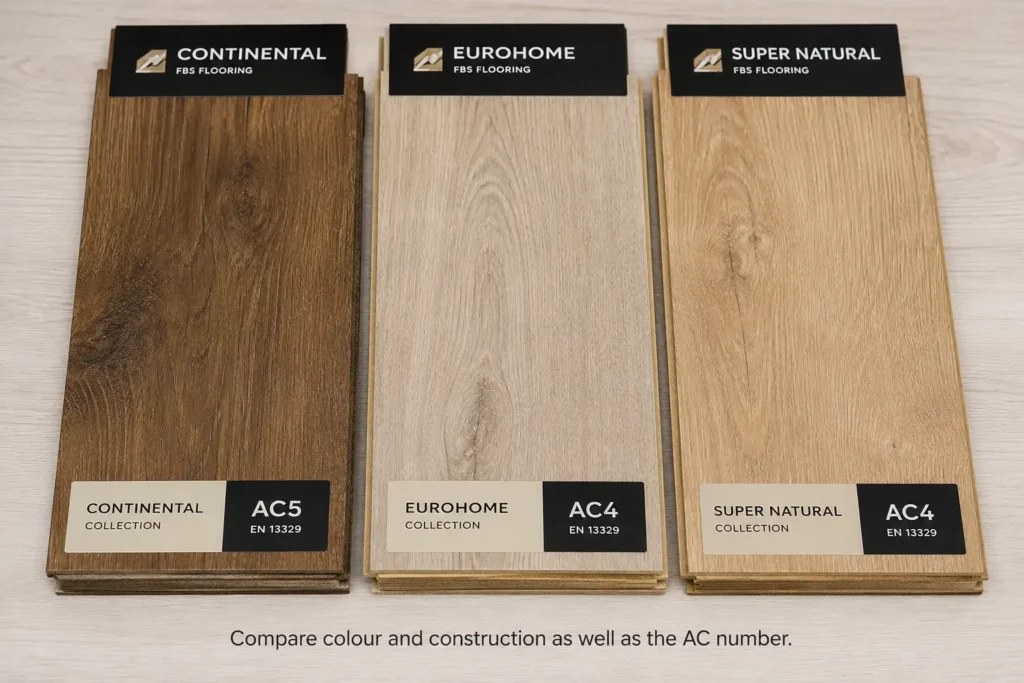
Continental AC5 versus Eurohome and Super Natural AC4
The distinction between these ranges illustrates why both abrasion and construction should be considered.
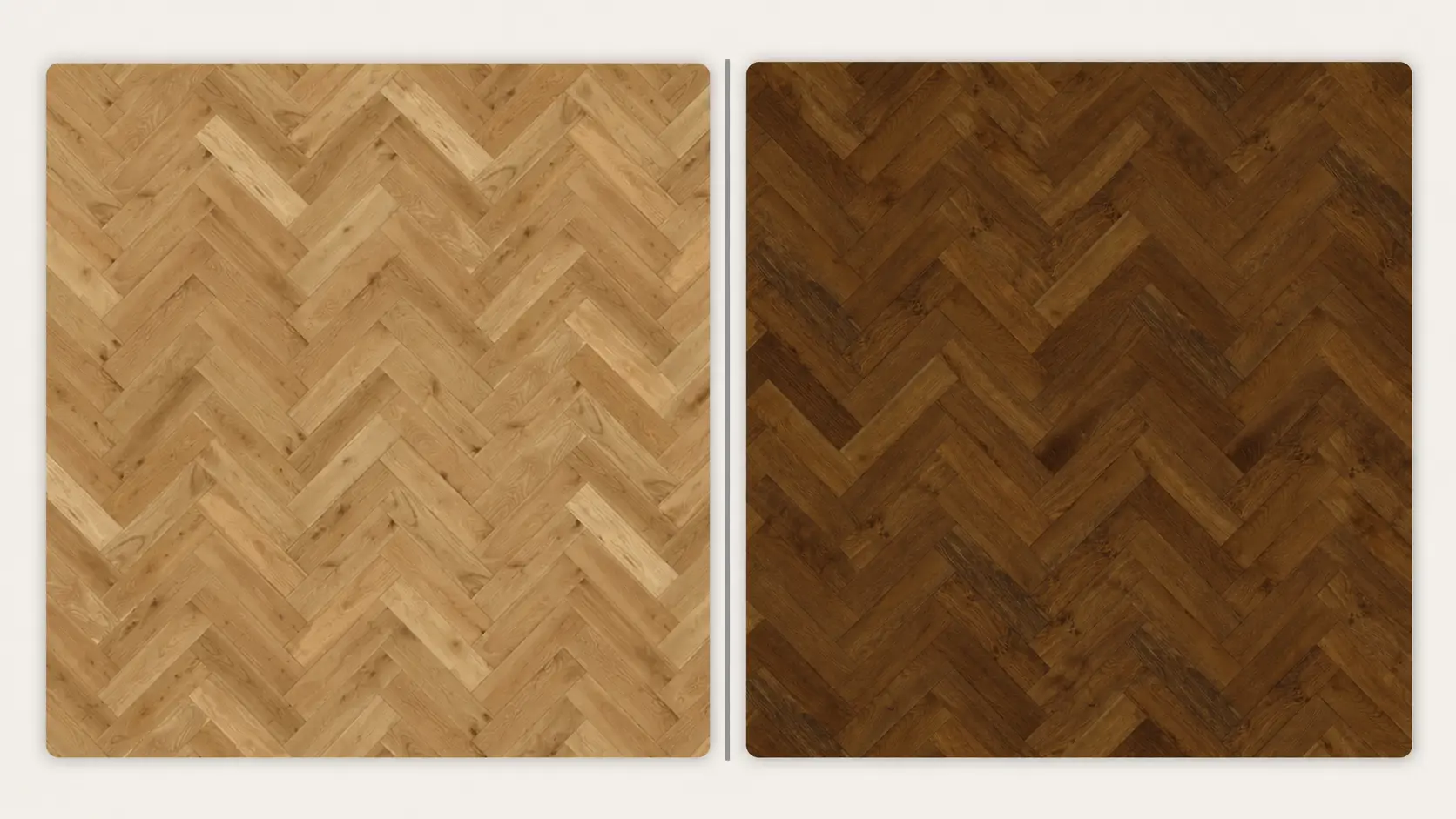
Selected Continental products, including Milan Honey Oak, Vienna Classic Oak and Verona Walnut Oak, are listed as 12mm AC5 laminate with HDF cores, waxed edges and click-lock installation. They offer greater wear headroom for busy rooms and are available in straight-plank and herringbone formats.
Eurohome examples such as Blonde Oak and Sand Sola Oak are listed as 12mm AC4. They retain the substantial feel of a 12mm board while offering an abrasion rating appropriate for high-use domestic spaces.
Super Natural Classic Wheat Cornforth Oak is listed as 8mm AC4, demonstrating that board thickness and abrasion rating are separate specifications.
| Range | Verified example | Thickness | AC rating | Best fit |
|---|---|---|---|---|
| Continental | Milan, Vienna Classic or Verona Walnut | 12mm | AC5 | Very busy homes, halls, rentals and design-led installations |
| Eurohome | Blonde Oak or Sand Sola Oak | 12mm | AC4 | Family living areas and buyers wanting a substantial domestic board |
| Super Natural | Wheat Cornforth Oak | 8mm | AC4 | Bedrooms, living rooms, offices and style-led renovations |
Continental should not be chosen simply because AC5 sounds superior. Eurohome or Super Natural may provide all the performance a normal residential room needs at a more appropriate specification.
Product details can change, and not every item within a collection necessarily shares identical specifications. Check the live data sheet before ordering.
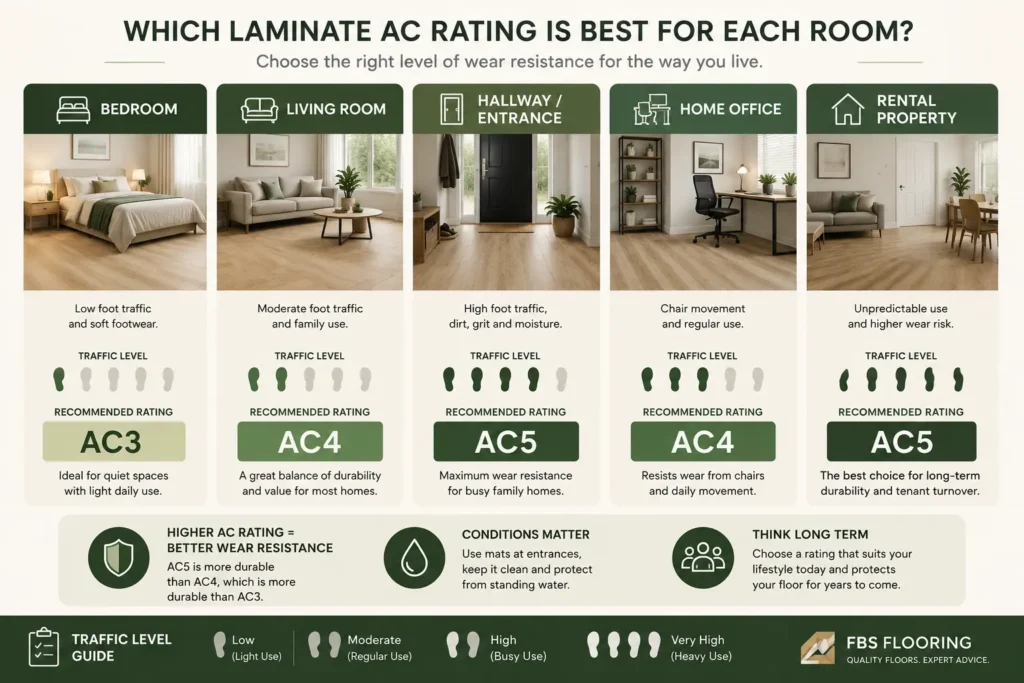
Which AC rating is best for each room?
Entrance hall
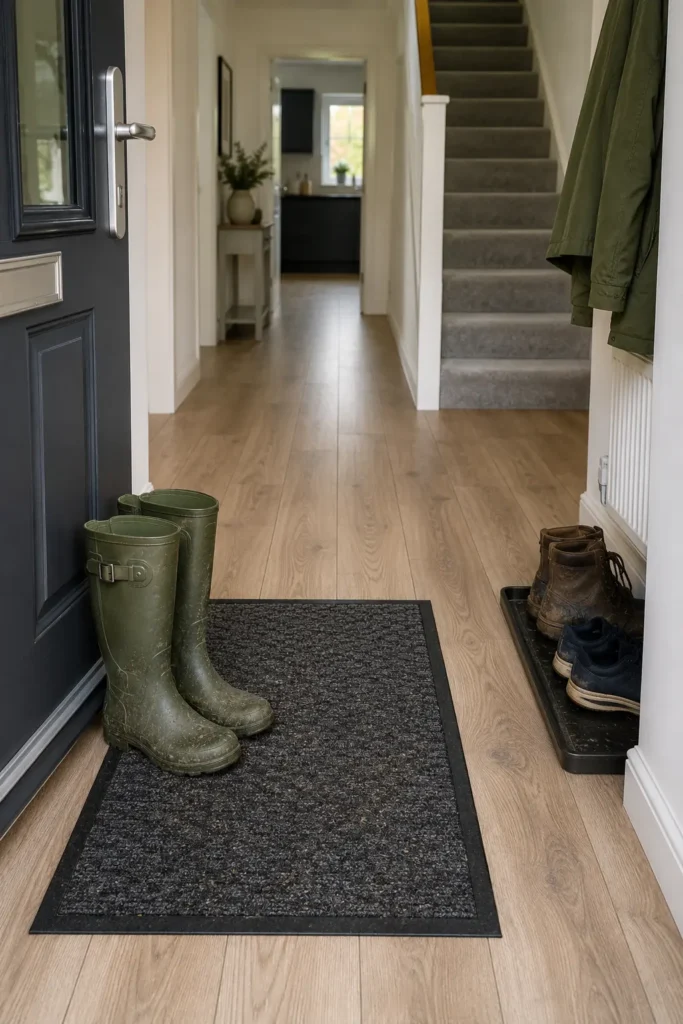
Choose AC4 as a sensible minimum for many busy entrances, with AC5 offering extra headroom in larger households. Ireland’s national annual average rainfall for 1991–2020 was approximately 1,288mm, making wet footwear and entrance maintenance genuine practical considerations.
Use external and internal mats. Remove grit regularly because hard particles carried beneath shoes accelerate abrasive wear.
Living room
AC4 suits most living rooms. Consider AC5 where the room forms part of an open-plan route connecting the entrance, kitchen and garden.
Bedroom
AC3 can be sufficient. AC4 adds flexibility and may make sense when the same product continues across the landing or other rooms. AC5 is normally optional rather than essential.
Kitchen
Do not select a kitchen floor using its AC rating alone. AC5 describes abrasion performance, not waterproofing. Check the manufacturer’s water-resistance system and approved room use.
Where spills, leaks or standing water are credible risks, a properly specified SPC or other waterproof flooring may be more suitable.
Home office
AC4 is generally appropriate. Consider AC5 for full-time offices with wheeled chairs, client traffic or heavy equipment. Use a chair mat where recommended.
Rental property
AC4 provides a strong baseline. AC5 may be worthwhile in entrances and shared living spaces because it provides greater surface-wear headroom between tenancies.
Apartment
AC4 is normally adequate, but impact-noise performance may be more important than moving from AC4 to AC5. Check the apartment’s flooring rules and choose an underlay compatible with both the laminate and acoustic requirements.
Stairs
AC rating is only part of the decision. Stairs require secure fitting, suitable profiles or nosings and confirmation that the product is approved for the installation method.
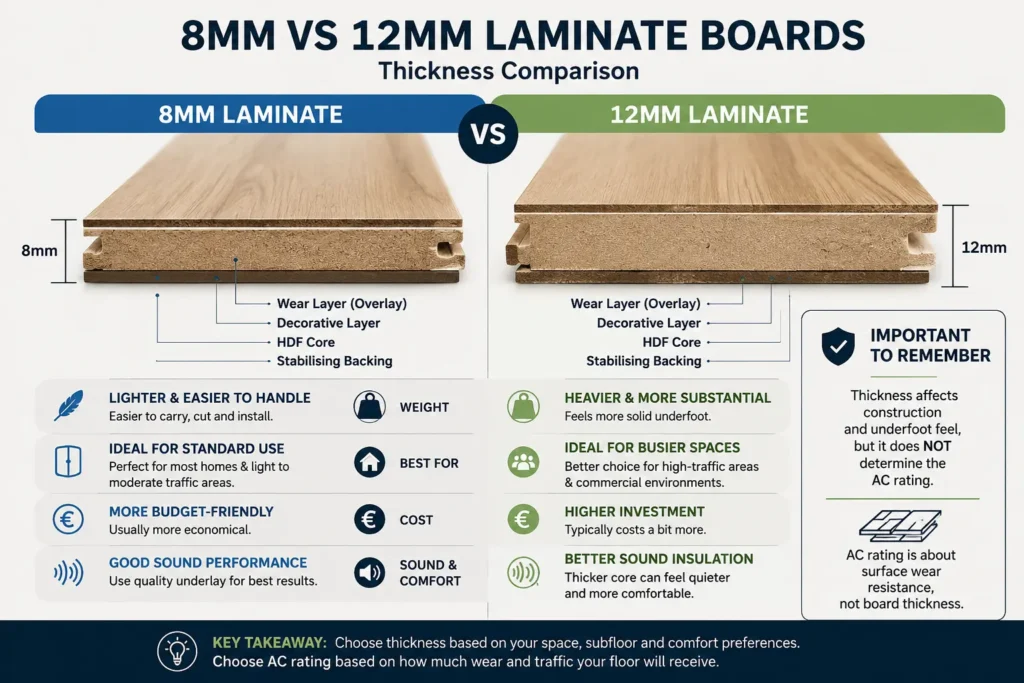
Is 12mm laminate better than 8mm?
Not automatically.
Thickness can influence:
- The solid feeling underfoot
- Joint profile and board rigidity
- Finished floor height
- Door and transition clearances
- Acoustic behaviour when combined with the correct underlay
AC rating measures a different characteristic. An 8mm Class 33 product can have a higher use classification than another 8mm Class 32 product, showing that thickness alone does not determine wear performance.
A 12mm AC4 board may feel more substantial than a thinner AC5 product, while the AC5 product may have stronger surface-abrasion resistance. Neither can compensate for poor subfloor preparation.
Common AC-rating myths
Myth: AC5 is scratch-proof.
Fact: AC5 offers high abrasion resistance, but sharp objects, dragging furniture and embedded grit can still mark a floor.
Myth: AC5 is waterproof.
Fact: Abrasion and water resistance are separate properties.
Myth: 12mm is always more durable than 8mm.
Fact: Thickness, abrasion class, core quality and usage class measure different characteristics.
Myth: AC3 is unsuitable for modern homes.
Fact: It can be a sensible specification for bedrooms and other controlled-traffic rooms.
Myth: Underlay fixes an uneven subfloor.
Fact: Underlay manages functions such as acoustics, support and vapour control. It is not a substitute for levelling.
Myth: Every product in one collection has the same rating.
Fact: Specifications may vary by format, thickness, production line or individual design.
Installation can matter more than upgrading from AC4 to AC5
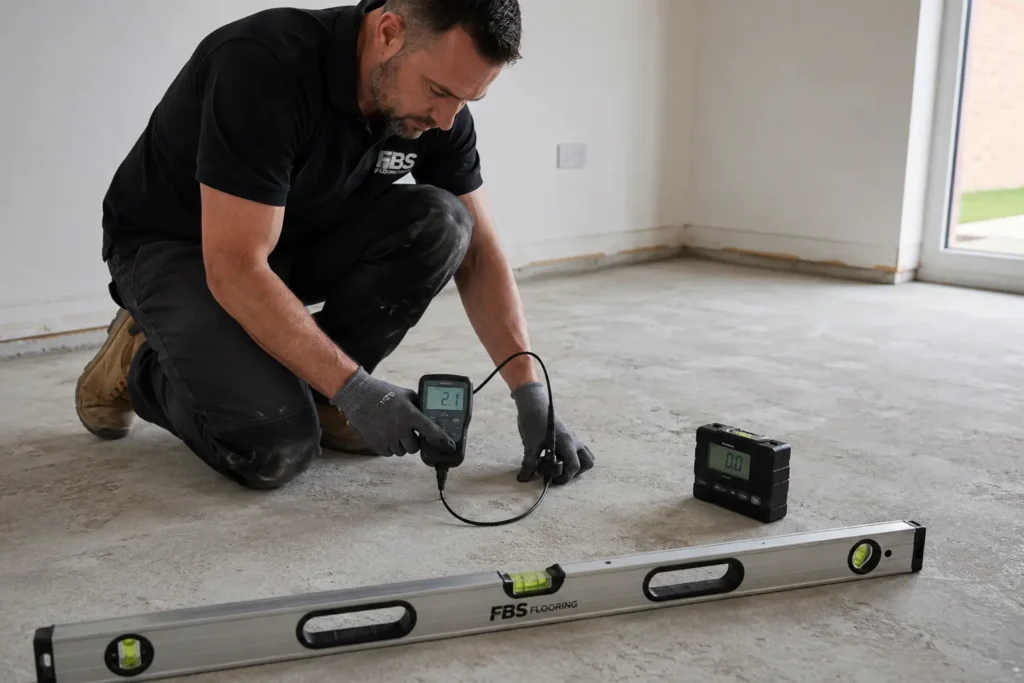
Before installation, the base should be dry, clean, stable and sufficiently level. EPLF installation guidance emphasises inspecting the subfloor, selecting an appropriate underlay and using suitable moisture protection over mineral screeds where required.
A reliable installation should address:
- Subfloor moisture
- Flatness and structural movement
- Acclimatisation requirements
- Expansion gaps
- Vapour-control layers
- Underfloor-heating limits
- Suitable underlay
- Door clearances and transitions
- Manufacturer fitting instructions
An AC5 floor laid over an unsuitable base can develop movement, damaged joints or moisture-related problems long before its wear layer reaches its limit.
How to choose the correct rating
Ask five questions:
- How much traffic will the room receive?
- Will wet footwear, spills or grit be common?
- Are there pets, children or wheeled chairs?
- What usage class and water protection does the manufacturer declare?
- Is the subfloor ready for a floating laminate installation?
A practical recommendation is:
| Household | Starting point |
|---|---|
| Single adult or couple | AC3–AC4 |
| Family with children | AC4 |
| Family with several pets | AC4–AC5 |
| Busy multigenerational home | AC5 in circulation areas |
| Landlord | AC4, with AC5 for halls and shared areas |
| Full-time home worker | AC4–AC5 around the workstation |
| Small office or shop | AC5 or the manufacturer-approved commercial class |
Protecting the floor after installation
To reduce premature surface wear:
- Place effective mats at entrances
- Vacuum or sweep away grit frequently
- Wipe spills promptly
- Use only the cleaning method approved by the manufacturer
- Fit felt pads beneath movable furniture
- Lift furniture rather than dragging it
- Use a suitable mat beneath wheeled chairs
- Avoid excessive water when mopping
- Maintain reasonable indoor temperature and humidity
EPLF similarly recommends entrance mats and cleaning with a vacuum, brush or well-wrung cloth.
Final verdict
AC3 can be appropriate for quieter domestic rooms. AC4 is the strongest all-round recommendation for many Irish homes, while AC5 provides additional abrasion resistance for busy entrances, rentals, pets, large households and suitable commercial environments.
The correct choice still depends on the complete floor: usage class, water protection, board construction, underlay, subfloor and installation conditions.
For buyers comparing actual options, Continental AC5 provides heavy-duty wear resistance, while Eurohome and Super Natural AC4 remain practical choices for normal family living. FBS Flooring can help compare samples and match the rating, thickness and fitting system to the room rather than recommending a higher number unnecessarily.
Frequently asked questions
What do AC3, AC4 and AC5 mean?
They are abrasion-resistance grades for laminate surfaces. AC3 is suitable for many domestic areas, AC4 handles stronger residential wear, and AC5 offers heavy-duty resistance for demanding homes and approved commercial environments.
Is AC4 good enough for an Irish family home?
Yes. AC4 is usually suitable for living rooms, dining rooms, bedrooms, home offices and many hallways. AC5 may be preferable where traffic is unusually intense.
Is AC5 better than AC4?
It is better specifically for surface abrasion. It is not automatically better for moisture protection, acoustics, impact resistance, appearance or value.
Does AC5 mean waterproof?
No. AC5 does not establish waterproofing. Check whether the individual product has tested water protection and whether the manufacturer approves it for the intended room.
Is AC5 worth paying extra for in a bedroom?
Usually not for wear resistance alone. AC3 or AC4 can be sufficient unless you want one continuous product across several busier rooms.
Which rating is best for a hallway?
AC4 is a strong baseline for most homes. AC5 offers greater wear headroom for main entrances, large families, pets and rental properties.
Which rating is best for homes with dogs?
AC4 or AC5 is normally appropriate, but trim claws, remove grit and clean spills quickly. No AC rating makes a floor completely scratch-proof.
Is 12mm AC4 better than 8mm AC5?
Neither is universally better. The 12mm board may feel more substantial, while the 8mm AC5 surface may offer greater abrasion resistance. Compare the complete specifications.
What is the difference between AC5 and Class 33?
AC5 concerns surface abrasion. Class 33 is a broader intensive-commercial use classification involving more than abrasion alone.
Can laminate be installed over underfloor heating?
Many products can, but only within the manufacturer’s stated temperature and thermal-resistance limits. The underlay must also be approved for the system.