Skip to content

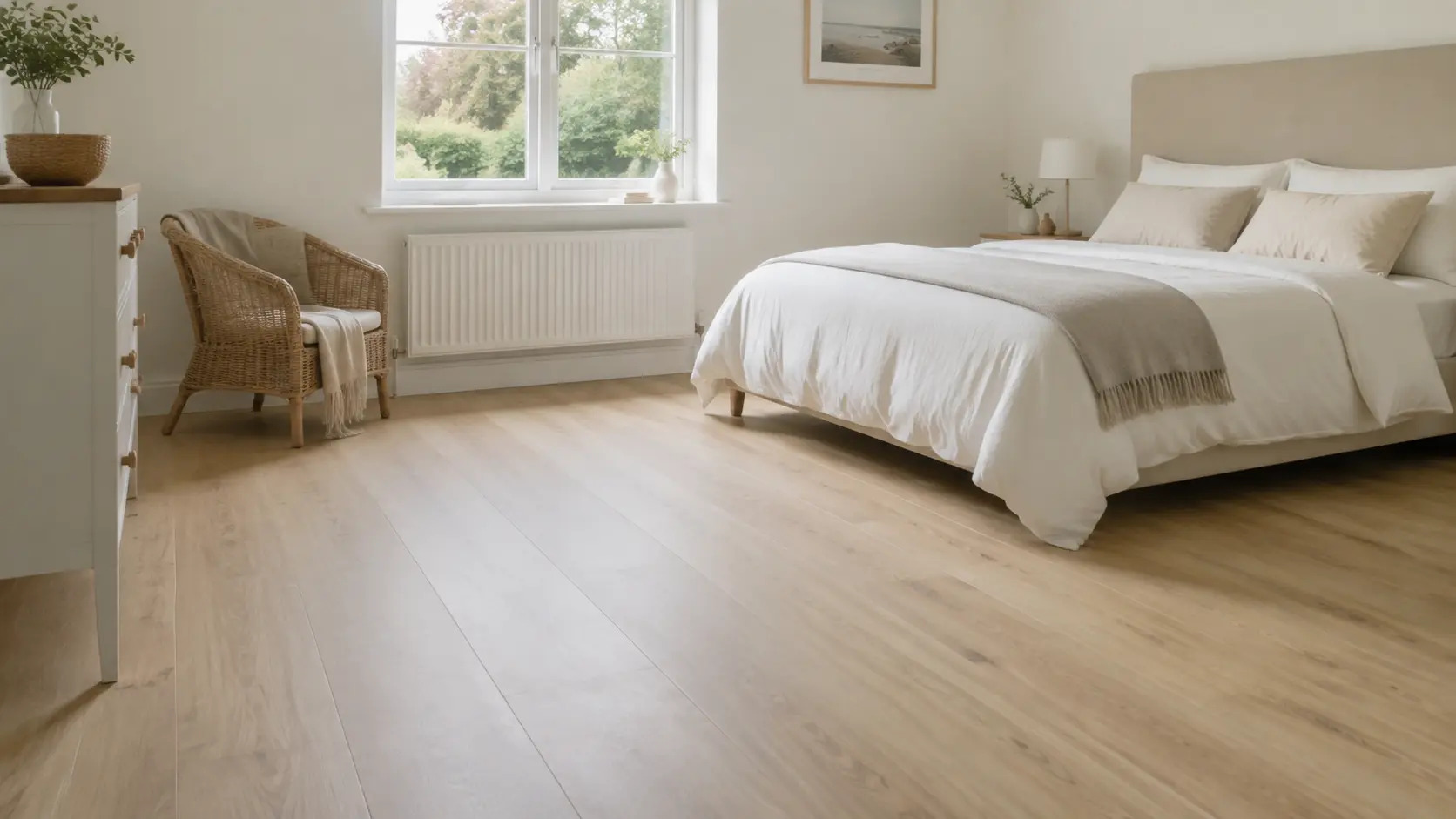
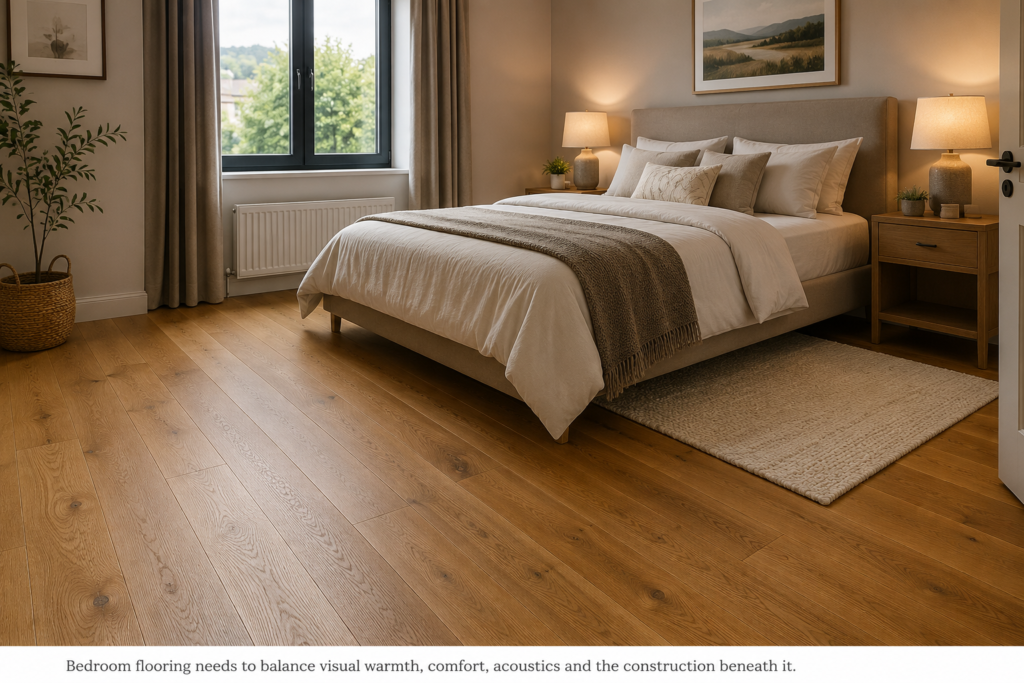
The best flooring for bedrooms in Ireland depends on what the room needs most. Carpet remains difficult to beat for softness, perceived warmth and quietness. High-quality laminate offers strong value and easy maintenance, engineered wood gives a more natural premium finish, while SPC or LVT suits bedrooms where easy cleaning, stability or occasional moisture are higher priorities.
For many Irish homes, however, the material on top is only half the decision. A cold concrete slab, noisy suspended timber floor, unsuitable underlay or poorly insulated room can matter more to comfort than whether the visible surface is laminate, wood or vinyl. SEAI consistently treats insulation and building fabric as central to improving comfort and reducing heat loss, so a new floor should not be expected to compensate for an inadequately insulated home.
What Is the Best Flooring for a Bedroom in Ireland?
For a quick decision:
| Priority | Best starting point | Why |
|---|---|---|
| Maximum softness and quiet | Carpet | Soft underfoot and naturally reduces room noise |
| Best value hard floor | Quality laminate | Strong visual choice without engineered-wood pricing |
| Premium natural finish | Engineered wood | Real timber surface and high-end appearance |
| Easy cleaning / moisture resilience | SPC or LVT | Practical resilient construction |
| Cold ground-floor bedroom | Insulation assessment + suitable floor/underlay | The floor build-up matters more than appearance |
| Upstairs bedroom | Carpet or hard floor with tested acoustic underlay | Helps manage footfall transmission |
| Bedroom with UFH | Compatible laminate, engineered wood or resilient floor | Low thermal resistance helps heat transfer |
| Hard floor but softer feel | Hard flooring + area rug | Combines practicality with bedside comfort |
There is therefore no honest universal winner. The right bedroom floor is the product whose thermal, acoustic, maintenance and installation characteristics match the room beneath it.
Bedroom Flooring Comparison
| Flooring | Warm Feel | Quietness | Barefoot Comfort | Cleaning | Moisture Tolerance | UFH Potential |
|---|---|---|---|---|---|---|
| Carpet | Excellent | Excellent | Excellent | Moderate | Low–Moderate | Product dependent |
| Laminate | Good | Moderate | Good | Very good | Product dependent | Often good |
| Engineered wood | Very good | Good | Very good | Good | Moderate | Often good |
| SPC/LVT | Moderate–Good | Good | Good | Excellent | Very good | Often very good |
| Cork-based flooring | Very good | Very good | Very good | Good | Product dependent | Product dependent |
| Tile | Cool without heating | Poor | Firm | Excellent | Excellent | Excellent |
The important qualifier is product dependent. A general material category does not tell you the complete performance of a floor. Manufacturers publish different requirements for moisture, underlay, underfloor heating and installation, and those specifications should take precedence over generic advice.
What Actually Makes a Bedroom Floor Feel Warm?
A floor that feels warm and a floor that retains heat in the building are not exactly the same thing.

Carpet, cork and timber-based surfaces tend to feel less cold to bare feet because they transfer heat away from the foot differently from highly conductive materials such as tile. But the temperature of a ground-floor bedroom also depends heavily on the construction below the finish: concrete slab, insulation, screed, suspended timber, ventilation and the heated or unheated space beneath it.
That distinction matters in older Irish houses. If a bedroom floor feels persistently cold because the building fabric is losing heat, changing the decorative flooring can improve the sensation underfoot without solving the underlying heat-loss problem. SEAI’s home-upgrade guidance places insulation at the centre of making homes warmer and more comfortable.
For a bedroom with underfloor heating, the logic changes. You normally want a floor assembly that does not excessively resist heat travelling upward. The European Producers of Laminate Flooring notes that, for laminate systems over below-floor heating, the thermal resistance of the entire flooring build-up—including relevant layers—should not exceed 0.15 m²K/W in its technical guidance.
This creates an important trade-off:
- On an unheated cold floor, additional thermal resistance can make the surface feel more comfortable.
- Over underfloor heating, excessive thermal resistance can slow heat transfer.
So “the thickest underlay is best” is poor advice.
For readers dealing specifically with cold rooms, this is the natural place to internally link to FBS Flooring’s guide to the best flooring for cold Irish homes.
Which Bedroom Flooring Is the Quietest?
Carpet generally gives the simplest route to a softer, quieter bedroom, but hard flooring can perform well when the complete floor assembly is designed for acoustics.
Two different noise problems are often confused.
Impact noise is created by footsteps, toys, furniture movement and objects hitting the floor. The vibration can pass through the floor structure into adjoining or lower rooms.
Airborne noise includes voices, television and music. Flooring can influence the room’s acoustic character, but replacing a floor finish alone is not a complete airborne-soundproofing solution.
This distinction is particularly important in apartments. Ireland’s Building Regulations Part E requires separating walls and floors between dwellings and other relevant spaces to provide reasonable resistance to sound. Technical guidance cited by Engineers Ireland identifies performance criteria of at least 53 dB airborne insulation and no more than 58 dB weighted impact sound level for separating floors, but these are whole-building-element performance figures, not a promise that a particular underlay will make an existing apartment compliant.
Underlay matters more than many buyers realise
European laminate-industry guidance distinguishes between sound heard in adjacent rooms and the walking sound heard within the room itself. It also uses standardised test methods rather than relying simply on underlay thickness.
That is why two 3 mm underlays can perform very differently.
For an upstairs bedroom or apartment, ask for:
- a relevant tested impact-sound result;
- compatibility with the chosen flooring;
- compressive performance appropriate for the locking system;
- suitable moisture characteristics for the subfloor;
- UFH suitability if applicable.
Readers dealing with neighbour noise or upstairs bedrooms should continue to FBS Flooring’s separate guide to soundproof flooring in Ireland.
Is Carpet the Best Flooring for Bedrooms?
Carpet is still one of the best bedroom choices where softness, warmth and acoustic comfort are the main priorities.
It feels comfortable when getting out of bed, reduces hard footfall within the room and avoids the sharp acoustic character that a poorly installed floating hard floor can produce.
Its disadvantages are mainly practical. Carpet is less convenient to wipe clean after spills, and households sensitive to house-dust mites need to think carefully about cleaning. The Asthma Society of Ireland notes that house-dust mites are commonly found in carpets, furniture and especially bedding, and can trigger allergic responses in susceptible people.
That does not mean carpet is automatically unsuitable for anyone with allergies. It means the material, pile and cleaning regime deserve consideration.
Best for: primary bedrooms, quiet adult bedrooms and rooms where barefoot comfort dominates.
Think twice if: spills, dampness, pets or very easy cleaning are the overriding concerns.
Is Laminate Flooring Good for Bedrooms?
Yes. Quality laminate is one of the strongest all-round hard-floor choices for an Irish bedroom, especially where budget, appearance and straightforward maintenance matter.
Bedrooms are normally lower-traffic environments than halls and kitchens, so a good laminate does not need to win purely through extreme wear resistance. More important factors are the floor’s sound, stability, underlay and visual quality.
Modern laminate products can also work with underfloor heating when specifically approved. EGGER, for example, publishes thermal-resistance figures between 0.07 and 0.10 m²K/W for examples in its laminate range and provides dedicated UFH-compatible underlays.
The weakness is acoustics: a floating laminate installed over the wrong substrate or weak underlay can sound noticeably harder than carpet.
For FBS Flooring customers, the better buying strategy is therefore to compare the company’s current laminate products by room, subfloor and underlay requirement first, and choose oak tone or plank format second.
Is Engineered Wood Good for Bedrooms?
Engineered wood is an excellent premium bedroom option when genuine timber character matters more than achieving the lowest possible cost.
Its top surface is real timber, giving bedrooms the tactile and visual variation associated with natural wood. It also pairs particularly well with rugs, textiles and upholstered furniture.
Many engineered floors can be used over underfloor heating, but compatibility should always be confirmed for the exact product. Specialist UFH guidance notes that engineered wood is among the hard surfaces that can transfer heat effectively when correctly specified.
Engineered wood is particularly attractive in:
- primary bedrooms;
- renovated period homes;
- premium extensions;
- bedrooms continuing from timber-floored landings.
It needs more respect for moisture and environmental conditions than SPC, and natural timber will change subtly over time.
For a premium bedroom renovation, FBS Flooring’s current engineered-wood products are worth comparing alongside laminate rather than assuming the more expensive material is automatically the better solution.
Is SPC or LVT Good for Bedrooms?
SPC and LVT can be very practical bedroom floors, particularly where cleaning, dimensional stability and moisture resistance matter more than maximum softness.
They are easy to maintain and can deliver convincing timber visuals without the maintenance profile of natural wood. They also work particularly well in households where the same practical hard floor is being carried through several rooms.
The trade-off is tactile. Even with acoustic backing, an SPC floor will not reproduce the softness of carpet. Nor should “integrated underlay” be interpreted as proof of high acoustic performance; acoustic performance should be judged from relevant test data.
Current Irish retail examples show SPC around the high-€20s to low-€30s per m² for certain products, although product construction and promotions vary.
For FBS Flooring, SPC is therefore best presented as a specific solution for practical bedrooms, not automatically as the best flooring for every bedroom.
What About Cork?
Cork deserves consideration where warmth, softer acoustics and resilience are priorities. Products incorporating cork can add sound absorption and a more forgiving surface than many conventional hard floors. Forbo, for example, uses cork backing in its click flooring specifically as a sound-absorbing layer.
Availability, finish choice and installation requirements may be more limited than mainstream laminate, SPC or engineered timber, so it remains more of a specialist alternative in many Irish projects.
Which Flooring Is Best for Different Types of Bedrooms?
This is where bedroom flooring advice becomes genuinely useful.
Main bedroom
Prioritise comfort, visual calm and long-term appearance.
Carpet works beautifully where softness is everything. Engineered wood suits a more premium finish. Good laminate creates much of the same visual effect at a lower material cost.
Children’s bedroom
Prioritise cleanability, impact resistance and noise.
Laminate or SPC can be easier to maintain after spills and play, although an area rug can soften the play zone and improve acoustics.
Guest bedroom
Because usage is normally lighter, value matters more than maximum performance. Quality laminate is often a sensible choice; carpet works if warmth is the desired atmosphere.
Ground-floor bedroom
Do not select the surface before understanding the substrate.
A cold concrete or screed floor may require moisture assessment and better thermal thinking. European laminate guidance specifically warns that residual moisture from mineral substrates can damage moisture-sensitive floors and recommends appropriate vapour control as part of the floor design where required.
Upstairs bedroom
Impact noise becomes much more important.
A hard floating floor over timber joists can transmit footsteps into the ceiling below if the build-up is poorly designed. Use an appropriate tested acoustic system rather than buying underlay simply by thickness.
Apartment bedroom
Check both the subfloor and any management-company requirements before changing an existing soft floor to hard flooring. Ireland’s Part E framework concerns sound resistance between dwellings, making acoustic performance especially relevant in multi-unit buildings.
Attic or loft bedroom
Timber construction can transmit impact vibration readily, while converted roof spaces can also experience larger temperature swings. Acoustic build-up, subfloor rigidity and room insulation should be considered together rather than independently.
Bedroom with underfloor heating
Choose the flooring and underlay as one thermal system. SEAI notes that heat pumps can work well with underfloor heating in appropriately insulated homes. Then verify the floor manufacturer’s temperature and thermal-resistance limits.
The Underlay Is Part of the Floor, Not an Accessory
Underlay affects far more than cushioning.
Depending on the system, it can contribute to:
- impact-noise reduction;
- walking sound;
- moisture control;
- thermal resistance;
- support for locking joints;
- tolerance of small substrate imperfections.
European guidance explicitly warns against judging underlay quality simply by density or thickness because application-specific performance tests provide more meaningful information.
This is particularly important when combining acoustic ambitions with UFH: an underlay may insulate well acoustically or thermally but introduce more resistance than is desirable above a heating system.
Select the flooring and underlay together.
Concrete vs Suspended Timber: Why the Subfloor Changes the Answer
A concrete bedroom floor generally brings questions about:
- residual moisture;
- flatness;
- thermal comfort;
- damp protection;
- UFH.
A suspended timber floor brings different concerns:
- movement;
- squeaks;
- joist stiffness;
- ventilation;
- sound transmission to rooms below.
Large irregularities should be corrected rather than expecting soft underlay to compensate for them; EPLF notes that significant unevenness can create hollow areas, worsen room acoustics and place excess stress on laminate locking systems.
This is one of the strongest reasons to have the room assessed before ordering flooring.
Bedroom Flooring and Indoor Air Quality
Bedrooms are occupied for long periods, so material emissions, dust management, damp and ventilation deserve consideration.
Rather than assuming one material is automatically “healthy”, look for recognised product-emission information, follow adhesive and installation instructions and address dampness before covering it.
For allergy-sensitive households, smooth flooring is easier to wipe clean, while carpet requires more deliberate dust control. The Asthma Society of Ireland identifies house-dust mites as a potential trigger and notes their presence in carpets and furnishings.
Good flooring cannot compensate for poor ventilation or an unresolved moisture problem.
Light Oak, Honey Oak or Dark Flooring?
Colour affects perceived atmosphere, not the thermal insulation of the room.
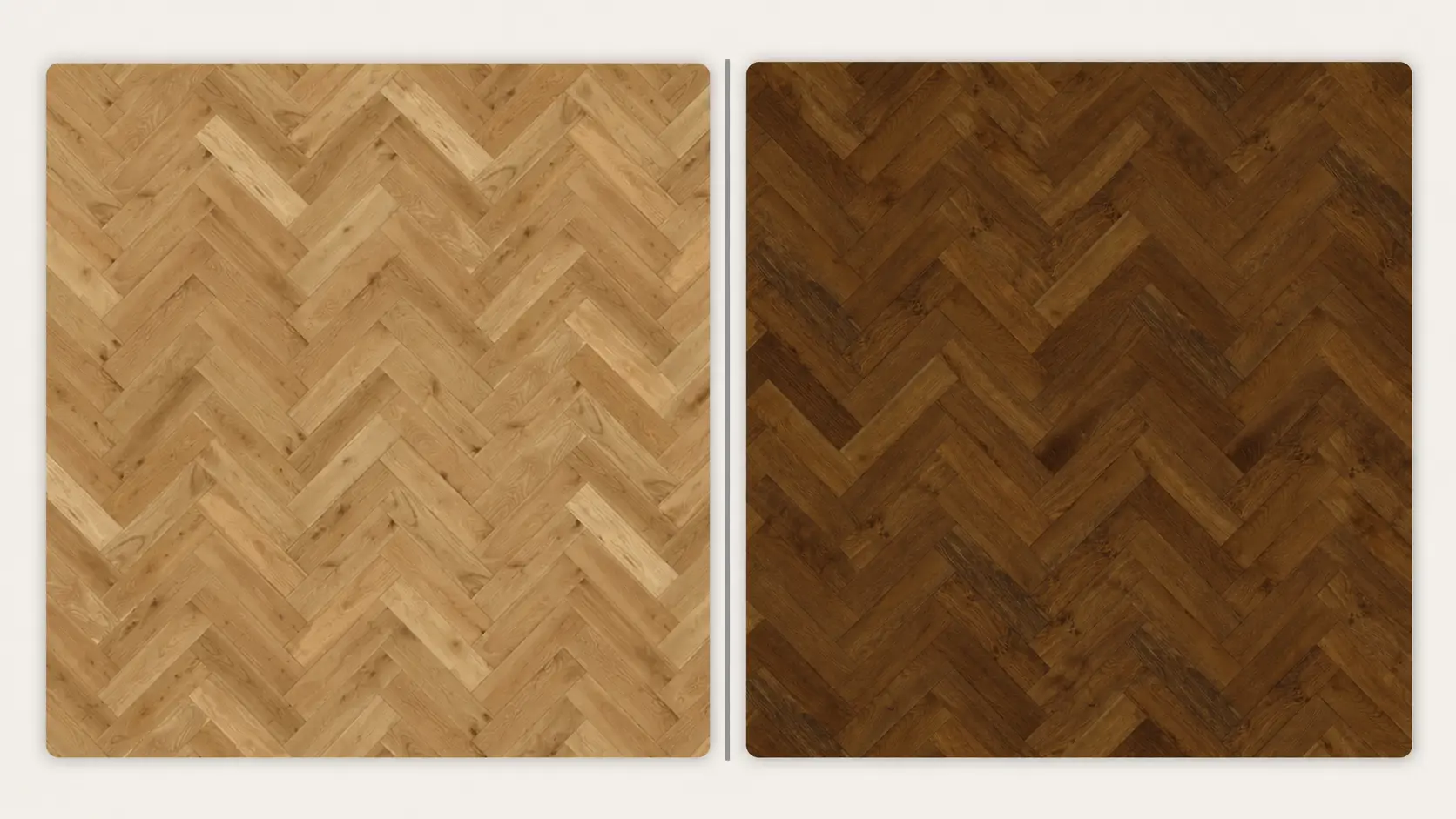
Light oak can help a compact or naturally darker bedroom feel visually open. Honey and golden oak tones create more perceived warmth. Dark walnut-style finishes can give larger, brighter bedrooms greater contrast.
Plank format matters too.
Straight planks generally create a calmer, simpler bedroom surface, while herringbone becomes a more visible design feature.
FBS Flooring customers can use this stage to compare current products and samples in the actual bedroom light rather than choosing solely from a screen.
Hard Flooring Plus a Rug: Often the Best Compromise
One of the most practical bedroom combinations is:
laminate, engineered wood or SPC + a properly sized area rug.
It gives you an easy-to-clean perimeter while adding softness beside the bed and reducing some reflected sound within the room.
It is particularly useful for homeowners who dislike wall-to-wall carpet but do not want an entirely hard bedroom.
How Much Does Bedroom Flooring Cost in Ireland?
Prices change with promotions and specifications, so the following are current retail examples rather than fixed national averages.
| Flooring | Current Irish material examples | Other costs to allow for |
|---|---|---|
| Laminate | roughly €18–€35/m² in current examples | Underlay, fitting, trims, preparation |
| SPC | roughly €28–€33/m² in current examples | Preparation, trims, installation |
| Engineered wood | roughly €55–€64/m² in current examples | Adhesive/underlay, fitting, preparation |
| Carpet | Highly product-dependent | Underlay, grippers and fitting |
Wood Floor Store currently lists numerous laminate products across roughly the high-teens to mid-€30s per m², engineered examples around €55–€64/m², and SPC examples around €28–€33/m². Another Irish retailer currently advertises laminate professional installation at around €10–€12 per m², illustrating why fitting should be budgeted separately from material.
Subfloor levelling, old-floor removal, moisture treatment, thresholds, skirting and door adjustment can all change the final quotation.
Which Bedroom Flooring Should You Choose?
Choose carpet if: softness, perceived warmth and quiet are your top priorities.
Choose laminate if: you want a convincing hard-floor finish with strong value and straightforward cleaning.
Choose engineered wood if: genuine timber and a more premium finish justify the higher investment.
Choose SPC/LVT if: practicality, cleaning and moisture resilience matter most.
Choose a hard floor plus rug if: you want easy maintenance without losing bedside softness.
And make the room itself part of the decision:
Cold ground floor → investigate insulation, moisture and thermal build-up first.
Noisy upstairs bedroom → prioritise tested acoustic performance.
Apartment → investigate the whole acoustic assembly and building requirements.
UFH → prioritise low thermal resistance and confirmed product compatibility.
Children’s bedroom → combine durability and cleaning with acoustic comfort.
Choosing Bedroom Flooring with FBS Flooring
FBS Flooring can add more value here than simply presenting a catalogue of colours.
A sensible bedroom-flooring consultation should work in this order:
room → subfloor → warmth → acoustics → heating → flooring type → underlay → colour and pattern.
That prevents a beautiful product from being selected for the wrong construction.
Readers can use FBS Flooring’s current laminate, SPC and engineered-wood products to compare different solutions, then use the company’s broader educational resources to understand cold floors, soundproofing, moisture and installation before making the final choice.
For a bedroom renovation, the useful next steps are to compare samples in the room, assess the existing subfloor and request a quotation based on the complete floor build-up—not simply a price per plank.
Conclusion
The best flooring for bedrooms in Ireland is not necessarily the warmest-looking or most expensive floor.
For maximum softness and quiet, carpet remains the benchmark. For value, quality laminate is difficult to ignore. For natural character, engineered wood is the premium option. For practical maintenance and moisture resilience, SPC/LVT can make excellent sense.
But the most successful bedroom floor starts underneath the visible surface. A cold slab needs thermal thinking; a timber upper floor needs acoustic thinking; an apartment needs whole-floor acoustic thinking; and UFH needs thermal-resistance thinking.
Choose the floor system, not just the floor colour.
Frequently Asked Questions
What is the best flooring for bedrooms in Ireland?
There is no single winner. Carpet is strongest for softness and quietness, laminate for value, engineered wood for a premium natural finish and SPC/LVT for practical maintenance. The best choice also depends on whether the bedroom is upstairs, over concrete, in an apartment or fitted with underfloor heating.
What is the warmest flooring for a bedroom?
Carpet typically feels warmest to bare feet, with cork and timber-based floors also offering comfortable surface sensations. If the entire room is genuinely cold, however, investigate insulation and the underlying floor construction rather than relying on a new finish to solve the problem. SEAI emphasises insulation as central to home comfort.
What is the quietest flooring for an upstairs bedroom?
Carpet is normally the simplest quiet option. If you want laminate or engineered flooring, pair the floor with an appropriate tested acoustic underlay and ensure the timber floor structure itself is sound. Acoustic performance should be judged from test data, not simply underlay thickness.
Is laminate flooring good for bedrooms?
Yes. Bedrooms are generally well suited to laminate because they are relatively dry and lower traffic than hallways or kitchens. Choose the underlay carefully, particularly upstairs, and confirm UFH and moisture requirements for the exact product.
Is SPC flooring good for bedrooms?
Yes, particularly where easy cleaning and moisture resilience are valuable. It is harder underfoot than carpet, so a bedroom rug can improve comfort. Acoustic claims should be checked using product-specific test data rather than assuming every SPC floor with attached backing is quiet.
Is engineered wood suitable for bedrooms?
Engineered wood is particularly suitable for premium bedrooms where homeowners want genuine timber character. Many products can also be used with UFH when correctly specified, but manufacturer temperature, moisture and installation requirements must be followed.
What is best for a cold ground-floor bedroom?
Start with the floor construction rather than the decorative finish. Determine whether insulation, damp or a cold concrete slab is responsible. Then choose a compatible floor and underlay that improves comfort without masking an unresolved moisture problem.
Do I need acoustic underlay in a bedroom?
Not always, but it becomes much more valuable with floating hard flooring in upstairs bedrooms and apartments. The underlay must also provide appropriate mechanical support for the flooring system; acoustic performance alone is not enough.
Can bedroom flooring be used with underfloor heating?
Many laminate, engineered-wood and resilient floors can be used with UFH, but only when the specific manufacturer approves the combination. The flooring and underlay should be assessed together because their combined thermal resistance affects heat transfer.