Skip to content

Installing your own floor can save a meaningful amount of labour costs in Ireland, particularly with straightforward click-fit laminate or rigid vinyl. But those savings can disappear quickly if the subfloor needs levelling, moisture is overlooked, boards are damaged, or the layout involves herringbone, glue-down products, underfloor heating or complicated transitions. The real decision is therefore not simply DIY versus professional flooring installation—it is whether your particular floor, room and subfloor are genuinely DIY-friendly.
Key Takeaways
- Straight click-fit laminate is one of the most realistic flooring projects for a competent DIY homeowner.
- Current Irish market guidance puts straightforward laminate fitting at roughly €14–€20/m², while laminate herringbone can rise to around €25–€45/m².
- Dublin wood-floor installation can be around €30–€40/m², depending on the material, subfloor and laying method.
- A click system does not eliminate the need for a dry, stable and sufficiently flat subfloor.
- Moisture, levelling, doorways, transitions and underfloor heating are where many apparently easy jobs become technical.
- Herringbone, glue-down LVT and premium timber usually make professional installation considerably easier to justify.
- A useful rule is to assess three things: the floor, the room and the subfloor.
DIY vs Professional Flooring Installation at a Glance
| Factor | DIY Installation | Professional Installation |
|---|---|---|
| Labour cost | Potential saving | Additional project cost |
| Tools | Buy, borrow or hire | Normally supplied by fitter |
| Speed | Depends heavily on experience | Usually faster |
| Subfloor assessment | Homeowner’s responsibility | Usually assessed before fitting |
| Moisture | Easy to underestimate | Can be professionally assessed |
| Straight click flooring | Reasonable DIY candidate | Straightforward professional job |
| Herringbone | Advanced | Usually preferable |
| Glue-down floors | Difficult | Strong professional case |
| Complex transitions | Time-consuming | Routine for experienced fitters |
| Risk of wasted material | Higher for inexperienced DIY | Generally lower |
| Best for | Simple rooms and click systems | Complex, premium or technically sensitive work |
How Much Does Professional Flooring Installation Cost in Ireland?
There is no official national flooring-fitting tariff, and published Irish prices vary according to location, project size and what the quotation includes.
OnlineTradesmen’s November 2025 Irish guide puts standard straight-plank laminate at an average of about €17/m², with a typical range of €14–€20/m². Premium straight-board work is shown at €15–€25/m², while laminate herringbone is approximately €25–€45/m². A general labour day rate of around €300 is also given.
That broadly follows an earlier Tradesmen.ie survey, where contractors across Dublin, Wexford, Kildare, Meath and other counties quoted roughly €10–€25/m² for straightforward laminate, with substantially higher prices for herringbone and engineered flooring. Those tradespeople repeatedly highlighted levelling, skirting, existing-floor removal and room shape as factors that change the final price.
For wood flooring, Dublin specialist RH Wood Floors currently indicates approximately €30–€40/m², depending on the flooring and how it is installed.
This is why comparing installers purely on one €/m² figure can be misleading. Ask whether the quotation includes:

- old-floor removal;
- disposal;
- moisture assessment;
- levelling;
- primer or damp-proof treatment;
- underlay;
- adhesive;
- thresholds;
- scotia or skirting;
- door trimming;
- difficult cuts;
- stairs;
- furniture movement.
What could DIY save on a simple laminate room?
Using the current €14–€20/m² straight-laminate fitting range purely as an illustration:
| Room | Indicative fitting labour avoided by DIY* |
|---|---|
| 12 m² bedroom | €168–€240 |
| 25 m² living room | €350–€500 |
| 50 m² open-plan area | €700–€1,000 |
*Before minimum call-out charges, VAT where applicable, preparation, tools, wastage and additional work. Based on the published OnlineTradesmen range rather than an FBS Flooring price.
For a larger floor, the potential saving becomes significant—but so does the financial consequence of getting it wrong.
FBS Flooring CTA: Before deciding based on labour alone, homeowners can compare the wider project using the FBS Flooring Cost Calculator, including flooring type and relevant installation extras. FBS’s website currently provides this calculator alongside its flooring range and services.
The Hidden Cost of DIY Flooring
The biggest mistake is treating:
professional labour price = guaranteed DIY saving.
A DIY project may also require:
- tape measure and long straight edge;
- spacers;
- tapping block and pull bar;
- rubber mallet;
- knee pads;
- jigsaw, circular saw or mitre saw;
- suitable replacement blades;
- moisture-testing equipment where appropriate;
- levelling compound and primer;
- underlay;
- vapour-control or damp-proof products where specified;
- transition profiles;
- adhesive;
- waste disposal;
- replacement boards after cutting or locking mistakes.
Professional installers already own most of these tools and know where extra preparation is necessary.
There is also a time cost. A 20 m² floor is not simply 20 m² of clicking boards together. Removing the old flooring, checking the substrate, undercutting door frames, planning the first and final rows, trimming around pipes and fitting profiles can consume a substantial part of the project.
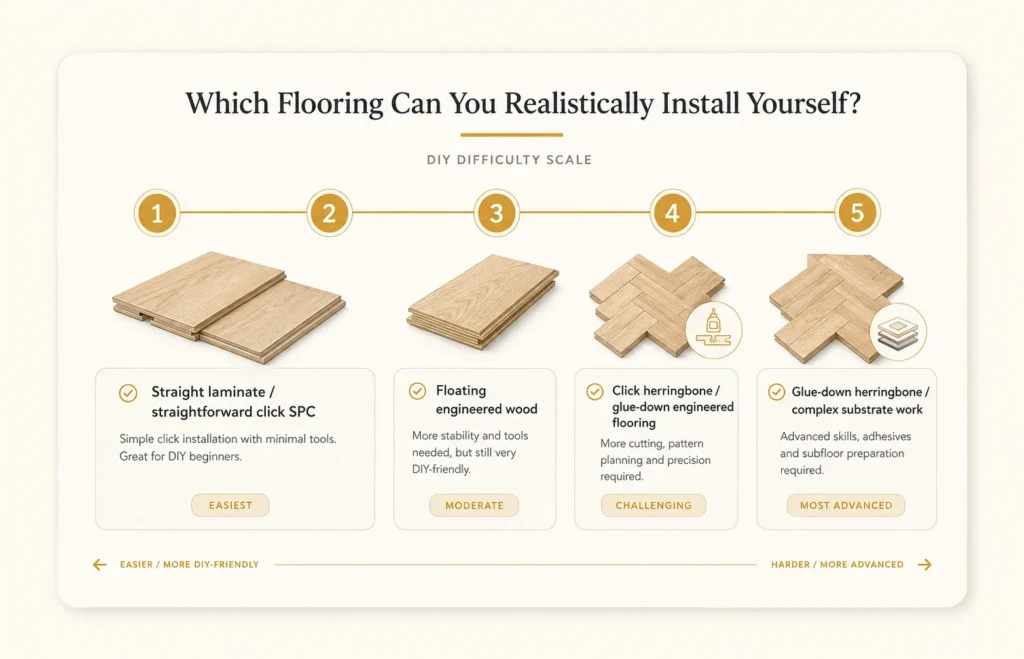
Which Flooring Can You Realistically Install Yourself?
| Flooring type | DIY difficulty | DIY verdict |
|---|---|---|
| Straight click laminate | 2/5 | Good DIY candidate |
| Click SPC / rigid vinyl | 2–3/5 | Possible |
| Floating engineered wood | 3/5 | Experienced DIY |
| Glue-down engineered wood | 4/5 | Professional preferred |
| Glue-down LVT | 4/5 | Professional preferred |
| Solid timber | 4–5/5 | Usually professional |
| Click herringbone | 4/5 | Advanced |
| Glue-down herringbone/parquet | 5/5 | Professional strongly advised |
| Any floor over problematic substrate | +1–2 levels | Assess first |
Click laminate
Modern click systems make laminate genuinely accessible to DIY installers. CLASSEN, for example, explicitly says its click laminate can be DIY installed, while stressing that the substrate must be clean and level.
The difficult part is often everything surrounding the click mechanism.
Door frames still need consideration. The first row has to be accurately planned. Expansion must be allowed where the particular manufacturer requires it. Quick-Step specifically provides installation guidance on expansion gaps, door frames, underlay and maximum uninterrupted floor lengths—evidence that “click-fit” is not the same thing as “no technical rules”.
Click SPC or rigid vinyl
Click vinyl can also be a reasonable DIY project. Quick-Step’s installation process still requires acclimatisation according to the product instructions, acceptable subfloor moisture, a stable and clean base, planning around door profiles, correct underlay where needed and appropriate joint staggering.
That makes it DIY-friendly only when the substrate is already suitable.
Floating engineered wood
A floating engineered floor can be installed by an experienced DIYer, but the material is usually more expensive than basic laminate, increasing the cost of mistakes.
Wood also puts greater emphasis on environmental and substrate conditions. Quick-Step’s wood guidance requires checking flatness and moisture before installation and provides product-specific acclimatisation conditions.
Glue-down engineered wood and LVT
This is where professional fitting becomes far easier to justify.
Karndean’s glue-down installation documentation covers subfloor treatment, adhesive selection, temperature control, levelling over existing surfaces, installation planning and special requirements around underfloor heating.
Glue-down LVT can visually reproduce imperfections underneath it, so substrate preparation becomes part of the finished appearance, not merely hidden construction work. Karndean likewise specifies a dry, clean and flat subfloor for gluedown LVT.
Herringbone and parquet
Herringbone introduces another difficulty: geometry.
A straight floor can tolerate relatively simple row planning. Herringbone requires accurate reference lines, repeatable angles, control of pattern drift and careful cuts at walls and doorways.
Karndean’s professional installation documentation, for example, begins patterned layouts by locating the centre of the room and establishing perpendicular reference lines.
That additional work is reflected in Irish pricing: straight laminate at €14–€20/m² versus roughly €25–€45/m² for herringbone in the current OnlineTradesmen guide.
The Biggest DIY Risk Is Usually Under the Floor
A beautiful board cannot correct a bad substrate.
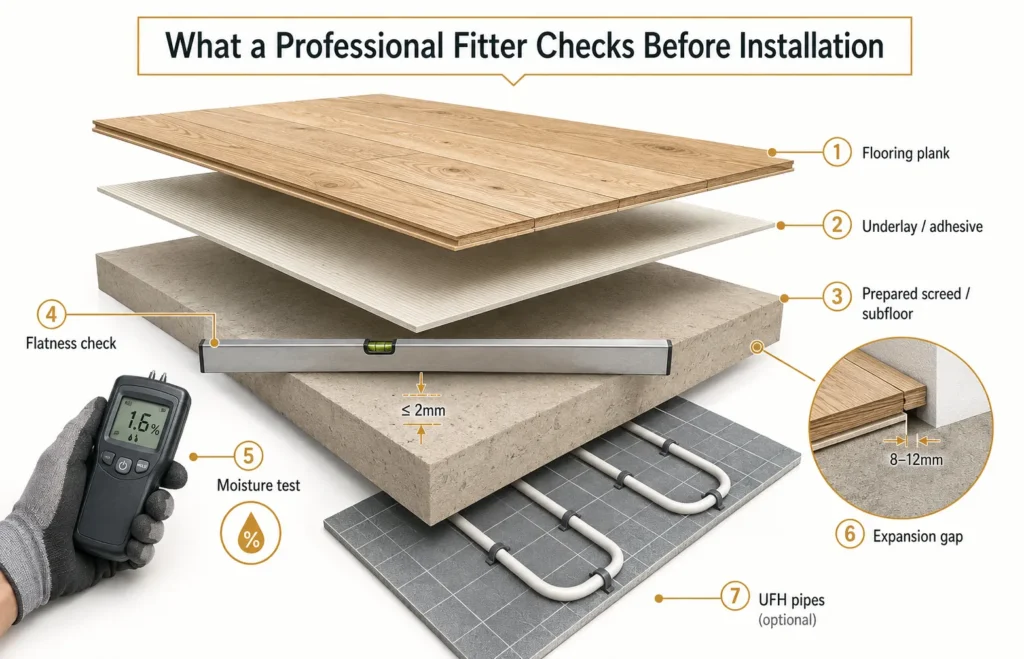
Before laying flooring, you need to know whether the base is:
dry + flat + clean + stable + compatible with the flooring system.
Quick-Step’s wood guidance gives a maximum irregularity example of 4 mm over 2 metres and 1 mm over 20 cm for that specific flooring system, alongside explicit moisture limits for cement and anhydrite screeds. These are manufacturer-specific requirements, not universal numbers, which is why the instructions supplied with the exact floor always take priority.
Moisture deserves particular attention in Ireland
Ireland’s climate makes moisture management a practical concern rather than a theoretical one. Met Éireann’s Dublin climate data shows high outdoor relative humidity through much of the year; its 1981–2010 Dublin averages include annual mean 09:00 relative humidity of around 83%, with afternoon averages also remaining substantial.
That does not mean your indoor subfloor automatically has excessive moisture. It means visual inspection alone is not enough to establish whether a screed or concrete slab satisfies the flooring manufacturer’s requirements.
A waterproof surface layer also does not magically make moisture beneath the product irrelevant.
Underfloor Heating Makes the Decision More Technical
Underfloor heating does not automatically mean you need a fitter, but it reduces the margin for improvisation.
Compatibility must be checked across the entire system:
heating system → screed → moisture → adhesive/underlay → flooring product.
Karndean states that certain Designflooring products can be installed over UFH provided the specified system conditions are observed, including a maximum temperature at the adhesive interface of 27°C for the relevant gluedown installation. Its instructions also specify commissioning, switching the heating off around installation and subsequently increasing temperature gradually.
EGGER similarly confirms that compatible laminate ranges can be used with specified underfloor-heating systems but directs installers back to the individual flooring installation instructions.
The lesson is simple: never assume that because one laminate, engineered floor or LVT works with UFH, every product in that category does.
For a deeper comparison, FBS Flooring readers can continue to the company’s Best Flooring for Underfloor Heating in Ireland guide.
15 DIY Flooring Mistakes That Can Cost More Than the Fitter
- Measuring only the room area and forgetting waste.
- Starting without checking the final row width.
- Assuming the concrete is dry because it looks dry.
- Ignoring an uneven substrate.
- Choosing unsuitable underlay.
- Failing to read the exact manufacturer’s instructions.
- Incorrect acclimatisation.
- Insufficient perimeter movement allowance.
- Pinning or trapping a floating floor.
- Damaging click-lock edges.
- Repeating or poorly staggering joints.
- Allowing herringbone reference lines to drift.
- Rough cuts around door frames or pipes.
- Forgetting finished floor height at appliances and doors.
- Assuming DIY automatically preserves every warranty condition.
The warranty point needs care. DIY installation does not automatically void every flooring warranty. What matters is the wording of the individual warranty and whether installation conditions—moisture, substrate, heating, accessories and fitting instructions—were followed. Manufacturer installation and warranty documentation should therefore be kept with the project records. Beauflor, for example, publishes installation guidance alongside separate warranty conditions.
DIY, Professional or Hybrid?
| Situation | Best route |
|---|---|
| 10–15 m² square bedroom, click laminate, good substrate | DIY realistic |
| Click SPC, simple dry room | DIY realistic |
| Large open-plan click floor | Experienced DIY or professional |
| Floating engineered wood | Experienced DIY / professional |
| Glue-down engineered wood | Professional |
| Glue-down LVT | Professional |
| Herringbone | Professional strongly worth considering |
| Uneven concrete | Professional preparation |
| Suspected damp | Assess before fitting anything |
| UFH and new screed | Technical/professional assessment |
| Stairs | Professional |
| Many doorways and transitions | Professional or highly experienced DIY |
The useful middle ground: hybrid installation
You do not have to choose between doing everything yourself and handing over the entire project.
A homeowner can potentially handle:
- furniture removal;
- straightforward uplift;
- disposal;
- clearing the room;
- simple skirting preparation.
A flooring professional can handle:
- moisture assessment;
- levelling;
- specialist DPM or primer systems;
- glue-down installation;
- herringbone;
- technical transitions;
- final fitting.
That can preserve some DIY savings without putting the technically critical work at risk.
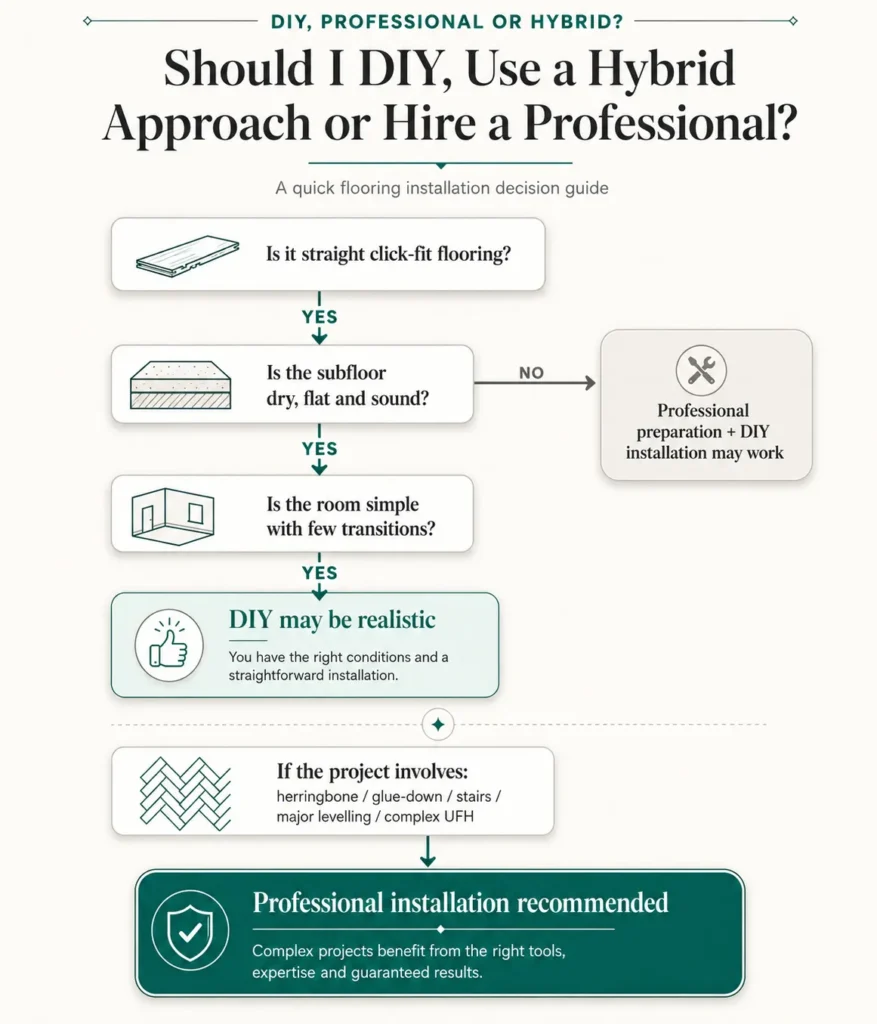
The Floor + Room + Subfloor Rule
A useful decision framework is to ask whether all three parts of the project are simple.
1. Floor
Click-fit straight plank?
2. Room
Square or rectangular, with few doorways and obstacles?
3. Subfloor
Dry, stable, clean and within the manufacturer’s flatness tolerance?
Three simple answers: DIY may be sensible.
One complicated answer: investigate before starting.
Two or three complicated answers: professional fitting becomes considerably easier to justify.
When Should You Definitely Consider a Professional Floor Fitter?
Hire or at least consult a professional when the project involves moisture uncertainty, significant levelling, glue-down flooring, premium engineered timber, solid wood, herringbone, stairs, large connected areas, many transitions or complicated underfloor heating. In these situations, the material lost to one installation error can be worth more than the labour you were trying to save.
What to Ask Before Accepting a Flooring Quote
Do not ask only, “How much per square metre?”
Ask:
- Is existing-floor removal included?
- Is disposal included?
- Who checks the substrate?
- What happens if moisture is too high?
- Is levelling included?
- Is the underlay specified by product?
- Are primer, adhesive or DPM included?
- Are thresholds included?
- Is skirting or scotia included?
- Is door trimming included?
- What waste allowance should I order?
- Is my floor compatible with my UFH system?
- What workmanship warranty applies?
- Which manufacturer installation requirements are being followed?
This creates a much fairer comparison between quotations.
How FBS Flooring Can Help
FBS Flooring currently supplies laminate, SPC, engineered wood and other flooring options and offers professional installation support from its Dublin operation. Its website also provides flooring products, technical articles and a cost calculator for homeowners researching a project.
For a simple DIY project, that may mean browsing a suitable straight-plank option and obtaining the right accessories.
For more complicated rooms, it may mean comparing supply-only with professionally installed options before buying the flooring.
Current FBS ranges include products such as Vienna Classic Oak, Milan Honey Oak, Verona Walnut Oak, Sandstone Oak Straight Plank and herringbone options. These are useful examples of why format matters: a straight plank and a patterned floor can create very different installation demands even when their visual family is similar.
Useful next reads on the FBS Flooring website include:
- The Homeowner’s Guide to Subfloor Issues in Ireland
- Moisture & Humidity in Irish Homes
- Acclimatising Flooring in Ireland
- Best Flooring for Underfloor Heating in Ireland
- Flooring Warranties in Ireland Explained
- What Is SPC Flooring? The Complete Irish Guide
- Flooring Services Ireland
These pages create a useful technical path for readers whose DIY decision reveals a specific subfloor, moisture or heating issue.
Before You Start a DIY Floor
- Measure the room accurately.
- Add the manufacturer’s recommended waste allowance.
- Read the exact installation instructions.
- Identify the subfloor.
- Check its flatness.
- Confirm appropriate moisture conditions.
- Check UFH compatibility.
- Choose the specified underlay or adhesive.
- Follow product acclimatisation instructions.
- Plan the first and final rows.
- Plan doorways and transitions.
- Confirm expansion requirements.
- Keep spare boards.
DIY vs Professional Flooring Installation: The Verdict
DIY flooring makes the most financial sense when the floor, the room and the subfloor are all straightforward. A dry, level bedroom with simple click laminate is a very different project from engineered herringbone over a newly screeded UFH floor.
The more expensive the material and the more complicated the moisture conditions, substrate, pattern, heating or transitions become, the smaller the margin for error.
So do not ask only:
“Can I install this floor?”
Ask:
“If I make one significant mistake, will I still have saved money?”
If the answer is uncertain, FBS Flooring can help compare products, project requirements and professional installation before you commit to the floor.
FAQ
Is it cheaper to install flooring yourself in Ireland?
Usually, yes, if the substrate is already suitable and the floor is genuinely DIY-friendly. Current Irish guidance puts straightforward laminate fitting at around €14–€20/m², so that labour is the most visible potential saving. Tools, waste, levelling, accessories and mistakes must still be included in the comparison.
How much do laminate floor fitters charge in Ireland?
OnlineTradesmen’s late-2025 guide gives approximately €14–€20/m² for standard straight laminate and €25–€45/m² for laminate herringbone. Smaller rooms, removals, skirting, door work and subfloor preparation can change the final quotation.
Can I install laminate flooring myself?
Yes. Modern click laminate is one of the more realistic DIY flooring options. Manufacturers such as CLASSEN explicitly describe their click laminate as DIY-installable, provided the substrate is clean and level and the installation instructions are followed.
Is SPC flooring easy to install yourself?
Click SPC or rigid vinyl can be DIY-friendly, but only after the substrate is checked. Manufacturer guidance still requires attention to moisture, flatness, underlay, door profiles, joint staggering and expansion requirements.
Can I install herringbone flooring myself?
Technically yes, particularly with some modern click systems, but it is substantially more demanding than straight plank. Accurate centre lines, symmetry, pattern control and numerous cuts make herringbone a strong candidate for professional fitting.
Do I need to moisture-test a concrete floor?
You should verify that the substrate satisfies the moisture requirement specified by the flooring manufacturer. Different floors and screeds can have different limits, so one generic number should not be applied to every product.
Can flooring be installed over underfloor heating?
Many laminate, engineered and LVT products can, but compatibility is product-specific. Flooring, underlay or adhesive, screed moisture and heating-system operating limits must all comply with the manufacturer’s instructions.
Does DIY installation void the flooring warranty?
Not automatically. Warranty eligibility depends on the individual manufacturer’s conditions. Problems arise when installation requirements involving moisture, substrate preparation, expansion, heating or approved accessories are not followed.
When is professional flooring installation worth the cost?
It becomes particularly valuable with expensive materials, herringbone, glue-down systems, stairs, moisture uncertainty, substantial levelling, UFH complications or large multi-room projects. In those cases the fitter is being paid as much for preparation and problem prevention as for laying the visible flooring.